The Promise That
Sounded Too Good to Be True
Every manufacturing leader has heard the pitch: find the one
bottleneck, focus all your improvement energy there, and watch
throughput soar. Eliyahu Goldratt’s The Goal sold millions of
copies on exactly that premise. The Theory of Constraints promised
simplicity in a world of complexity — identify the weakest link,
strengthen it, and repeat.
It sounded clean. It sounded actionable. And for a handful of
organizations, it actually worked.
For the majority? TOC became another program-of-the-month. Another
set of vocabulary words — “drum-buffer-rope,” “throughput accounting,”
“exploit the constraint” — that managers deployed in meetings without
changing a single thing on the shop floor. The bottleneck kept shifting,
nobody tracked it, and the throughput gains never materialized.
This article examines why TOC implementations stall, what separates
organizations that achieve real throughput breakthroughs from those that
merely talk about them, and how quality engineers can apply constraint
thinking without falling into the usual traps.
What TOC Actually
Says — Stripped of the Hype
At its core, the Theory of Constraints rests on five focusing
steps:
- Identify the system’s constraint
- Exploit it (get maximum output from it as-is)
- Subordinate everything else to it
- Elevate it (invest resources to increase its
capacity) - Repeat — don’t let inertia become the new
constraint
The logic is airtight. A production system can only flow as fast as
its slowest resource. Improving a non-bottleneck does nothing for
overall throughput — it just builds more inventory upstream or starves
downstream operations. Therefore, every improvement effort should target
the constraint directly.
Where things break down is not in the theory. It’s in the
execution.
Why Most TOC Implementations
Fail
The Constraint Won’t Hold
Still
In a dynamic manufacturing environment, bottlenecks shift. A machine
that was the constraint on Monday might not be the constraint on
Wednesday if a different work center goes down for maintenance. Product
mix changes, supplier delays, and seasonal demand swings all reshuffle
where flow gets choked.
Organizations that succeed with TOC build mechanisms to
detect constraint shifts in real time. They do not
assume the bottleneck identified in last quarter’s value stream map is
still relevant. They track queue lengths, cycle times, and WIP
accumulation at key resources daily — sometimes hourly.
Failed implementations, by contrast, anchor to a single bottleneck
they identified once and never revisit. They optimize for a constraint
that no longer exists while the real one goes unaddressed.
Subordination
Is the Hardest Part — and the Most Skipped
Step three — subordinate everything else to the constraint — is where
most organizations quietly abandon TOC. Subordination means
non-bottleneck resources should NOT produce at full capacity. They
should produce only what the constraint can consume. Running a fast
machine at full throttle upstream of a bottleneck just piles up
inventory and hides problems.
This is deeply counterintuitive for managers trained to maximize
utilization. A machine sitting idle looks like waste. A worker with
nothing to do looks like inefficiency. And yet, in a constrained system,
anything produced above the bottleneck’s capacity is literal waste — it
consumed raw materials, labor, and energy to create inventory that
cannot be sold.
| What Managers Want | What TOC Requires | The Conflict | |—||—|
| 95%+ machine utilization everywhere | Non-bottlenecks produce only
what the drum needs | Idle capacity at non-constraints looks wrong | |
Balanced line (equal capacity everywhere) | Deliberately unbalanced with
a clear constraint | Feels inefficient on paper | | Local efficiency
metrics | Global throughput as the primary metric | Department-level
KPIs fight system-level goals | | Reduce cost everywhere | Invest
aggressively at the constraint only | Feels like neglecting most of the
plant |
The organizations that break through this conflict do so by changing
their measurement systems. They stop tracking local efficiency at
non-bottleneck resources. They stop rewarding operators for hitting
output targets that just build inventory. They reframe the conversation
around throughput, inventory, and operating expense — the three TOC
global metrics.
The
Drum-Buffer-Rope Mechanism Gets Implemented as a Slogan
Drum-buffer-rope is TOC’s scheduling mechanism. The drum is the
constraint — it sets the pace. The buffer protects the constraint from
starvation. The rope limits the release of raw materials to match the
drum’s pace.
In practice, most plants that claim to use drum-buffer-rope are doing
nothing of the sort. They release work orders based on due dates and
customer pressure, not based on the constraint’s actual capacity.
Buffers are either non-existent or so large they defeat the purpose. The
rope — the mechanism that should prevent overproduction — exists only in
theory.
A functioning DBR system requires three things most plants lack:
- A clearly identified, actively monitored constraint
whose schedule drives the entire plant - Buffer management with formal definitions of buffer
status (green/yellow/red) and escalation protocols when buffers
breach - A rope mechanism — typically a controlled WIP
release process that ties raw material launches directly to constraint
consumption signals
Without these three elements operating together, DBR is just
vocabulary.
What Successful
TOC Implementations Look Like
Organizations that achieve genuine throughput gains share several
characteristics:
They measure differently. Throughput (rate at which
the system generates money through sales) replaces efficiency as the
primary metric. Inventory and operating expense are tracked as secondary
global metrics. Local departmental efficiency is de-emphasized or
eliminated as a performance driver.
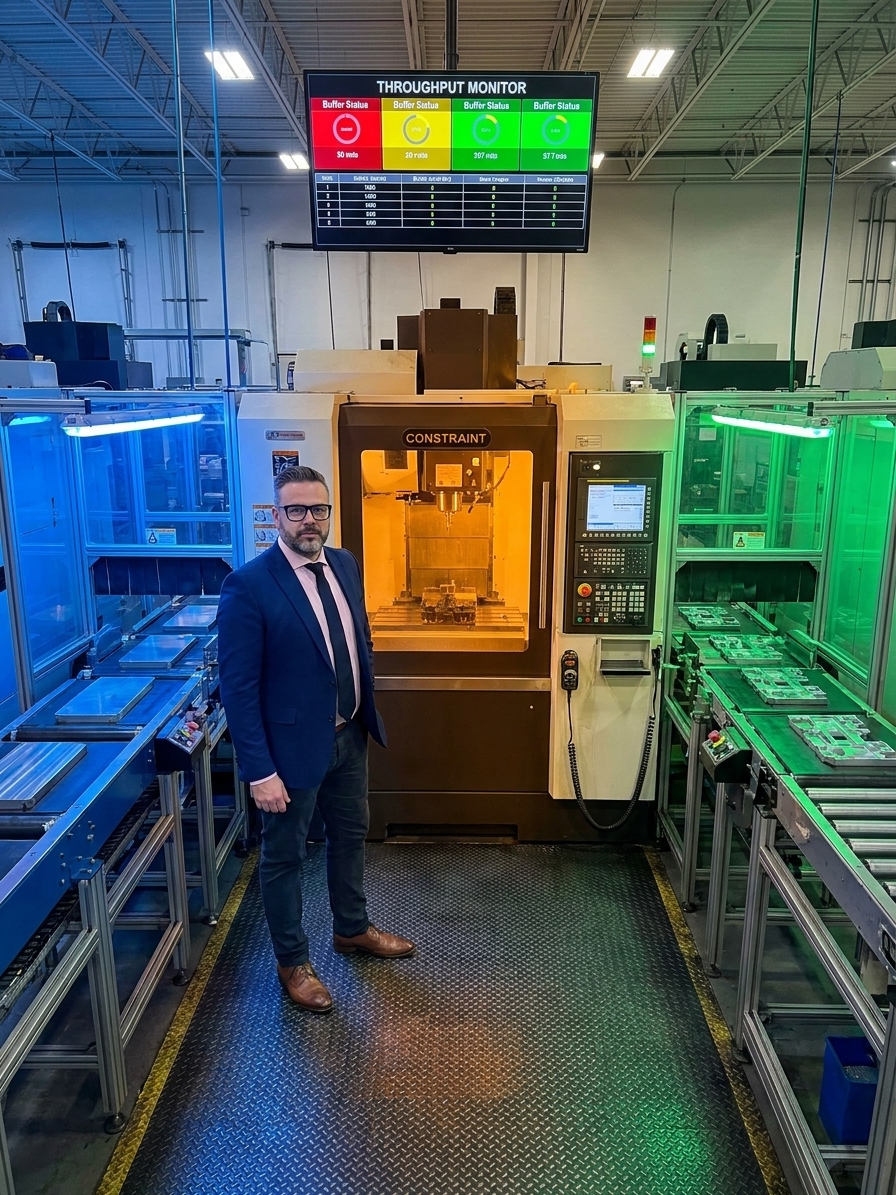
They make the constraint visible. Physical or
digital boards track the constraint’s status in real time. Everyone on
the floor knows where the bottleneck is today — not where it was last
quarter. When the constraint shifts, the information propagates within
hours, not weeks.
They invest disproportionately at the constraint. If
the bottleneck is a CNC machining center, that machine gets the best
maintenance, the best operator, the best tooling, and the most
attention. Preventive maintenance intervals tighten. Spare parts sit on
the shelf. Engineering support prioritizes the constraint above all
else.
They protect the constraint aggressively. Buffer
management at the constraint is formal and enforced. When a buffer hits
red status, the plant responds with the same urgency as a quality escape
or a safety incident. Starving the constraint is treated as a
manufacturing emergency, not a routine scheduling inconvenience.
They revisit the five steps continuously. After
elevating a constraint, they immediately search for the next one. They
do not declare victory and move on to the next initiative. Constraint
management becomes an operational discipline, not a project.
How Quality
Engineers Can Apply Constraint Thinking
You do not need a formal TOC program to benefit from constraint-based
thinking. Quality engineers can apply these principles within their
sphere of influence:
Focus inspection resources on constraint output. If
the bottleneck produces 80% of your throughput, a quality escape there
costs more than a defect anywhere else. Shift your inspection intensity
accordingly. Non-bottleneck resources can tolerate slightly higher
defect rates if the downstream constraint catches them — but a defect AT
the constraint represents lost capacity that can never be recovered.
Apply SPC where it matters most. Control charts on
non-bottleneck processes are useful, but control charts on the
constraint are critical. A special-cause variation event at the
bottleneck doesn’t just produce a defective part — it steals
irreplaceable capacity. Prioritize SPC deployment at constrained
resources.
Use constraint thinking in CAPA prioritization. When
multiple corrective actions compete for limited resources, ask which one
addresses a problem at or near the constraint. A defect that occurs at
the bottleneck has a disproportionately large impact on system
throughput and deserves higher priority.
Challenge local optimization in quality metrics. If
your quality scorecard rewards each department for reducing its own
defect rate, you may be encouraging behavior that optimizes locally
while subordinating system performance. Push for quality metrics that
reflect throughput-weighted defect impact rather than flat defect
counts.
The
Measurement Trap: When Throughput Accounting Meets Reality
Goldratt’s throughput accounting — where Throughput minus Operating
Expense equals Net Profit, and Inventory is treated as a liability —
provides a fundamentally different lens than standard cost accounting.
Under throughput accounting, producing goods that sit in a warehouse is
not “productive” — it consumed resources without generating revenue.
The problem is that most ERP systems, financial reporting structures,
and executive dashboards are built on standard cost accounting. Variance
reports reward production volume regardless of whether that production
sells. Inventory is treated as an asset on the balance sheet. Labor
efficiency variances punish managers who deliberately underutilize
non-bottleneck resources.
Organizations that succeed with TOC eventually confront this
accounting mismatch. Some implement parallel throughput-based reporting
alongside their standard financials. Others push for genuine accounting
changes — reclassifying WIP, changing variance calculations, redefining
what “productive” means.
This is hard, political, and often thankless work. But without
addressing the measurement system, TOC will always fight upstream
against metrics that reward exactly the behaviors it tries to
eliminate.
Common
Warning Signs Your TOC Implementation Is Failing
Watch for these indicators that constraint management has become
theater rather than practice:
- Nobody can name today’s constraint without checking a report from
weeks ago - Non-bottleneck work centers are measured on efficiency and held to
90%+ utilization targets - The plant’s constraint has been “the same machine” for over a year —
which means either it’s genuinely fixed or nobody is looking - Buffer management consists of a number on a dashboard that nobody
acts on - Meetings about throughput improvements focus on cost reduction
rather than flow - Operators cannot explain how their work connects to the constraint’s
performance - The scheduling system releases work based on due dates, not
constraint capacity
If you recognize three or more of these patterns, your TOC
implementation has drifted from a discipline into a slogan. The good
news is that recovery is possible — but only if leadership is willing to
confront the measurement systems and management habits that undermined
the approach in the first place.
Building a
Sustainable Constraint Management Process
Sustainability requires embedding constraint thinking into daily
operations rather than treating it as a separate initiative. Key
elements include:
Daily constraint review. A 10-minute stand-up where
the team confirms the current constraint, reviews buffer status, and
identifies any threats to constraint performance. This is not a lengthy
meeting — it is a quick tactical check.
Weekly buffer analysis. A deeper dive into buffer
breaches over the past week, root causes, and corrective actions. This
feeds directly into the CAPA system for systemic issues.
Monthly constraint shift assessment. A formal review
to determine whether the constraint has moved, whether subordination
policies need updating, and whether elevation investments are on
track.
Quarterly measurement audit. A check that local
metrics still align with global throughput goals, that nobody has
quietly reintroduced efficiency-based targets at non-bottleneck
resources, and that the scheduling system still honors the rope.
Conclusion:
The Constraint Is Not the Problem — Your Relationship With It Is
The Theory of Constraints is not flawed. The five focusing steps work
when they are applied with discipline and supported by appropriate
measurement systems. The failure mode is almost never the theory — it’s
the organization’s inability to subordinate, to accept idle capacity at
non-bottlenecks, and to let go of local optimization.
Quality engineers who understand constraint thinking have a powerful
lens for prioritization. Not every problem deserves equal attention. Not
every process needs the same level of control. By identifying where flow
is actually constrained and directing quality resources there, you
multiply the impact of every hour spent on improvement.
The question is not whether you have a bottleneck. You do. The
question is whether you know where it is right now — and whether your
organization has the discipline to act on that knowledge.
Peter Stasko is a Quality Architect with over 25
years of experience in manufacturing quality, process improvement, and
systems engineering. He specializes in bridging the gap between
theoretical frameworks and shop-floor reality — helping organizations
move beyond slogans to measurable results.