You implemented Kanban. You printed the cards. You drew the bins. You
trained the team on pull logic, signaled replenishment, and set up your
supermarket. For a week—maybe a month—the system worked. Parts moved.
Signals triggered. Inventory stayed lean.
Then somebody lost a card. Somebody else moved a bin without scanning
it. A supplier went down and your team bypassed the system “just this
once.” Six months later, you have shelves of untracked inventory, cards
piled in a drawer, and a production schedule that runs on expediting
instead of pulling.
This is the story of nearly every Kanban implementation I have
encountered in 25 years of quality and manufacturing consulting. Not the
textbook version. The real one.
What Kanban Actually
Is (Beyond the Cards)
Kanban translates roughly to “signboard” or “visual signal” in
Japanese. Taiichi Ohno developed it at Toyota in the late 1940s as part
of the Toyota Production System. The concept is deceptively
straightforward: instead of pushing parts to the next process based on a
schedule, each process pulls from the previous one only when it is ready
to consume.
The mechanics rely on visual signals—traditionally physical cards,
now often electronic—that communicate three critical pieces of
information: what to produce, how many, and when. A downstream process
removes a container of parts from inventory, which removes or triggers a
Kanban card that travels back upstream to authorize replacement
production.
In theory, this creates a self-regulating system. Inventory levels
are capped by the number of Kanban cards in circulation. Overproduction
becomes physically impossible because nothing gets built without an
authorizing signal. Waste becomes visible because excess or shortage
shows up immediately as a broken signal flow.
In practice, the gap between theory and execution is where most
organizations lose their way.
Why Kanban Implementations
Fail
I have audited dozens of manufacturing facilities that adopted Kanban
with genuine enthusiasm and abandoned it within a year. The failure
pattern is remarkably consistent across industries, company sizes, and
even national cultures. Understanding these failure modes matters more
than memorizing the implementation steps, because avoiding mistakes is
far cheaper than recovering from them.
Signal Integrity Breaks Down
Every Kanban system depends on one fragile assumption: that signals
will actually be transmitted, received, and honored. Physical cards get
lost under machines, stuffed into pockets, or piled on desks. Electronic
signals require scanning discipline that operators abandon under time
pressure. Once signals go missing, the entire pull logic
collapses—upstream processes stop producing because they receive no
authorization, while downstream processes run dry and trigger emergency
expediting.
One automotive supplier I worked with lost track of 340 Kanban cards
in a single quarter. Their system was designed for 1,200 cards across a
six-stage value stream. Losing nearly 30% of their signaling capacity
meant the system could not function, yet nobody noticed the cumulative
drift until customer shortages forced an audit. By that point, the “pull
system” had become a chaotic hybrid of guessed-at schedules and
emergency production runs.
Inventory Creeps
Through Exception Handling
Kanban systems are designed to limit inventory through a fixed number
of containers. This works perfectly when demand is stable and supply is
reliable. The moment either condition breaks—and in real manufacturing,
both break constantly—organizations face a choice: hold firm and accept
production stops, or add “temporary” extra inventory to bridge the
gap.
Almost everyone chooses the bridge. Extra cards get printed. Safety
stock gets quietly added. A supplier goes down for a week, so
procurement orders triple the normal quantity. These exceptions are
always explained with legitimate urgency, and each individual decision
seems reasonable. But exceptions accumulate. Without a mechanism to
retire temporary cards and return to baseline, the system’s inventory
cap erodes permanently.
I visited a electronics manufacturer that started with 800 Kanban
cards and, three years later, had 2,100 in circulation. Demand had grown
approximately 20% over that period. The remaining increase—roughly 1,100
extra cards—represented pure inventory inflation through unmanaged
exceptions. Their warehouse, originally designed for lean storage, was
overflowing. The Kanban system existed on paper but functioned as a push
system with decorative cards.
Rules Are Understood but
Not Enforced
Most Kanban implementations include clear operating rules: don’t
produce without a card, don’t move a bin without scanning, don’t bypass
the supermarket, don’t exceed card limits. These rules are typically
covered in training, posted on walls, and reinforced during the kickoff
phase.
The problem is that enforcement disappears after the initial rollout.
Supervisors under production pressure look the other way when operators
skip scanning. Engineers design workaround procedures that bypass the
pull logic to save time. Managers who never fully understood the system
cannot recognize when it is being circumvented. After enough time
passes, rule violations become normal practice, and the system’s
integrity silently degrades.
The System Is Never
Recalibrated
Kanban card quantities are not permanent. They reflect a snapshot of
demand patterns, cycle times, supplier lead times, and container sizes
at the moment of calculation. When any of these factors change—and they
change constantly in dynamic manufacturing environments—the card count
must be recalculated.
This recalibration almost never happens. I have reviewed Kanban
systems where demand had shifted 40% from the original baseline, yet the
card quantities remained untouched for three years. The result is
predictable: cards representing obsolete demand patterns create
systematic overproduction of some parts and chronic shortages of others.
The system was perfectly calibrated for a past that no longer
exists.
A medical device manufacturer I consulted for had Kanban cards sized
for a product mix that changed 18 months prior when they launched a new
product line. The old products’ cards still authorized production at the
original volumes, filling shelves with components nobody assembled
anymore. Meanwhile, the new products had no Kanban coverage at all and
ran entirely on emergency ordering. They had a Kanban system that was
actively generating waste rather than eliminating it.
What a
Functional Kanban System Actually Looks Like
Despite these failure modes, I have seen Kanban work beautifully when
implemented with discipline and maintained with rigor. The successful
implementations share specific characteristics that go well beyond
printing cards and drawing floor markings.
Mathematical Foundations
Effective Kanban systems start with honest calculations, not
optimistic estimates. The standard formula for determining card count is
straightforward:
Number of Kanban = (Average Daily Demand × Lead Time × Safety
Factor) / Container Quantity
Each variable demands scrutiny. Average daily demand should be
calculated from recent actuals, not annual forecasts divided by working
days. Lead time must reflect real replenishment cycles, including
variation. The safety factor—often called the alpha factor—should be
driven by data on demand variability and supply reliability, not by
someone’s comfort level.
Container quantity itself is a strategic decision that balances
handling efficiency against inventory granularity. Large containers mean
fewer cards and simpler management but coarser inventory control. Small
containers provide precise pull signals but multiply the administrative
overhead. The right answer depends on part value, consumption rate, and
physical handling constraints.
Visual Management
That Actually Communicates
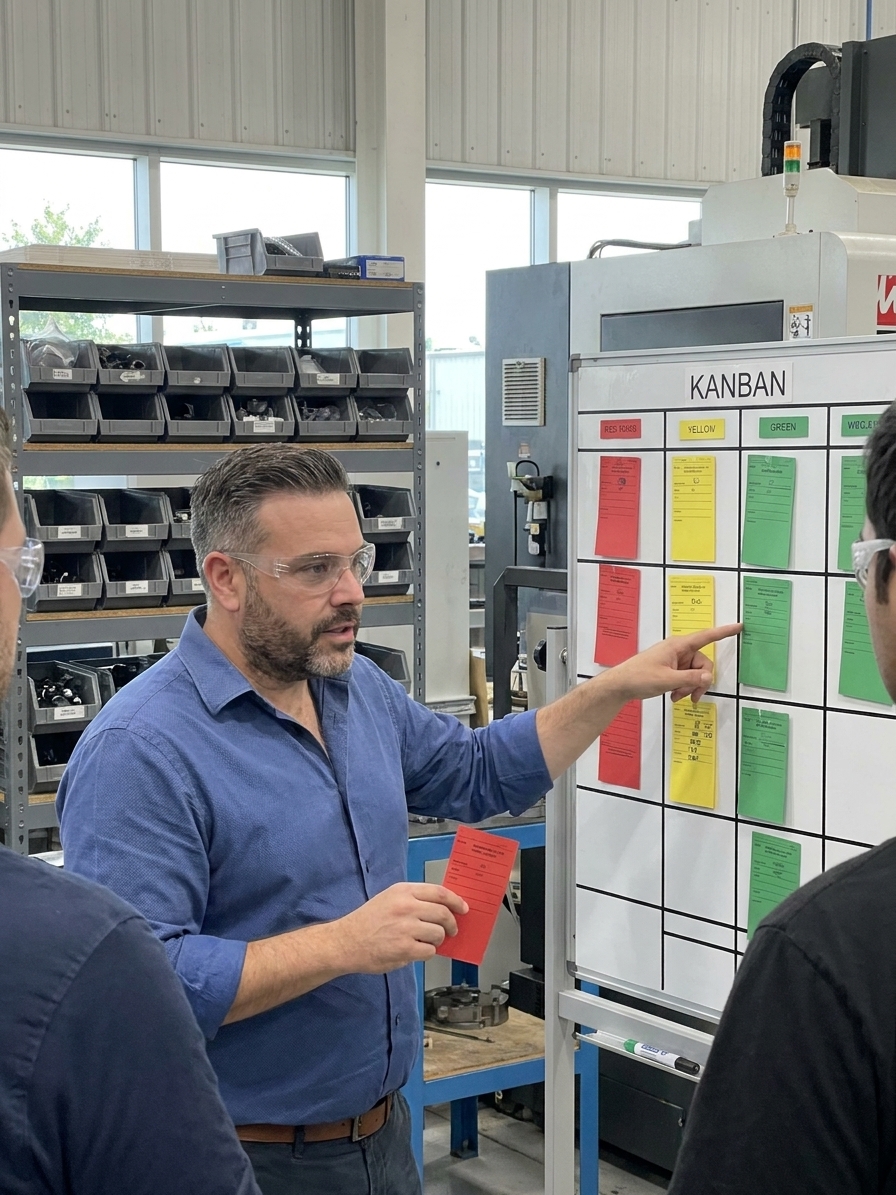
The whole point of Kanban is visual clarity—anyone walking through
the area should immediately understand the production state. This
requires more than cards in bins. Functional systems use color-coded
bins, marked floor locations, signal boards showing card status, and
clearly displayed limits at each pull point.
A well-designed Kanban supermarket looks like organized transparency.
You can see at a glance which parts are in stock, which are being
consumed, and which have triggered replenishment. Contrast this with the
typical implementation, where cards sit in unmarked bins scattered
across shelves and nobody can answer “how much WIP do we have right
now?” without a spreadsheet lookup.
Escalation Triggers
for Abnormal Conditions
Healthy Kanban systems define what happens when normal flow breaks
down. What should an operator do when the card rack is empty? When a bin
stays in the supermarket past its aging limit? When a supplier signal
goes unanswered for longer than the expected lead time?
Without predefined escalation rules, abnormal conditions become
invisible. Inventory ages silently. Supplier delays go undetected until
shortages hit production. Healthy systems build in visual alerts—an
empty card slot turns red, an aging bin gets flagged, an unanswered
signal generates automatic notification.
Regular System Audits
The organizations that sustain Kanban effectively treat it as a
living system requiring periodic maintenance. Monthly audits verify card
counts match actual inventory, confirm scanning compliance, check for
orphaned or duplicated cards, and assess whether demand patterns justify
recalculation.
These audits take a few hours per area and prevent the slow drift
that kills most implementations. The cost is trivial compared to the
inventory inflation that unchecked drift produces.
Digital Kanban: Promise and
Pitfalls
Electronic Kanban (e-Kanban) systems promise to solve the physical
card problem by moving signals into software. RFID tags, barcode
scanning, and automated ERP integration eliminate lost cards, enable
real-time visibility, and generate data for continuous improvement.
In principle, this is the right direction. In practice, digital
systems introduce their own failure modes that can be equally
destructive.
Systems that require manual scanning still depend on operator
discipline—a barcode scanner is just a card that beeps. If operators
skip scans under time pressure, the electronic system generates the same
garbage data as a manual one, but with false confidence in its
accuracy.
Over-automated systems that remove human judgment entirely can create
rigidity. One automotive plant I audited had an e-Kanban system that
automatically triggered supplier orders based on consumption signals.
When a quality issue required quarantining an entire batch, the system
continued reordering replacement parts for the quarantined inventory,
creating a massive oversupply of defective-adjacent components. Nobody
had designed an exception protocol, so the automation faithfully
executed its logic straight into a warehouse full of parts nobody could
use.
The best digital implementations I have seen maintain human oversight
at critical decision points while automating the routine signal flow.
They track compliance metrics electronically—scanning rates, signal age,
exception frequency—giving managers data to manage the system rather
than hoping it runs itself.
The Kanban Maturity Model
Based on observations across hundreds of facilities, I have come to
think of Kanban implementation as a maturity progression with distinct
stages:
| Stage | Characteristics | Typical Duration |
|---|---|---|
| Launch | Cards printed, training delivered, initial enthusiasm high | 1-3 months |
| Drift | Exceptions accumulate, scanning discipline slips, inventory creeps up |
3-9 months |
| Breakdown | System exists on paper but operates as push with decorative signals |
9-18 months |
| Recognition | Audit or crisis reveals the gap between designed and actual state |
Variable |
| Recovery | Honest recalculation, rule enforcement, system recalibration | 2-6 months |
| Sustainment | Periodic audits, compliance metrics, ongoing recalibration | Ongoing |
Most organizations cycle through stages 2-4 repeatedly without ever
reaching sustainment. The ones that break through to stage 6 share a
common trait: they assign explicit ownership. Someone—a materials
manager, a lean coordinator, a production supervisor—has Kanban system
health as a defined responsibility in their performance objectives, not
as a side task buried under other priorities.
Connecting Kanban
to Broader Quality Systems
Kanban does not exist in isolation. It interacts with every element
of your production system, and its health reflects the health of those
connected systems.
Supplier quality problems disrupt Kanban flow by creating batch
rejections that suddenly remove inventory from the pull loop. If your
supplier quality engineering is weak, no Kanban system can compensate
for the resulting instability.
Engineering change management affects Kanban by invalidating card
quantities whenever product designs change. Organizations that lack
disciplined change control find their Kanban systems constantly lagging
behind reality, with cards representing obsolete configurations.
Production scheduling coherence matters because Kanban assumes
relatively stable demand patterns. Companies with erratic,
schedule-driven order patterns create demand variability that no pull
system can absorb without excessive safety stock.
This interconnectedness is why Kanban implementations should never be
treated as standalone projects. They are system-level interventions that
expose weaknesses across the value stream. The Kanban system will not
fix those weaknesses—it will simply make them impossible to ignore.
Making Kanban Work: Hard
Truths
After 25 years of working with manufacturing organizations on pull
systems, I have reached several conclusions that contradict the standard
consulting narrative.
Kanban is not simple. The concept is simple; execution is complex,
requiring mathematical precision, behavioral discipline, and sustained
management attention. Organizations that implement it because it seems
easy are setting themselves up for disappointment.
Kanban is not universal. Some production
environments—high-mix/low-volume, highly custom, or
engineered-to-order—may benefit more from other pull approaches. Forcing
a repetitive manufacturing tool onto non-repetitive processes creates
frustration without flow.
Kanban is not self-sustaining. Every successful long-term
implementation I have observed includes dedicated resources for system
maintenance, regular audits, and proactive recalibration. The system
requires ongoing investment of time and attention.
Most importantly, Kanban is not an end in itself. It is a tool for
exposing problems—overproduction, instability, poor supplier quality,
weak change control—and creating the conditions for those problems to be
solved. If you implement Kanban and everything runs smoothly, you
probably are not using it aggressively enough. A functioning pull system
should constantly surface issues that demand attention.
The organizations that get the most value from Kanban are not the
ones where the system works flawlessly. They are the ones where the
system surfaces problems quickly enough to solve them before they become
crises.
That is the real promise of Kanban. Not perfect flow, but visible
flow. Not zero problems, but rapid problem detection. Not lean inventory
for its own sake, but inventory that tells you something true about your
production system.
The question is not whether you can implement Kanban. The question is
whether you are ready for what it will show you.
Peter Stasko is a Quality Architect with over 25
years of experience in manufacturing quality, lean implementation, and
production system design. He has worked with automotive, medical device,
electronics, and aerospace manufacturers across North America and
Europe, helping organizations build quality systems that deliver
measurable results rather than impressive-looking frameworks that decay
into paperwork.