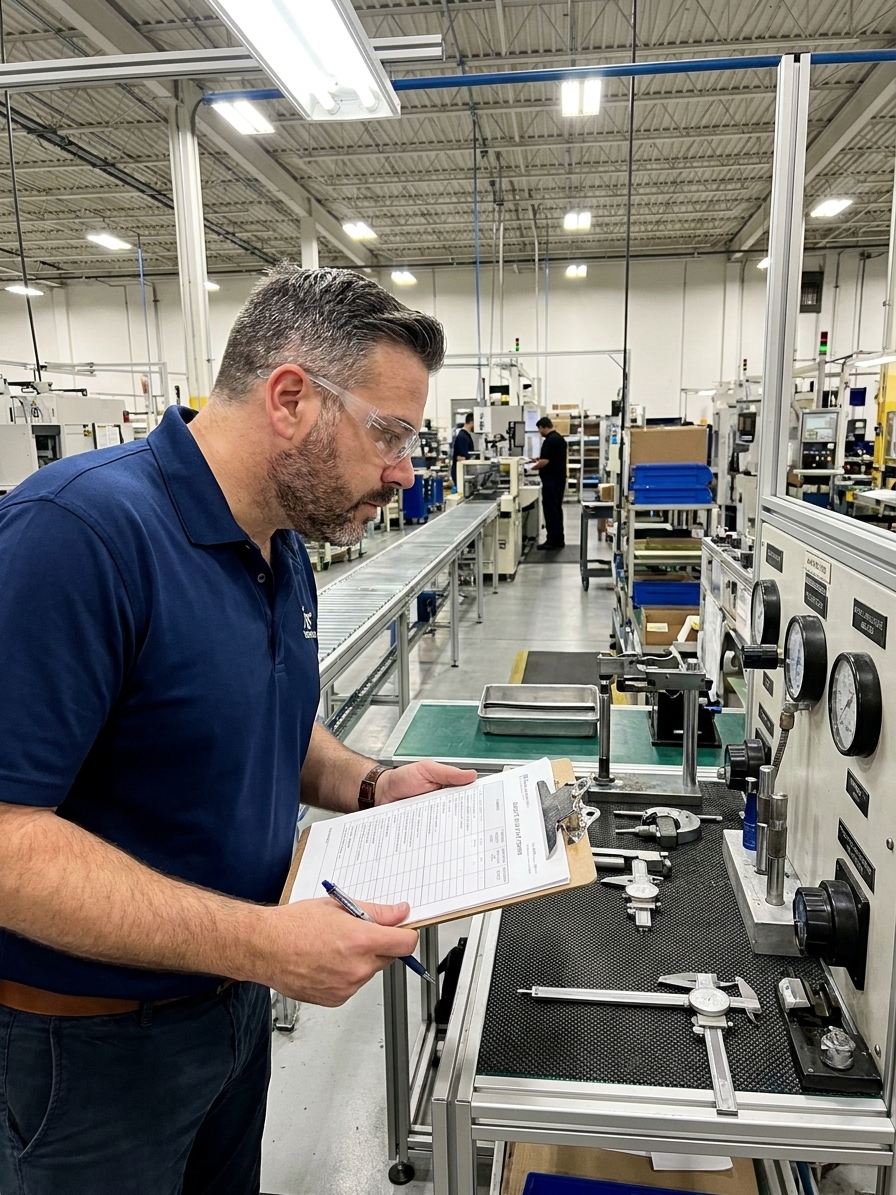
Walk into any facility with a mature IATF 16949 or AS9100 quality system and you will find Layered Process Audits (LPA). Based on the AIAG CQI-8 framework, the premise is built on a hard truth: traditional inspection catches defects after they occur, but process verification catches the conditions that cause them before they occur.
Multiple layers of personnel, from operators to plant managers, conduct frequent audits of critical process characteristics. Each layer checks specific items at a defined frequency. The goal is to verify that what should be happening is actually happening, every shift, every day.
Yet in practice, most LPA systems I have encountered across 20 years in automotive and aerospace are failing quietly. They do not fail in a way that shows up immediately in a third-party audit finding. They degrade one checkbox at a time, until someone discovers a critical parameter has been drifting for weeks and nobody noticed. The problem is not in the methodology's design. The problem is in the execution.
How Audit Systems Degrade Into Checklists
The most common failure mode is checklist mentality. An LPA form is created with 30 items. Operators are told to complete it each shift. Within weeks, the form becomes a ritual. The operator walks the line, glances at the process, and marks everything as conforming. The form has become muscle memory, and muscle memory does not catch subtle drift.
I have audited plants where every item on an LPA form is marked OK for 30 consecutive days. Then a customer rejects a shipment for a defect that the LPA was specifically designed to catch. When I asked the operator what happened, the answer was always the same: they did not think that specific item was actually important.
This checklist mentality is a design problem, not a training problem. When you ask someone to verify 30 items every shift, you are not asking them to audit. You are asking them to perform a ritual. Attention degrades after the first ten items, and the remaining twenty become automatic marks on a page. A short, focused audit forces genuine engagement with the process.
The secondary failure is finding fatigue. A well-designed LPA will find nonconformances. But many organizations are unprepared for the volume. Findings accumulate, corrective actions pile up, and the closure rate cannot keep pace with the discovery rate. Instead of expanding resources, organizations reduce audit sensitivity. Items are removed, findings are reclassified as observations, and the system is tuned to produce fewer findings. This is the quality equivalent of turning off a fire alarm because it keeps going off.

The Collapse of Audit Layer Independence
The LPA system is supposed to have distinct layers with different perspectives. The operator checks process parameters. The team leader verifies the operator's checks. The supervisor evaluates systemic factors. The plant manager checks whether the system itself is functioning.
In practice, the higher layers stop conducting independent audits and instead review the lower layers' paperwork. The plant manager does not walk the floor; they review a stack of completed forms and sign off. The supervisor checks whether the team leader signed the form, not whether the process conditions are actually met.
This defeats the entire purpose of layering. The layers exist to provide independent verification. When each layer simply reviews the previous layer's paperwork, you have a chain of trust with no actual verification at any link. One missed finding propagates upward, invisible, because nobody is looking at the process itself. Layer compression turns a verification system into a documentation loop.
Paperwork Verification vs Process Verification
What collapsed layers do
- Plant manager reviews signed forms in an office
- Supervisor verifies that the team leader signed off
- Higher layers audit the existence of lower layers' paperwork
- Findings propagate upward invisibly until a defect escapes
What independent layers do
- Plant manager reviews finding trends and system effectiveness
- Supervisor examines tooling condition and changeover adherence
- Each layer applies a different lens to the actual process
- Redundant paperwork is replaced by independent floor observation
Structuring Audit Items for Genuine Attention
An LPA form with 30 items is a compliance artifact. The human brain cannot meaningfully assess 30 distinct process characteristics in a single walk-through. If an item has never failed and has no history of causing problems based on your PFMEA, it does not belong on the daily audit. Move it to a weekly or monthly check.
Limit each layer to 5 to 8 critical items. These should be the characteristics that, if wrong, would directly cause a defect or a safety issue. An operator verifying 5 critical parameters is actually looking at the process. An operator checking 30 items is filling out a form. The shorter list forces cognitive engagement with the specific risk being verified.
Audit items must be selected based on PFMEA risk priority numbers, historical defect data, and customer-specific requirements. The items that could cause the most harm get the most attention. When you trim the list to only high-risk characteristics, the audit becomes a targeted tool for catching drift, not a generic compliance exercise.
This redesign directly addresses the finding fatigue problem. When audits only check critical characteristics, the findings that do emerge demand immediate attention. They cannot be dismissed as minor observations because every item on the list was pre-qualified as a direct driver of defects or safety risks.
Building a Closed-Loop Escalation System
An LPA finding without a corrective action is just a record of a problem. I have seen facilities with hundreds of open LPA findings, some dating back months, with no associated 8D or corrective action. The findings are logged in a spreadsheet, reviewed in a monthly meeting, and carried forward to the next month.
The disconnect usually stems from a structural divide. The people conducting the audits, operators and team leaders, do not have the authority or resources to implement corrective actions. The people who do have that authority, engineers and managers, are not closely connected to the audit process. They see the findings as data points in a report, not as urgent process issues.
You must define escalation triggers in advance. A minor deviation might need immediate adjustment. A repeated finding needs root cause analysis. A finding that recurs across multiple layers indicates a systemic failure that requires engineering intervention. When triggers are predefined, there is no waiting for a monthly meeting or guessing whether a finding is important enough to escalate.
A finding logged without an owner and a deadline is just a record of a problem you have decided to tolerate.
| Trigger Condition | Required Response | Timeframe |
|---|---|---|
| Single finding, first occurrence | Immediate correction by operator | Same shift |
| Same finding, 2 consecutive shifts | Notify team leader for investigation | Within 24 hours |
| Same finding across 2+ layers | Engineering root cause analysis | Within 72 hours |
| Recurrence after corrective action | Escalate to plant manager, stop process if needed | Immediate |
Designing Distinct Layers of Verification
Each layer must examine something different. If the operator checks torque values, the team leader should not also check torque values. They should check whether the operator performed the check correctly and whether the torque tool is calibrated. If the supervisor checks the same items as the team leader, you have redundancy without independence.
Layer 1, conducted by the operator each shift, verifies critical process parameters directly. Layer 2, conducted by the team leader daily, verifies that Layer 1 was completed correctly and checks secondary characteristics. Layer 3, conducted by the supervisor weekly, examines systemic factors like tooling condition, fixture integrity, and changeover adherence.
Layer 4, conducted by the plant manager monthly, does not check the process at all. It reviews the LPA system itself: finding trends, closure rates, and overall effectiveness. This is the layer that catches systemic blind spots. If repeat findings are climbing, the plant manager is the one who demands to know why the root cause analysis process is failing.
Together, these layers create a composite picture of process health that no single layer could achieve alone. The key is that each layer adds a new dimension of verification rather than simply repeating the previous layer's work. This structure prevents the chain-of-trust failure that occurs when everyone simply signs off on the paperwork below them.
Measuring LPA Effectiveness Beyond Completion Rates
You do not measure an LPA system by counting completed forms. You measure it by whether process performance is improving. A healthy system finds issues early, implements corrections, and the finding rate for that specific item declines. If the finding rate is flat or increasing, your corrective actions are not effective.
Track the repeat finding rate. What percentage of findings are for items that have failed before? This metric should trend toward zero. If it is not, your root cause analysis process is broken. Track time to closure. Set a target of 72 hours for most findings and measure adherence. Findings that remain open for weeks indicate a structural failure in your escalation process.
Internal PPM, customer complaints, and first-pass yield should all correlate with LPA effectiveness. If the LPA system is robust and these customer-facing metrics are not improving, your audit items are not targeting the right characteristics. The LPA is verifying something, but it is not verifying the things that actually drive defects in your process.
Technology can support this measurement, but it is not the solution. The system design is the solution. Digital platforms, even simple ones built on existing manufacturing execution systems, can provide real-time escalation, trend dashboards, and automated tracking. But technology only removes friction. It cannot fix a fundamentally broken audit structure. Fix the design first, then apply the tools.