Quality
A3 Thinking: When Your Organization Stops Solving Problems With
PowerPoint and Starts Solving Them on a Single Sheet of Paper — and the
Discipline of Thinking Clearly on One Page Becomes the Most Powerful
Problem-Solving Skill Your Team Ever Learned
The
Meeting That Should Have Been an Email That Should Have Been an A3
It was a Tuesday morning in a Tier 1 automotive plant in Slovakia,
and the conference room was full. The plant manager, the quality
director, the production supervisor, two engineers, and a intern who had
no idea why he was there. The agenda: customer complaint #4471 — a batch
of injection-molded connectors with dimensional non-conformances that
had escaped to a German OEM.
The quality director opened a 47-slide PowerPoint presentation. The
first slide said “Root Cause Analysis — Customer Complaint #4471.” The
second slide was an organizational chart. By slide 14, nobody could
remember what the actual defect was. By slide 23, the plant manager was
checking his phone. By slide 38, two people were arguing about whether
the issue was “really dimensional or more cosmetic.” By slide 47, the
meeting ended with “Let’s form a task force and reconvene next
week.”
Three weeks later, the same customer sent another complaint. Same
defect. Same part number. Different batch.
The problem wasn’t that the team was incompetent. The problem was
that they had confused activity with thinking. They
had confused presenting with solving. And they had
confused having a lot of information with understanding the
problem.
A consultant — a quiet Japanese man who had spent 20 years at Toyota
City — walked into that same conference room a month later. He didn’t
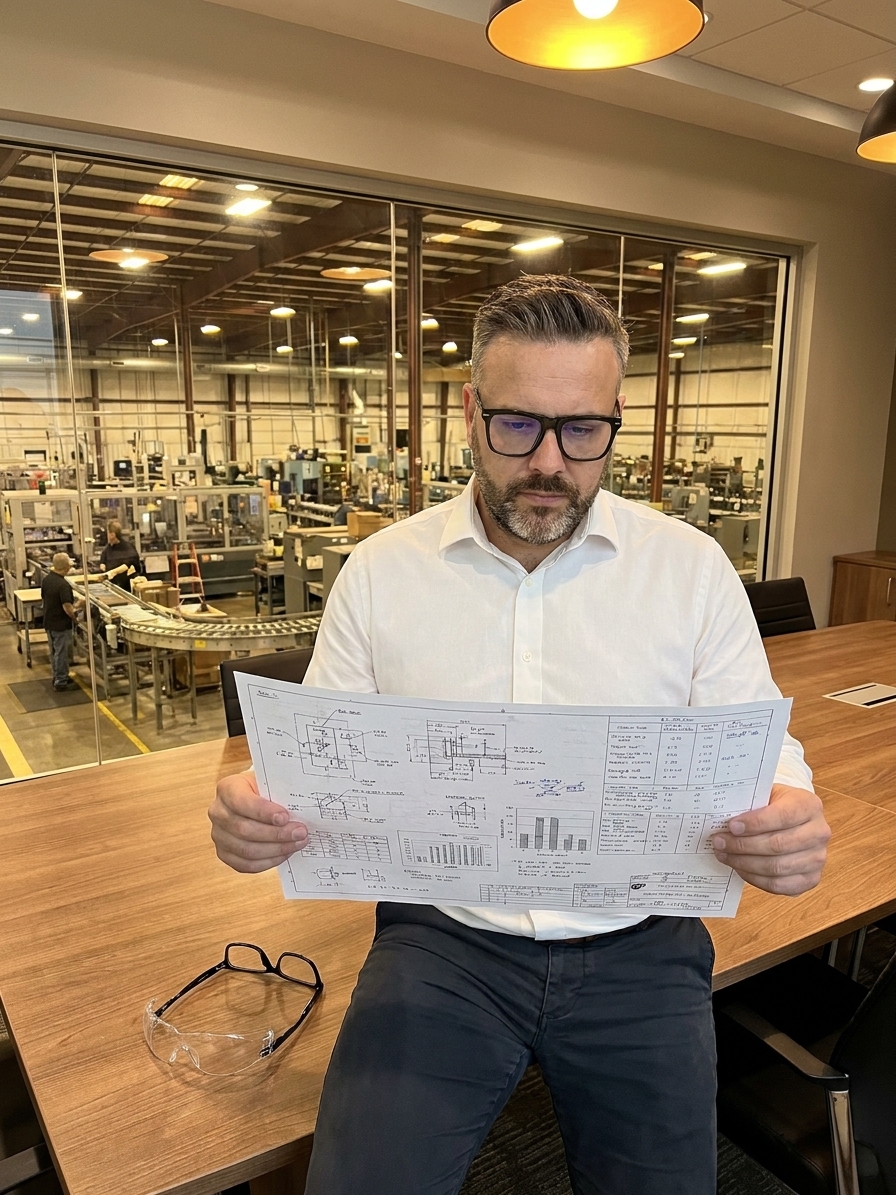
bring a laptop. He brought a single sheet of A3 paper — 297 × 420
millimeters — and a pencil.
“Tell me the problem,” he said.
That was it. No slides. No pre-meeting. No task force. Just a blank
sheet of paper and a question that most organizations think they answer
every day but almost never do.
What A3 Thinking
Actually Is — and What It Isn’t
A3 Thinking is a structured problem-solving methodology developed at
Toyota, named after the European paper size (11 × 17 inches in the US,
for the metrically challenged). But calling it a “report format” is like
calling a Ferrari “transportation.” Technically accurate. Completely
misses the point.
A3 Thinking is a thinking discipline. It’s a
framework that forces you to:
- State the problem clearly — in one sentence, not
one paragraph, not one slide deck - Understand the current condition — with data, not
opinions - Define the target condition — specifically,
measurably, with a deadline - Analyze root causes — deeply, not superficially,
not stopping at the first convenient answer - Develop countermeasures — targeted, prioritized,
and testable - Implement with a plan — who does what, by when,
with what resources - Follow up and confirm — did it work? If not, why
not? What did we learn?
All of this fits on one page. Not because one page is a constraint,
but because clarity is compact. If you can’t explain
your problem-solving logic on one page, you don’t understand it well
enough. Period.
What A3 is NOT: – It’s not a form you fill out after you’ve already
solved the problem – It’s not a template you hand to someone to
“complete” – It’s not a reporting tool for management – It’s not a
document — it’s a conversation
The A3 is the artifact of a thinking process. The real work happens
in the dialogue between the person writing the A3 and their coach,
mentor, or manager. Toyota calls this nemawashi — the
collaborative process of building consensus through dialogue, not
presentation.
The
Seven Elements of an A3 (And Why Each One Will Hurt)
1. Background — The Context
Every A3 starts with context. Not a history lesson. Not a
philosophical treatise. Just enough information to answer: Why does this
problem matter? What’s the business case? Who is affected?
The trap most organizations fall into is writing background that’s
either too vague (“Quality is important to our company”) or too detailed
(a timeline of every quality initiative since 1997). The discipline is
in finding the one or two sentences that make anyone reading the A3 say,
“Yes, this matters. I need to pay attention.”
2. Current Condition —
Reality, Not Theory
This is where A3 Thinking separates the professionals from the
amateurs. The current condition section demands data.
Not “we think the defect rate is about 3%.” Not “operators say it’s been
getting worse.” Actual numbers, plotted over time, showing patterns.
Go to gemba. Stand where the work happens. Watch the process. Count
the defects. Time the cycle. Map the flow. Draw what you see — literally
draw it. A hand-drawn process map on an A3 is worth more than a Visio
diagram that nobody verified against reality.
The current condition should make the reader say: “I can see exactly
what’s happening, and I can see why it’s a problem.”
3. Goal — The Target Condition
Most organizations set goals like “reduce defects” or “improve
quality.” These are not goals. These are wishes. A proper A3 goal
is:
“Reduce connector dimensional non-conformances from 3.2% to <0.5%
by end of Q3 2026, measured at final inspection station IF-04.”
Specific. Measurable. Time-bound. And connected to something the
reader can verify without asking anyone for clarification.
4. Root Cause Analysis — Going
Deep
This is where most problem-solving efforts fail, and where A3
Thinking delivers its greatest value. The discipline here is not in the
tool — fishbone diagram, 5 Whys, fault tree analysis — but in the
willingness to keep digging past the first answer.
The first “why” gives you a symptom. The second gives you a
contributing factor. The third gets you closer to a system issue. The
fourth usually touches a process or policy. The fifth — if you’re honest
— almost always points to a management decision, a resource allocation,
or a cultural norm.
A3 Thinking doesn’t let you stop at “operator error.” If your root
cause is “the operator made a mistake,” you haven’t finished analyzing.
You’ve barely started.
5. Countermeasures —
Targeted Solutions
Countermeasures are not brainstormed wish lists. They are specific,
prioritized actions directly linked to root causes. Every countermeasure
on the A3 should trace back to a specific root cause. If it doesn’t, it
doesn’t belong on the page.
Each countermeasure gets evaluated for: –
Effectiveness — Will it actually address the root
cause? – Feasibility — Can we implement it with the
resources we have? – Impact — What’s the expected
improvement? – Risk — What could go wrong? What are the
unintended consequences?
The best A3s propose 3-5 countermeasures, ranked by impact and ease
of implementation, with a clear rationale for the ranking.
6. Implementation
Plan — Who Does What, By When
This is the action plan. Nothing fancy. Just a simple table:
| Action | Owner | Start | Complete | Status |
|---|---|---|---|---|
| Adjust mold temperature profile | Ján Kováč | May 20 | May 22 | Planned |
| Install additional cooling sensor | Maria Nováková | May 20 | May 27 | Ordered |
| Update work instruction WI-4471 | Peter Horváth | May 23 | May 25 | Draft |
No ambiguity. No “we’ll get to it.” If you can’t name a person and a
date, you don’t have a plan — you have a hope.
7. Follow-Up — Did It Work?
The most neglected step in problem-solving, and the one that closes
the PDCA loop. The follow-up section answers:
- Did we hit the target?
- If yes, what sustained it? How do we standardize?
- If no, what did we learn? What’s the next A3?
Toyota’s rule: Every A3 generates either a new standard or a
new A3. There is no “close it and move on.” Either you solved
the problem and the new way becomes the standard, or you didn’t and you
need to investigate further. Either way, you learned something.
The Real Magic: A3 as
Coaching Tool
Here’s what most organizations miss about A3 Thinking. The document
is not the product. The conversation is the
product.
At Toyota, a team member writes an A3 and presents it to their
manager. But the manager doesn’t approve or reject it. The manager
asks questions:
- “How do you know that’s the current condition? Did you go and
see?” - “Why did you stop at the third ‘why’? What’s beneath that?”
- “What evidence do you have that this countermeasure will work?”
- “What happens if it doesn’t work? What’s your plan B?”
- “Who else needs to be involved? Have you talked to them?”
This dialogue — called A3 coaching — is where the
real development happens. The A3 is the vehicle. The coaching
conversation is the journey. The improved thinking capability is the
destination.
I’ve seen organizations adopt A3 as a template, fill it out
dutifully, file it in a binder, and wonder why nothing changed. They
adopted the form but not the discipline. They got the document but not
the dialogue. They checked the box but missed the point.
The Three Levels of A3
Maturity
Level 1: The Form Filler
The organization uses A3 as a reporting format. Someone is assigned
to “do the A3” after the problem is already solved (or after they’ve
already decided what to do). The A3 is a paperwork exercise. Nobody
coaches. Nobody questions. The A3 goes in a file cabinet and is never
seen again.
Symptom: A3s look like post-hoc rationalizations of
decisions that were already made.
Level 2: The Problem-Solving
Tool
The organization uses A3 as a genuine problem-solving framework.
Teams go through the seven steps. They collect data. They analyze root
causes. They implement countermeasures and follow up. Problems actually
get solved.
But — the coaching element is weak or missing. Managers review A3s
but don’t challenge the thinking. The quality of the A3 depends entirely
on the skill of the person writing it, not on the quality of the
coaching they receive.
Symptom: Some A3s are excellent. Others are
mediocre. There’s no consistent standard.
Level 3: The Thinking Culture
A3 Thinking is embedded in the organizational culture. It’s how
people think about problems — not just how they document them. Managers
coach. Team members develop. The dialogue around the A3 is more
important than the document itself.
Problems are solved sustainably. Countermeasures become standards.
Learning compounds. The organization doesn’t just solve problems — it
develops problem-solvers.
Symptom: People reach for an A3 instinctively when
they encounter a problem, the same way a carpenter reaches for a
hammer.
The Neuroscience of
One-Page Thinking
There’s a reason A3 works, and it’s not because Toyota discovered
some magical paper size. It’s because constraints drive
clarity.
Cognitive science calls this “desirable difficulty.” When you’re
forced to express a complex problem on a single page, your brain can’t
hide behind volume. You can’t overwhelm the reader with data dumps. You
can’t bury the key insight on page 23 of a report nobody will read.
The constraint of one page forces you to: –
Prioritize — What information actually matters? –
Synthesize — How do these data points connect? –
Communicate — Can someone who wasn’t involved
understand this?
Research by Heidi Grant Halvorson at Columbia University found that
specific, difficult goals produce higher performance than vague “do your
best” goals. A3 Thinking operationalizes this principle. The one-page
constraint is the difficulty. The structured framework provides the
specificity.
Additionally, the visual nature of A3 engages spatial reasoning — a
different cognitive pathway than linear text. When you draw a process
map, plot data on a graph, and sketch a fishbone diagram on the same
page as your analysis, you’re engaging multiple parts of your brain
simultaneously. This produces insights that pure text-based analysis
often misses.
Common
Anti-Patterns (Or: How to Fail at A3 Thinking)
The “A3 by Committee”
Ten people in a room, one A3 template on a projector, everyone
shouting ideas. Nobody owns the thinking. Nobody goes to gemba. The A3
becomes a group therapy session rather than a disciplined analysis.
Fix: One person writes the A3. One person coaches.
Others contribute data and perspective, but the thinking ownership is
singular.
The “PowerPoint A3”
Someone takes the A3 template and turns it into a slide deck. Because
12 slides are better than one page, right? Wrong. The moment you add a
second slide, you’ve lost the discipline. You’ve given yourself
permission to be verbose, unfocused, and unclear.
Fix: Use actual paper. Actual pencil. The tactile
constraint is part of the discipline. Digital A3 tools exist, but they
should replicate the one-page constraint, not bypass it.
The “Retrospective A3”
The team solves the problem first, then writes the A3 to document
what they did. This is like writing a recipe after you’ve already cooked
the meal — by memory. You’ll forget ingredients, skip steps, and
rationalize decisions that were actually guesses.
Fix: Write the A3 as you solve the
problem. Update it in real time. Let it be messy. Let it
evolve. The A3 is a living document, not a final report.
The “A3 as Performance
Review”
Management uses A3s to evaluate employees. “Your A3 wasn’t detailed
enough.” “You should have found the root cause faster.” The moment A3
becomes an evaluation tool, people stop being honest on them. They start
writing what they think management wants to hear, not what they actually
found.
Fix: A3 is for learning, not judging. The best A3
coaching conversations start with “What did you learn?” not “Why didn’t
you…”
A Practical Implementation
Guide
Week 1-2: Select a Pilot Problem
Choose a real, current problem. Not a hypothetical. Not a historical
case study. Something that matters now. Assign one owner — someone who
will carry the A3 from blank page to completed follow-up.
Week 2-4: Coach Through the First A3
The owner’s manager (or an experienced A3 coach) meets with them 2-3
times per week for 15-30 minutes. Each meeting focuses on one section of
the A3. The coach asks questions. The owner investigates and returns
with answers.
Week 4-6: Implement and Follow Up
Execute the plan. Track results. Document what happens. The follow-up
meeting answers: Did we hit the target? What did we learn? What’s
next?
Week 6-8: Reflect and Scale
The owner presents the completed A3 to a broader audience. Not as a
show-and-tell, but as a learning opportunity. What worked? What didn’t?
What would we do differently?
Month 3-6: Build the Habit
Repeat. Every new problem gets an A3. Every A3 gets coached. Over
time, the organization develops a shared language and a shared
discipline for problem-solving.
The Surprising ROI of
One Page of Paper
I worked with a medical device manufacturer that was spending an
average of 34 hours per problem-solving investigation, using traditional
methods — meetings, reports, presentations, follow-up meetings. After
implementing A3 Thinking with proper coaching, the average dropped to 12
hours per investigation.
But here’s the real number: first-pass resolution rate went
from 31% to 78%.
They weren’t just solving problems faster. They were solving them
better. Problems that used to recur three or four times before
being truly resolved were being solved correctly the first time. The
cost savings from eliminated re-investigations alone paid for the entire
A3 training program within six months.
Another plant — automotive components in Poland — tracked the impact
over two years. In the year before A3 implementation: 47 customer
complaints, average closure time 23 days, recurrence rate 42%. In the
year after: 19 customer complaints (many prevented by countermeasures
from earlier A3s), average closure time 11 days, recurrence rate 8%.
One sheet of paper. That’s the difference.
The Deeper Lesson
A3 Thinking is ultimately about intellectual
humility. It’s about admitting that your first understanding of
a problem is probably wrong. That your first solution is probably
insufficient. That the data you haven’t collected matters more than the
data you have.
It’s about replacing the instinct to react with the
discipline to think. Replacing the urge to present
with the commitment to dialogue. Replacing the comfort of
complexity with the courage of clarity.
In a world drowning in data, overwhelmed by presentations, and
addicted to activity, the most radical act in quality management might
be the simplest: take one sheet of paper, one pencil, one real problem,
and one honest conversation.
That’s A3 Thinking. Not the template. Not the format. The discipline
of thinking clearly enough to fit on one page.
Peter Stasko is a Quality Architect with 25+ years
of experience transforming organizations across automotive, aerospace,
and pharmaceutical industries. He has implemented A3 Thinking programs
in over 30 plants across Europe, helping teams move from firefighting to
systematic problem-solving. His approach combines Toyota’s original
methodology with modern cognitive science to build thinking
organizations, not just reporting ones.