“
Quality
and Groupthink: When Your Organization’s Desire for Consensus Silences
the Dissent That Would Have Prevented the Defect
The
Meeting Where Everyone Agreed — and Everyone Was Wrong
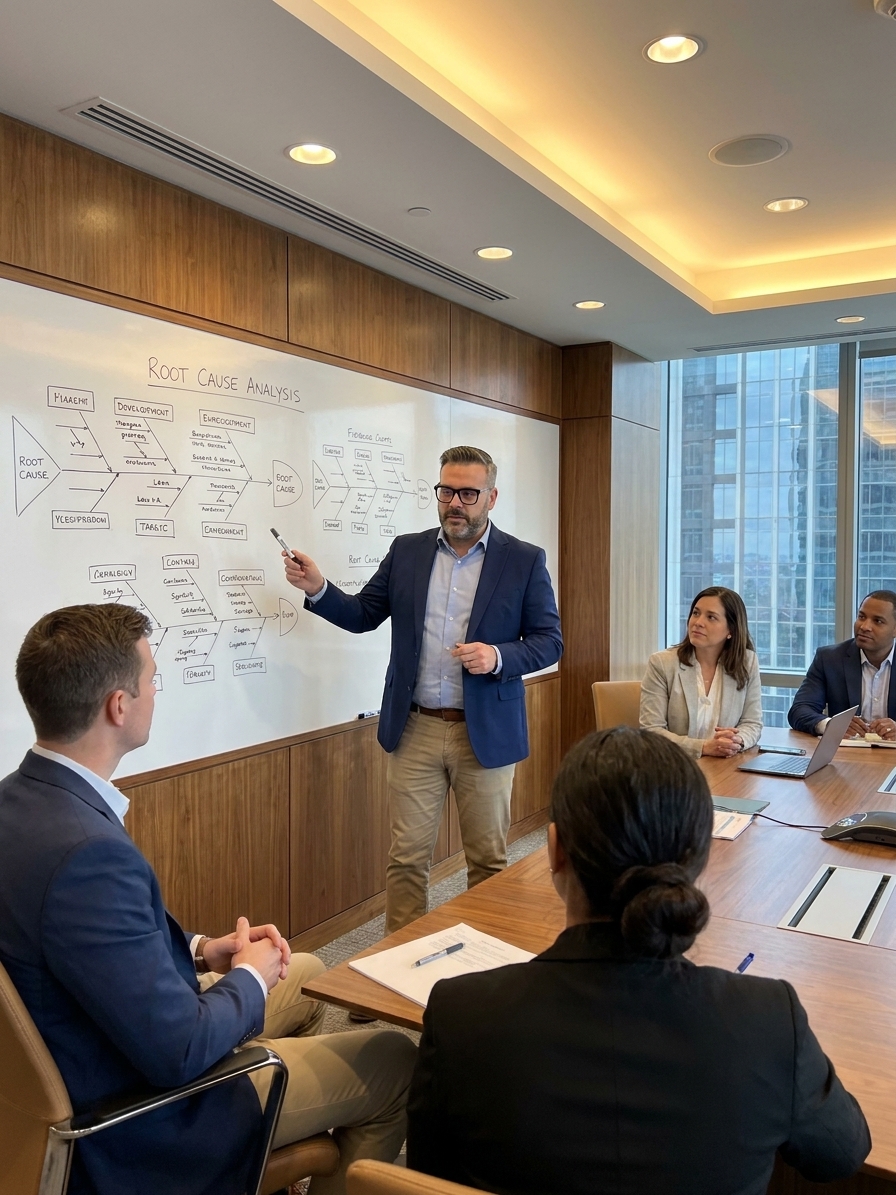
Picture this: a cross-functional team gathered in a conference room
to review the root cause analysis for a recurring defect that had cost
the company $2.3 million over eighteen months. The quality engineer
presented the findings. The production manager nodded. The design
engineer agreed. The supplier quality lead concurred. The plant manager
smiled and said, “Great work, team. Let’s implement the corrective
action.”
Everyone left satisfied. The corrective action was implemented. Three
months later, the defect returned — worse than before.
What happened in that room wasn’t analysis. It was performance. The
team had reached consensus not because the evidence was compelling, but
because disagreement felt uncomfortable. One junior engineer had noticed
that the root cause analysis had skipped a critical variable — the
humidity fluctuations in the cleanroom that correlated perfectly with
the defect pattern. She had the data on her laptop. She never raised her
hand.
That silence cost another $1.8 million.
This is groupthink. And it is one of the most destructive forces in
quality management — not because it introduces errors, but because it
prevents the organization from seeing them.
What Is Groupthink?
The psychologist Irving Janis coined the term in 1972 after studying
catastrophic foreign policy decisions made by seemingly intelligent
advisory groups. He found that cohesive teams under pressure often
developed a collective tunnel vision: they suppressed dissent,
rationalized warnings, and convinced themselves that everyone agreed —
even when individual members harbored serious doubts.
Janis identified eight symptoms:
- Illusion of invulnerability — “Our process is
solid; we’ve handled worse.” - Belief in inherent morality — “We’re the quality
team; our intentions are good, so our conclusions must be right.” - Collective rationalization — “That outlier data
point doesn’t fit, so it must be a measurement error.” - Illusion of unanimity — “Nobody’s objecting, so
everyone must agree.” - Direct pressure on dissenters — “Are you really
questioning the team’s conclusion?” - Self-censorship — “I have concerns, but I’ll keep
them to myself.” - Illusion of impartiality — “We’re being objective;
the data speaks for itself.” - Self-appointed mindguards — “Let’s not bring that
up; it’ll derail the meeting.”
Read that list again. Not in the context of foreign policy, but in
the context of your last FMEA review, your last management review
meeting, or your last corrective action team discussion. If you’re
honest, you’ve seen at least three of these in the past month.
Why Quality Teams Are
Uniquely Vulnerable
Quality professionals like to believe they’re driven by data and
objectivity. That belief is precisely what makes groupthink so dangerous
in quality contexts. When a team is convinced of its own rationality, it
becomes blind to its irrationality.
Several factors make quality teams especially susceptible:
Time pressure. CAPA deadlines, customer mandates,
audit findings — the pressure to close issues quickly creates urgency,
and urgency suppresses critical thinking. The team doesn’t have time to
debate; they need an answer now. So they converge on the first plausible
explanation and move on.
Hierarchy dynamics. In many organizations, the
quality director or plant manager leads the problem-solving team. When
the leader expresses an opinion early — even casually — it anchors the
entire discussion. Everyone else aligns. The junior engineer with the
contradictory data stays silent.
Technical authority. The person who knows the most
about a process often dominates the discussion. But expertise in one
area doesn’t mean they see the whole picture. The Six Sigma Black Belt
who ran the DOE may have missed the operator factor because operators
weren’t in the experimental design. Nobody challenged the methodology
because the Black Belt “knows statistics.”
Cohesion. Quality teams that work well together
develop trust. Trust is valuable — but excessive cohesion breeds
conformity. Teams that like each other tend to avoid conflict, even
productive conflict. The desire to maintain group harmony overrides the
need to find the truth.
Confirmation bias amplified. When a team
collectively favors one explanation, each member unconsciously filters
evidence to support it. The team doesn’t just agree — they genuinely see
the data differently. They’re not lying. They’re genuinely blind to the
disconfirming evidence.
The Anatomy of
a Groupthink-Driven CAPA Failure
Let me walk you through a real pattern I’ve witnessed across multiple
organizations:
Step 1: The defect appears. A customer reports a
dimensional nonconformance on a critical component. The complaint
escalates quickly because the customer is a major OEM.
Step 2: The team assembles. A cross-functional team
is formed under tight deadline. The quality director leads. The pressure
is palpable.
Step 3: The dominant voice speaks early. The senior
process engineer says, “I’ve seen this before. It’s the tooling wear on
Station 4. We should have replaced that die months ago.” The quality
director nods.
Step 4: The group converges. Others start building
the case. “Yes, Station 4 has been a problem.” “The maintenance logs
show we extended the replacement interval.” “I noticed the surface
finish changing last week.”
Step 5: Disconfirming evidence is dismissed. A data
analyst mentions that the defect rate didn’t correlate with tooling age
— in fact, the worst defects came from a brand-new die. Someone
responds, “The new die might not have been properly qualified.” The
group rationalizes the anomaly.
Step 6: The CAPA is written. Root cause: premature
tooling wear. Corrective action: reduce die replacement interval from
50,000 to 35,000 cycles.
Step 7: The defect returns. Three months later, same
defect, same part. The die had been replaced at 35,000 cycles — well
within the new limit. The actual root cause? A thermal expansion issue
in the holding fixture that caused dimensional shift during afternoon
shifts when ambient temperature peaked. The temperature data was in the
SPC charts all along. Nobody looked at it because the group had already
decided.
Step 8: The cycle repeats. A new team is formed. The
quality director leads again…
The Cost of Artificial
Consensus
Groupthink doesn’t just produce wrong answers. It produces
confidently wrong answers. And in quality management, confidently wrong
is more dangerous than honestly uncertain.
When a team reaches false consensus:
CAPAs fail to prevent recurrence. The organization
implements a corrective action that addresses the wrong root cause. The
defect returns. The CAPA system loses credibility. Auditors start asking
harder questions.
Resources are wasted. Tooling replacements,
additional inspections, process modifications — all targeting the wrong
cause. The organization spends money on solutions that don’t solve
anything.
Customer trust erodes. When recurring defects
persist despite “corrective actions,” customers conclude that the
supplier either doesn’t know what it’s doing or doesn’t care. Neither
interpretation is good for business.
Organizational learning is impaired. The team files
a CAPA that documents a false root cause. That documentation becomes
organizational memory. Future teams reference it. The error compounds.
The organization learns the wrong lessons and encodes them into its
knowledge base.
Psychological safety deteriorates. When dissenting
voices are repeatedly ignored or punished — even implicitly — people
stop offering their insights. The pool of available intelligence shrinks
with each silenced objection. The organization doesn’t just lose the one
insight; it loses the person’s willingness to contribute anything in the
future.
Recognizing the Warning
Signs
How do you know groupthink is operating in your quality meetings?
Watch for these patterns:
Rapid consensus. If a complex root cause analysis
produces agreement within the first fifteen minutes of discussion, be
suspicious. Real problems are messy. Genuine analysis takes time. Quick
agreement usually means someone dominant spoke early and everyone else
fell in line.
Absence of minority opinions. If every person in the
room agrees with every conclusion, someone is holding back. In a team of
eight, you should hear at least two or three alternative perspectives on
a complex issue. Uniform agreement is a red flag, not a green light.
Language of certainty. Listen for phrases like
“Obviously,” “Clearly,” “Everyone knows,” and “It goes without saying.”
These aren’t arguments — they’re social pressure. They signal that
questioning the conclusion would mean questioning the group’s
competence.
Dismissal of outliers. When someone raises a concern
and the response is to explain it away quickly rather than investigate
it, groupthink is at work. The outlier might be the signal.
Meeting dynamics. Who speaks? Who listens? Who gets
interrupted? If the same two or three voices dominate every discussion
and others defer, the group is not thinking — it’s following.
Breaking the Consensus Trap
Preventing groupthink requires deliberate structural intervention.
Good intentions won’t do it. You need to design your quality processes
to make dissent not just acceptable but expected.
Assign a Devil’s Advocate
For every significant root cause analysis, formally assign one team
member the role of challenging the group’s conclusions. This person’s
job is to argue the alternative explanations, question the evidence, and
poke holes in the logic. Rotate the role so it doesn’t become a
permanent identity.
The key insight: when dissent is formally assigned, it removes the
social cost. The person isn’t “being difficult” — they’re fulfilling
their role. This transforms the social dynamic completely.
Use Structured
Problem-Solving Methods
Methods like 8D, A3, and the Five Whys are designed partly to prevent
premature convergence. When the team must document the problem
statement, gather data, consider multiple root causes, and test
hypotheses before selecting a root cause, the process itself slows down
convergence and creates space for alternative explanations.
But here’s the catch: structured methods only prevent groupthink if
you actually follow them. If the team fills out the 8D form after
already deciding the answer, the structure becomes theater. The form
doesn’t prevent groupthink — the discipline of following the form
does.
Separate Generation From
Evaluation
In brainstorming root causes, separate the divergent phase from the
convergent phase. During divergence, every idea is recorded without
critique. Only after all ideas are on the table does the team evaluate
them.
This separation prevents the anchoring effect — where the first idea
mentioned becomes the frame through which all subsequent ideas are
judged. It also gives psychological cover to people who might not voice
an unconventional theory if they knew it would be immediately
evaluated.
Seek Outside Perspectives
Bring in someone who wasn’t involved in the initial analysis. An
engineer from a different product line. A quality professional from
another plant. An external consultant. Fresh eyes see what familiar eyes
have stopped seeing.
I once watched a team spend six weeks trying to solve a plating
adhesion problem. They tested chemistry, temperature, current density,
and agitation — all the standard variables. A visiting engineer from the
machining division asked one question: “Have you looked at the surface
preparation before plating?” Turns out, a change in the deburring media
had left a microscopic residue that prevented adhesion. Nobody on the
plating team thought to look upstream because they were too close to the
problem.
Create Anonymous Input
Channels
Not everyone is comfortable speaking up in a group, especially when
the group has a strong leader or a clear direction. Anonymous input
methods — written submissions before the meeting, digital polling during
the meeting, or one-on-one interviews — capture insights that would
otherwise be lost.
The Leader Speaks Last
If you’re leading the meeting, resist the urge to share your opinion
first. Your opening statement will anchor the entire discussion.
Instead, ask questions. Solicit input. Let others build the case before
you weigh in. The leader’s most powerful tool is not their expertise —
it’s their restraint.
The Paradox of
Constructive Conflict
Here’s what makes groupthink so insidious in quality contexts: most
quality professionals genuinely want to find the right answer. They’re
not being lazy or malicious. They’re being human. The desire for
harmony, the discomfort of conflict, the fear of looking foolish — these
are normal psychological responses. Groupthink exploits them.
The solution isn’t to eliminate these human tendencies. It’s to build
systems that counteract them. The best quality teams I’ve worked with
don’t avoid conflict — they structure it. They have clear norms about
disagreement. They separate the person from the position. They reward
the engineer who catches the flaw, not the one who agrees the
fastest.
Constructive conflict isn’t dysfunction. It’s the engine of good
problem-solving. A team that never disagrees is a team that never thinks
deeply enough.
A Personal Observation
Over twenty-five years in quality, I can count on one hand the times
a root cause analysis team’s first hypothesis was correct. In almost
every case, the real root cause was the third or fourth theory — the one
that someone initially dismissed, the one that required looking at a
different data set, the one that came from the quiet person in the
corner who finally spoke up.
The quality organizations that consistently get it right aren’t the
ones with the smartest people. They’re the ones with the best processes
for capturing and testing diverse perspectives. They understand that the
enemy of good quality isn’t lack of knowledge — it’s the illusion of
consensus.
The next time your team reaches rapid agreement on a root cause,
pause. Ask yourself: did we investigate thoroughly, or did we converge
comfortably? Did everyone speak, or did everyone who spoke agree? Is
there data we haven’t looked at, a perspective we haven’t heard, a
variable we haven’t considered?
That moment of discomfort — the willingness to reopen a question that
seemed settled — might be the most valuable thing you do all year. It
might also be the thing your organization’s quality culture needs
most.
Peter Stasko is a Quality Architect with 25+ years
of experience transforming organizations across automotive, aerospace,
and pharmaceutical industries. He has led quality system implementations
on three continents and believes that the most important quality tool
isn’t a statistical method — it’s the willingness to ask the question
nobody wants to hear.
“