Quality
and Inattentional Blindness: When Your Inspector Looks Right at the
Defect and Genuinely Doesn’t See It
The Defect That
Was Staring Them in the Face
It was a Tuesday morning in March when the customer complaint landed
on Maria’s desk. A batch of 400 injection-molded connector housings had
shipped with a visible crack running along the seam — a crack roughly
twelve millimeters long, wide enough to see with the naked eye, and
positioned directly in the center of the part’s most visible
surface.
Maria was the Quality Manager at a Tier 2 automotive supplier in
central Europe. She’d been in quality for nineteen years. She’d seen
plenty of escapes. But this one didn’t make sense.
Every single part in that batch had passed through a 100% visual
inspection station. The inspector — Katarina, a twelve-year veteran with
a reputation for being one of the sharpest eyes on the floor — had
signed off on every piece. The inspection record was clean. No defects
noted. No rework. No second looks.
Maria pulled Katarina into the quality lab and showed her one of the
returned parts. Katarina held it under the light, turned it over, and
went silent. The crack was unmistakable. She looked at Maria with
genuine confusion.
“I don’t understand,” Katarina said. “I looked at every single one. I
would have seen that.”
And she was telling the truth. She really would have. She was
skilled, experienced, and conscientious. She hadn’t been lazy. She
hadn’t been distracted. She hadn’t been cutting corners to hit a
production target.
She simply hadn’t seen it.
Not because the defect was subtle. Not because the lighting was bad.
Not because she lacked training.
Because her brain had decided — without her permission or awareness —
that this particular visual information did not deserve to enter her
consciousness.
That is inattentional blindness. And if you run visual inspection in
your organization, it is almost certainly happening on your shop floor
right now.
What Is Inattentional
Blindness?
Inattentional blindness is a well-documented phenomenon in cognitive
psychology where an observer fails to perceive a fully visible, often
conspicuous stimulus because their attention is engaged on something
else. It is not a visual problem. The eyes work perfectly. The
information hits the retina, travels through the optic nerve, and
arrives at the visual cortex. But somewhere between the visual cortex
and conscious awareness, the brain discards it.
The most famous demonstration comes from researchers Daniel Simons
and Christopher Chabris in 1999. They created a short video in which six
people — three in white shirts, three in black — pass basketballs
around. Viewers are instructed to count the passes made by the
white-shirted team. About halfway through the video, a person in a
gorilla suit walks into the middle of the scene, turns to face the
camera, thumps its chest, and walks out. The gorilla is on screen for
roughly nine seconds.
Roughly half of all viewers never see the gorilla.
Not because it’s hidden. Not because it’s small. The gorilla is
large, central, and utterly unexpected. But the viewer’s brain has
allocated its limited attentional resources to the counting task, and
anything that doesn’t fit the expected pattern of “people passing
basketballs” gets filtered out before it reaches awareness.
This is not a flaw. It is a feature. The human brain processes
roughly eleven million bits of sensory information per second, but
conscious awareness can handle only about fifty bits per second.
Something has to do the filtering. Most of the time, the brain’s
filtering system works brilliantly. It keeps us from being overwhelmed
by the noise of existence.
But in a quality inspection context, that same filtering system
becomes a liability — because the brain doesn’t know that a hairline
crack on a connector housing is more important than the texture of the
workbench surface or the pattern of overhead lights. It just knows what
it’s been told to look for, and it discards everything else.
Why This Destroys Quality
Systems
Most organizations design their visual inspection processes around an
assumption that is neurologically false: that a trained, motivated
inspector looking at a product will see whatever defect is present. This
assumption underpins virtually every manual inspection station in
manufacturing. It is written into control plans, work instructions, and
audit criteria. “100% visual inspection” appears on thousands of control
plans across every industry, and it is treated as a meaningful
safeguard.
But the research on inattentional blindness tells us something
uncomfortable: even under ideal conditions, a human inspector will miss
a significant percentage of visible defects — not because of negligence,
but because of the fundamental architecture of human attention.
The implications cascade through your entire quality system.
Your control plan says “100% visual inspection.” Your auditor
verifies that the inspection is being performed. Your inspector is
trained, qualified, and genuinely trying. And yet defects escape — not
occasionally, but systematically, predictably, and invisibly. The escape
rate isn’t captured anywhere because the system assumes the inspection
works. The inspector doesn’t know they missed anything. The defect data
never shows up. Your defect rate looks better than it is.
You are building quality decisions on a foundation of unexamined
faith in human perception.
This is not a small problem. Research published in the journal
Visual Cognition suggests that under conditions of sustained
attention — which is exactly what a four-hour inspection shift demands —
miss rates for visible targets can range from ten percent to over thirty
percent, depending on the complexity of the visual environment and the
number of competing attentional demands.
Thirty percent. That means for every ten defects present in your
product stream, your best inspector might be catching seven. And the
three that get through? They’re not the subtle ones. They’re often the
obvious ones — the ones that should have been impossible to miss.
The Attentional Tax on
Your Shop Floor
Inattentional blindness doesn’t operate in isolation. It interacts
with the real-world conditions of your shop floor in ways that amplify
its effect.
Task load. The more things an inspector has to check
simultaneously — surface finish, dimensional features, color, markings,
orientation — the more attentional resources each check consumes, and
the more likely the brain is to filter out an unexpected defect type. An
inspector looking for five specific defect categories will miss defects
from category six, even if category six is staring them in the face.
Expectation. The brain filters based on predictions.
If an inspector has checked ten thousand parts and never seen a crack,
their brain’s predictive model begins to assign a probability of
approximately zero to “crack present.” The visual system then actively
suppresses signals that match the crack pattern because the brain has
classified them as irrelevant noise. This is why experienced inspectors
can be more vulnerable to inattentional blindness than new ones — their
brains have stronger priors about what they expect to see.
Time pressure. When production is pushing and the
line is running, inspectors speed up. But attention doesn’t scale
linearly with time. Cutting inspection time by thirty percent doesn’t
just mean you cover less ground — it means the attentional filtering
becomes more aggressive. The brain, faced with processing more visual
information in less time, clamps down harder on what it lets
through.
Fatigue. Sustained visual attention is one of the
most cognitively demanding tasks you can assign to a human being. After
sixty to ninety minutes of concentrated visual inspection, attentional
resources deplete measurably. The miss rate climbs. The inspector
doesn’t feel less attentive — they feel the same. But their brain’s
filtering threshold has shifted, and more information is being discarded
before it reaches awareness.
Multiple targets. One of the most counterintuitive
findings in the inattentional blindness literature is that asking
someone to look for more things doesn’t make them more likely to see
unexpected things — it makes them less likely. Each additional
inspection target consumes attentional bandwidth, leaving less capacity
for detecting anything outside the defined checklist.
Now consider your typical inspection station: a trained operator,
working an eight-hour shift, checking a part against a list of eight to
twelve visual criteria, under time pressure, in a noisy factory
environment, with fluorescent overhead lighting, while production
supervisors walk by asking about throughput.
You have designed the perfect conditions for inattentional blindness.
And then you called it “100% inspection.”
The
Difference Between Inattentional Blindness and Carelessness
This distinction matters because most organizations respond to
inspection failures as if they were carelessness. They retrain the
inspector. They issue a corrective action. They add a second inspector —
which, paradoxically, can make the problem worse if both inspectors know
someone else is also checking, creating a diffusion of
responsibility.
Inattentional blindness is not carelessness. It is not a motivational
problem. It is not a training problem. You cannot train someone out of
inattentional blindness any more than you can train someone to see
ultraviolet light. The limitation is structural. It is a consequence of
how human consciousness works.
The inspector who misses the crack didn’t see it and not report it.
They genuinely didn’t see it. The visual information entered their eyes
but was discarded by attentional processes before it reached conscious
awareness. No amount of exhortation, disciplinary action, or “be more
careful next time” will change the architecture of the human visual
attention system.
This is why the corrective action of “retrained operator” — which
appears on countless 8D reports — is so often ineffective. The operator
didn’t miss the defect because they didn’t know what a defect looked
like. They missed it because their brain, operating exactly as designed,
filtered it out of conscious experience.
Understanding this distinction changes everything about how you
design inspection systems.
What Actually Works
If you can’t eliminate inattentional blindness through human effort,
you have to design around it. Here is what the research and practical
experience suggest:
Automated inspection for critical defects. Machine
vision systems don’t suffer from inattentional blindness. They don’t
have attentional filters, expectations, or fatigue. If a defect falls
within their detection algorithm, they will find it every time. For
critical defects — the ones that must not escape — automated inspection
is not an upgrade. It is a necessity.
Poka-yoke for visual characteristics. Where
automated vision isn’t feasible, design physical mistake-proofing that
makes the defect impossible to miss or impossible to pass. Jigs, gauges,
templates, and go/no-go fixtures transform visual judgment into binary
physical confirmation.
Break inspection into shorter intervals. Don’t
assign anyone to four consecutive hours of visual inspection. Break it
into forty-five to sixty-minute sessions with different tasks in
between. The attentional recovery after even a brief change of activity
is significant.
Reduce the number of inspection targets per station.
Instead of asking one inspector to check twelve characteristics,
consider splitting the inspection across two stations with six
characteristics each. Fewer attentional targets per inspector means more
residual capacity for detecting the unexpected.
Introduce unexpected defect probes. Periodically
seed the inspection line with known defects that the inspector isn’t
expecting. This serves two purposes: it measures the actual detection
rate (not the assumed one), and it keeps the brain’s predictive model
from becoming too confident that all parts are good. The probe doesn’t
eliminate inattentional blindness, but it can modulate the expectation
effect.
Rotate inspectors. A fresh pair of eyes brings a
different attentional set. Rotation disrupts the expectation patterns
that build up when one person inspects the same product for weeks. Even
rotating between two products on the same shift can reduce miss
rates.
Design the visual environment. Lighting, background
color, part presentation angle, and viewing distance all affect the
attentional system’s ability to detect anomalies. A bright, uniform,
high-contrast inspection booth with controlled background isn’t a luxury
— it’s an engineering control against a known neurological
limitation.
Acknowledge the limitation explicitly. Name it in
your training. Tell your inspectors about inattentional blindness. Show
them the gorilla video. Let them understand that missing a defect
doesn’t make them bad at their job — it makes them human. This shifts
the culture from blame to system design, which is where the real
improvement lives.
The Deeper Lesson for
Quality Leadership
Inattentional blindness is a quality problem, but it is also a
leadership metaphor. The same phenomenon that causes inspectors to miss
visible defects causes leaders to miss visible problems in their
organizations.
You look at your quality metrics every day. You review the same
dashboard, the same KPIs, the same trend lines. Your brain learns what
to expect. It builds a predictive model. And then something changes — a
subtle shift in supplier quality, a creeping increase in customer
returns, a new failure mode that wasn’t on your risk register — and you
don’t see it. Not because it’s hidden. Because your attentional system
is locked onto the patterns you’ve been told to watch, and the new
pattern doesn’t fit.
This is why fresh eyes matter. Why external auditors find things that
internal teams walked past for months. Why new employees ask questions
that veterans stopped asking years ago. Why cross-functional reviews
catch problems that single-function reviews miss.
The gorilla is always walking through your factory. The question is
whether your quality system is designed to see it.
A Final Return to Katarina
After the connector housing escape, Maria didn’t retrain Katarina.
She didn’t write a corrective action about operator attentiveness. She
didn’t add a second inspector to the station.
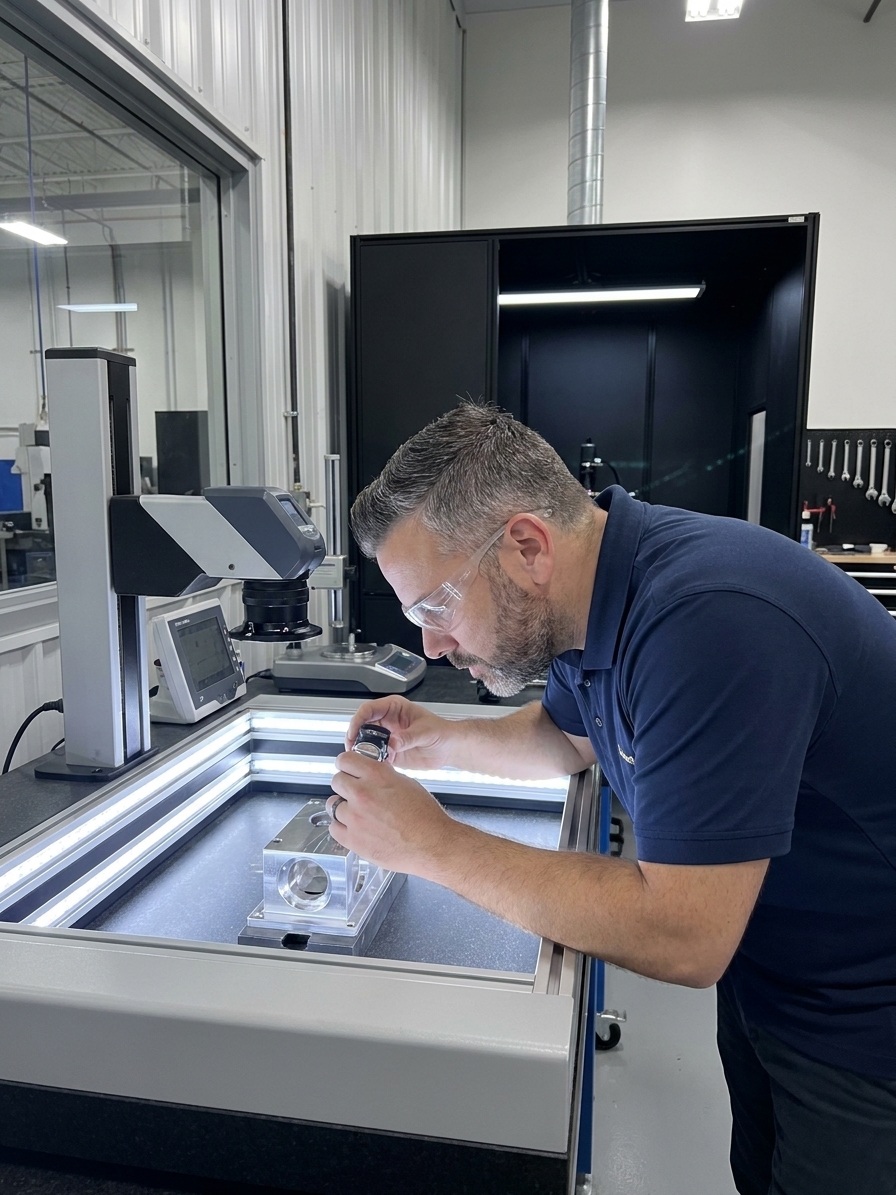
Instead, she went back to the engineering team and asked them to
redesign the inspection fixture so that the seam — where the cracks were
forming — was presented at eye level under a focused LED array with a
dark background. She implemented a rotation schedule that moved
inspectors between stations every ninety minutes. She seeded the line
with cracked parts twice per shift to measure detection rates in real
conditions.
Within three weeks, the detection rate for seam cracks went from
roughly seventy percent to above ninety-five percent. Not because the
inspectors tried harder. Because the system stopped asking human
attention to do something it was never designed to do alone.
Katarina is still one of the best inspectors on the floor. She still
has sharp eyes. And now, when a crack walks through her station like a
gorilla through a basketball game, the system is designed to make sure
her brain can’t filter it out.
That’s what quality engineering looks like when it respects human
nature instead of fighting it.
Peter Stasko is a Quality Architect with 25+ years of experience
transforming organizations across automotive, aerospace, and
pharmaceutical industries. He specializes in designing quality systems
that work with human psychology — not against it.