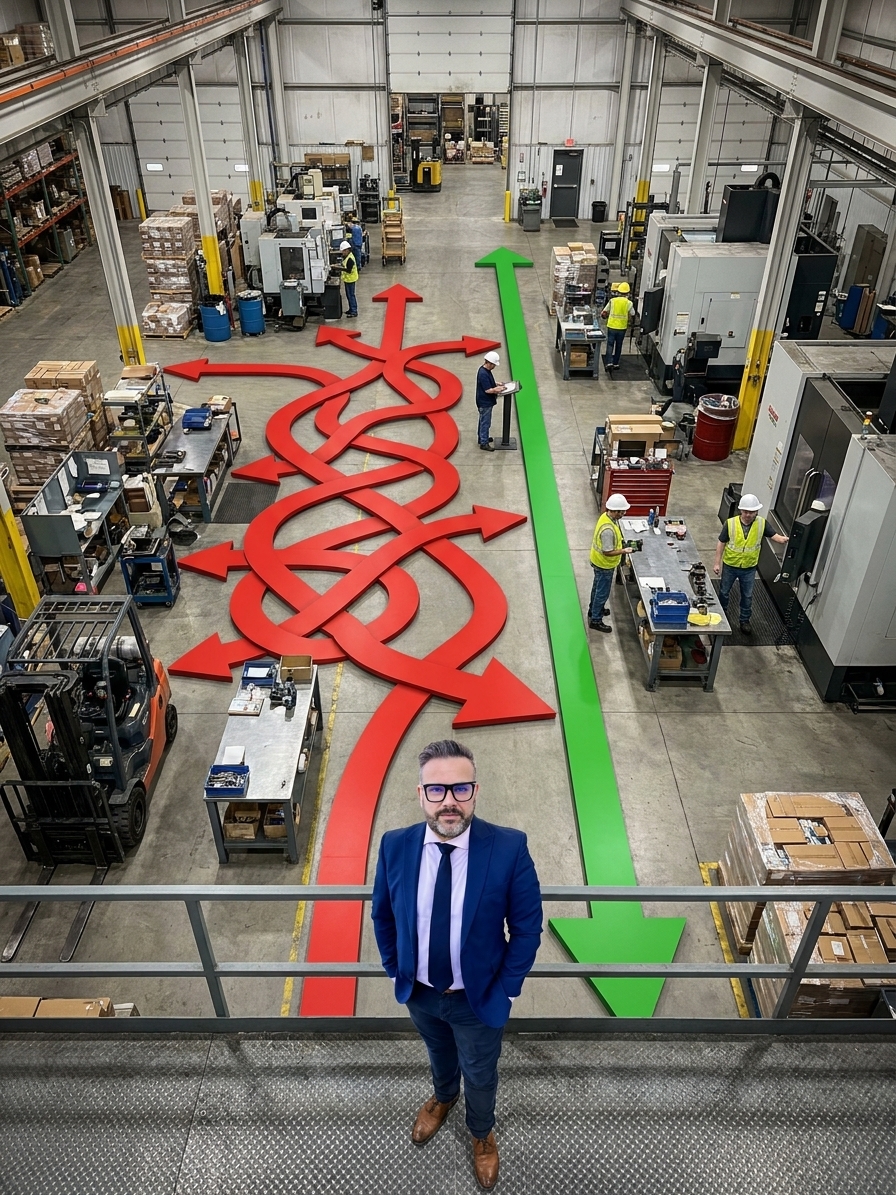
Every manufacturing conference has that moment. A keynote speaker
from a company you admire describes their quality transformation. They
implemented Six Sigma. They deployed statistical process control across
every line. They achieved a defect rate that reads like a statistical
impossibility. And sitting in the audience, your vice president of
operations leans over and whispers: “We need to do that.”
By Monday morning, there’s a mandate. By next quarter, there’s a
budget. By the end of the year, there’s a program with a name, a logo,
and a steering committee. What there isn’t — what there never is — is a
serious conversation about whether this particular tool, this particular
methodology, this particular approach makes any sense for your
operation, your products, your people, or your actual problems.
This is the bandwagon effect in manufacturing quality, and it is
quietly one of the most expensive forces in the industry.
What the Bandwagon Effect
Really Is
The bandwagon effect is a cognitive bias where people adopt
behaviors, beliefs, or tools primarily because others are doing the same
thing. In manufacturing quality, it manifests as the adoption of
methodologies, standards, and tools not because they’ve been
analytically determined to be the right solution to a specific problem,
but because industry leaders, competitors, or certification bodies have
endorsed them.
The logic sounds reasonable on the surface: if Toyota uses this
method, and Toyota is world-class, then using this method will make us
world-class. If our top competitor just achieved IATF 16949
certification, we need it too. If every speaker at the quality
conference is talking about Industry 4.0, we’re falling behind if we’re
not implementing it.
The problem is that this logic skips the most important step:
understanding why the method works in its original context and whether
that context maps to yours.
The Anatomy of a Bandwagon
Adoption
Here’s how it typically unfolds in a manufacturing organization:
Phase 1: Exposure. Someone senior attends a
conference, reads a Harvard Business Review article, or sits through a
vendor presentation. They return energized. “Company X reduced their
defect rate by 73% using this approach.” The number is specific, which
makes it feel rigorous, even though it’s almost certainly a
cherry-picked metric from a carefully selected time window.
Phase 2: Mandate. Leadership announces the
initiative. There’s usually a catchy name — “Quality Excellence 2.0” or
“Operational Transformation Program.” A budget is allocated. A project
manager is assigned. Sometimes a consultant is hired — often the same
consultant who gave the presentation that started Phase 1.
Phase 3: Deployment. Training sessions are
scheduled. People are pulled off the line to attend workshops. Software
is purchased. Forms are created. Checklists multiply. The apparatus of
the new methodology is constructed with admirable speed and considerable
expense.
Phase 4: Reality. The tool doesn’t quite fit the
problems the organization actually faces. The training was too generic
to address the specific processes on the floor. The software requires
data inputs that nobody has the infrastructure to collect reliably. The
checklists ask questions that don’t map to the actual failure modes. But
nobody says this out loud, because the program has executive sponsorship
and questioning it would be career-limiting.
Phase 5: Theater. The program continues — not
because it’s producing results, but because abandoning it would mean
admitting a costly mistake. Reports are generated that show activity.
Metrics are created that measure compliance with the program rather than
improvement in quality. The methodology becomes a performative exercise,
something the organization does to demonstrate that it’s serious about
quality, even as its actual quality performance remains unchanged or
declines.
Phase 6: The Next Bandwagon. A new conference, a new
keynote, a new methodology. The cycle begins again. The old program
doesn’t die — it just gets a new name and becomes part of the
“continuous improvement culture” that everyone references but nobody can
clearly define.
Real-World
Examples of the Bandwagon in Action
Six Sigma Everywhere
Six Sigma was developed by Motorola for high-volume, repetitive
manufacturing processes where statistical analysis could meaningfully
reduce variation. It was phenomenally effective in that context. Then
the bandwagon arrived.
Organizations with low-volume, high-mix production adopted Six Sigma
because it was the quality methodology of the moment. They trained Black
Belts. They created DMAIC projects. They calculated sigma levels for
processes that didn’t have enough data points to make the calculation
meaningful. They spent hundreds of thousands of dollars on certification
programs and statistical software licenses.
And for many of them, the results were negligible — not because Six
Sigma is flawed, but because it was the wrong tool for their context. If
you’re running 50 units of a custom-engineered product, statistical
process control based on normal distribution assumptions doesn’t give
you actionable intelligence. You’d be better served by a well-structured
FMEA, rigorous first-article inspection, and robust process
documentation. But those don’t have the same conference appeal as a
Black Belt certification.
ISO 9001 as a Quality
Substitute
ISO 9001 certification has become a prerequisite for doing business
in many industries. And the standard itself, properly implemented,
provides a solid framework for quality management. But the bandwagon
effect has turned it into something else entirely.
Organizations pursue ISO 9001 certification not because they want to
improve their quality management system, but because their customers
require it. The certification becomes the goal rather than the byproduct
of good practice. Consultants help organizations pass audits by
constructing documentation that satisfies the auditor rather than
improving the processes that produce the product.
The result is an organization that is certified but not necessarily
competent. The quality manual is immaculate. The procedures are
documented. The records are maintained. But the actual quality of the
product — the thing the standard was designed to improve — may be no
better than it was before the certificate hung on the lobby wall.
Industry 4.0 FOMO
The current bandwagon is digital transformation. Every manufacturer
feels the pressure to implement IoT sensors, machine learning
algorithms, and predictive analytics on their production lines. The fear
of missing out is palpable.
Some organizations genuinely benefit from these technologies. A
high-volume automotive plant with thousands of sensors generating
continuous data streams can use machine learning to predict equipment
failures and optimize process parameters. But a job shop producing small
batches of custom components may spend six figures on an IoT platform
that generates alerts nobody has time to respond to and dashboards
nobody looks at.
The bandwagon effect prevents the honest assessment: do we have the
data infrastructure, the analytical talent, and the operational
discipline to extract value from these technologies? If the answer is no
— and for many organizations, it is — then the investment is premature
at best and wasteful at worst.
Why the Bandwagon Is So
Seductive
The bandwagon effect persists in manufacturing quality for several
interconnected reasons:
Legitimacy signaling. Adopting industry-standard
tools signals to customers, auditors, and stakeholders that your
organization is serious about quality. It’s easier to say “we use Six
Sigma” than to explain the bespoke quality system you’ve designed for
your specific operation, even if the bespoke system is more
effective.
Risk avoidance. No one was ever fired for
implementing the same quality system as their competitors. If something
goes wrong, you can point to the methodology and say you followed best
practices. Implementing a custom approach carries personal risk for the
decision-maker.
Consultant and vendor incentives. The quality
consulting industry has a vested interest in promoting universal
adoption of specific methodologies. More adopters means more training
contracts, more certification programs, more software licenses. The
economic ecosystem around quality tools actively reinforces the
bandwagon.
Cognitive ease. Adopting an existing methodology is
cognitively easier than analyzing your specific problems and designing a
tailored solution. The framework is already built. The training
materials exist. The certification path is clear. Thinking for yourself
— about what your operation actually needs — requires more effort and
more intellectual honesty.
Social proof. When every major manufacturer in your
industry has adopted a particular approach, the social proof becomes
overwhelming. It feels irrational to resist. “Surely all these
successful companies can’t be wrong?” But they may not all be right for
the same reasons, and what works for a Fortune 500 automotive OEM may
not work for a 200-employee precision machining shop.
The Cost of Jumping On
The financial cost of bandwagon adoptions is significant but often
hidden. Training programs, consultant fees, software licenses, and the
labor hours devoted to implementation are easy to quantify. The hidden
costs are more damaging:
Opportunity cost. Every dollar and every hour spent
implementing a methodology that doesn’t fit your operation is a dollar
and an hour not spent on solving your actual quality problems. The most
expensive thing about a bad quality initiative isn’t what it costs —
it’s what it prevents you from doing instead.
Cynicism. When employees have lived through multiple
bandwagon adoptions that produced no real improvement, they develop a
deep and justified cynicism about quality programs in general. The next
time leadership announces a genuine, well-considered initiative, the
organizational response is eye-rolling rather than engagement. You get
one or two chances to credibly launch quality improvements. Bandwagon
adoptions burn that credibility.
Complexity without value. Each adopted methodology
adds layers of process, documentation, and reporting. Over time, the
organization accumulates a patchwork of quality systems — remnants of
Lean, bits of Six Sigma, some TPM elements, a digital dashboard from the
Industry 4.0 push. None of them are fully implemented. All of them
require maintenance. The result is a quality management system that is
complex, fragmented, and exhausting to navigate.
Misallocated expertise. Your best quality engineers
end up spending their time maintaining the apparatus of adopted
methodologies rather than investigating defects, improving processes, or
mentoring operators. The people who should be solving problems become
the people who maintain the theater.
How to
Resist the Bandwagon Without Falling Behind
Resisting the bandwagon effect doesn’t mean ignoring industry
developments or refusing to adopt new methods. It means adopting
deliberately rather than reflexively.
Start with your problems, not with solutions. Before
adopting any quality tool or methodology, clearly define the specific
problems you’re trying to solve. What are your top three quality
challenges? What data do you have about them? What have you already
tried? If you can’t answer these questions specifically, you’re not
ready to evaluate any methodology — you need to understand your
operation better first.
Evaluate fit, not just prestige. A methodology’s
effectiveness depends on context. Ask: Does this tool fit our production
volume and mix? Do we have the data infrastructure it requires? Do we
have the talent to implement it properly? Is our organizational culture
compatible with its assumptions? If the answer to any of these is no,
the methodology may still be valuable, but you’ll need to adapt it — and
adaptation requires understanding it deeply enough to know what to
change and what to preserve.
Pilot before you commit. Run a small, time-limited
pilot in one area of your operation. Measure the results honestly. If
the methodology produces measurable improvement in your specific
context, expand it. If it doesn’t, stop. This sounds obvious, but it’s
remarkable how many organizations skip the pilot phase entirely because
the conference presentation was so convincing.
Be willing to build your own system. The most
effective quality management systems are often hybrids — elements of
established methodologies adapted and combined to fit a specific
operation. This requires more thought and more expertise than adopting
an off-the-shelf framework, but it produces better results because it’s
designed for the problems that actually exist rather than the problems
the methodology assumes.
Measure what changes, not what you do. The metric of
a quality initiative’s success is not how many people were trained, how
many forms were filled out, or how many certificates were earned. It’s
whether defect rates decreased, customer complaints declined, first-pass
yields improved, and warranty costs went down. If the activity metrics
improve but the outcome metrics don’t, you’re on a bandwagon, not a
quality journey.
Create a culture that questions adoption. Encourage
your quality team to critically evaluate any new methodology before it’s
adopted. Make it safe to say, “This doesn’t fit our operation.” The most
valuable person in a quality organization isn’t the one who knows every
methodology — it’s the one who can determine which methodology is right
for the problem at hand.
The Uncomfortable Truth
Here’s the thing that conference keynotes rarely mention: the
organizations that achieve genuinely world-class quality rarely get
there by adopting someone else’s methodology wholesale. They get there
by deeply understanding their own processes, honestly confronting their
own failures, and incrementally building quality systems that are
uniquely suited to their operations.
Toyota’s quality system works because it was developed over decades
within Toyota’s specific cultural and operational context. Copying the
tools without the context — without the management philosophy, without
the long-term supplier relationships, without the organizational norms
around problem-solving — produces a facsimile of quality rather than the
real thing.
The bandwagon effect in manufacturing quality is ultimately a form of
intellectual shortcut. It replaces the hard work of understanding your
own operation with the easier work of adopting someone else’s solution.
It feels like progress. It looks like progress in reports and
presentations. But on the production floor, where quality actually lives
or dies, it’s often just noise.
Your operation has its own problems, its own constraints, its own
opportunities, and its own people. The quality system that will work for
you is the one designed for that reality — not the one designed for the
company that gave the keynote at last year’s conference.
Peter Stasko is a Quality Architect with over 25
years of experience in manufacturing quality management. He has
implemented and evaluated quality systems across automotive, aerospace,
and precision manufacturing industries, and has watched more bandwagon
adoptions than he cares to remember.