You know the scenario. A defect moves through your production line —
past the operator, past the in-process inspector, past the quality gate,
past the final inspector, past the shipping review — and arrives at the
customer. Five checkpoints. Forty pairs of hands. Not one person stopped
it.
When the customer complaint lands on your desk, you ask the question
that every quality manager has asked at least once in their career: “How
did this get past everyone?”
The answer is uncomfortable. It got past everyone because it
got past everyone.
This is the Bystander Effect in manufacturing. It is one of the most
destructive forces in quality management, and almost no organization
recognizes it by name. They see the symptoms — repeated escapes,
unclaimed defects, vague accountability — but they treat each incident
as an isolated failure of attention rather than what it actually is: a
systematic psychological failure built into the way they have structured
their quality checks.
The Bystander Effect was first described by social psychologists Bibb
Latané and John Darley in 1968, following the murder of Kitty Genovese
in New York. The original interpretation — that thirty-eight witnesses
watched and did nothing — has been challenged by later research, but the
core psychological mechanism they identified has been replicated
hundreds of times: the more people who are present, the less
likely any individual is to act.
In manufacturing, the parallel is exact. The more inspection points,
the more quality gates, the more people who “touch” the product, the
less likely any single person is to feel personally responsible for
catching a defect. Every additional checkpoint does not double your
protection. It dilutes it.
How It Happens on the
Production Floor
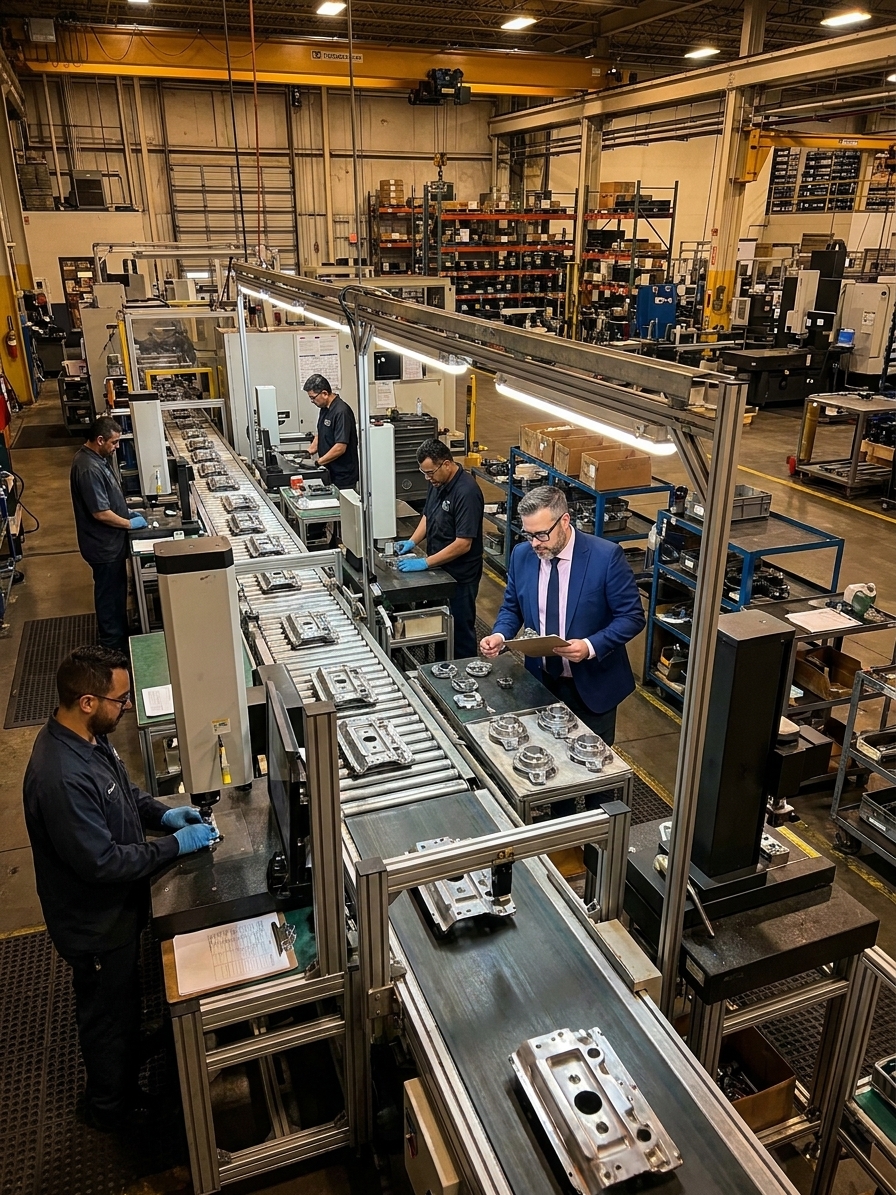
Consider a typical automotive parts manufacturer. A machined bracket
goes through the following steps:
- CNC machining — operator checks critical dimensions with
calipers - Deburring and washing — operator visually inspects surface
finish - In-process inspection — quality technician measures key
characteristics with a CMM - Assembly — assembler checks fit and function
- Final inspection — quality inspector performs a full dimensional and
visual check - Packaging and shipping — warehouse verifies part number and
quantity
Six checkpoints. Every one of them staffed by a competent human being
with the tools and training to catch defects. And yet defects escape.
Not occasionally. Routinely.
When you investigate the escapes, you find a pattern. It is not that
people are incompetent. It is not that they are careless. It is that
each person at each checkpoint unconsciously calculates: “The next
person will catch it if I miss it.” Or, looking backward: “The previous
person should have caught it already.” Both calculations relieve the
individual of the psychological burden of personal responsibility.
The CNC operator thinks the CMM will catch anything he misses. The
CMM technician thinks final inspection will catch anything the CMM
doesn’t. The final inspector assumes the in-process check already
validated the part. The packager assumes the part has been checked six
times already — it must be fine.
At every station, the defect passes through a gap that exists not
because of tooling or training but because of psychology. The gap is the
space between “someone should catch this” and “I should catch this.”
The Diffusion of
Responsibility
The technical term is diffusion of responsibility,
and it is the engine that drives the Bystander Effect in organizations.
In the original laboratory experiments, subjects were less likely to
report smoke filling a room when other people were present. In your
factory, inspectors are less likely to flag a marginal defect when they
know three more people will look at the same part after them.
This is not laziness. This is not negligence. This is a
well-documented cognitive bias that operates below conscious awareness.
Your people are not choosing to let defects pass. They are unconsciously
recalibrating their vigilance based on the presence of other
checkpoints.
The more layers of inspection you add, the worse it gets. This is the
paradox that traps organizations. A customer complaint comes in.
Management responds by adding another inspection step. The Bystander
Effect intensifies. The next escape is worse, not better. Management
adds yet another layer. The cycle continues until your quality system is
a bloated bureaucracy of overlapping checks, none of which work as
intended.
I have seen plants with seven quality gates on a single production
line that had worse escape rates than plants with two. The difference
was not the number of checks. The difference was the clarity of
ownership.
The Ambiguity Problem
The Bystander Effect is amplified by ambiguity. In the classic
experiments, bystanders were slower to act when the situation was
unclear — when it was not obvious whether the event was an emergency or
not.
In manufacturing, ambiguity is the norm. Is that scratch within
specification? Is that burr acceptable? Is that color variation normal
or a sign of process drift? These judgment calls happen hundreds of
times per shift. When the decision is clear — a part is obviously
cracked, a dimension is wildly out of tolerance — people act. When the
decision is ambiguous, the Bystander Effect takes over.
The inspector looks at a marginal condition. It could be a defect. It
could be nothing. He knows the next station will look at it too. He
passes it. The next inspector sees it, makes the same calculation,
passes it again. The ambiguity provides cover for inaction, and the
presence of other checkpoints provides the psychological
justification.
This is why your most dangerous defects are not the catastrophic
ones. Those are caught — they are unambiguous. Your most dangerous
defects are the marginal ones, the borderline cases, the ones that sit
in the gray zone between acceptable and not acceptable. These are the
defects that the Bystander Effect feeds on.
The Pluralistic Ignorance
Trap
A related mechanism makes things even worse. Pluralistic
ignorance occurs when each individual privately believes
something is wrong but looks to the behavior of others for cues. When
nobody else seems concerned, each person concludes that the situation
must be normal — even when everyone individually suspects it is not.
On the production floor, this looks like a subtle defect that
multiple people notice but none of them flag. The CNC operator sees a
slight discoloration on a batch of parts. He does not say anything
because the in-process inspector did not flag the previous batch, and
that batch looked similar. The in-process inspector notices the
discoloration too but does not flag it because the CNC operator did not
mention it when handing off the parts. Each person’s silence becomes
evidence to the other that the condition is normal.
By the time the parts reach final inspection, the discoloration has
been implicitly validated by every person who looked at the parts and
did not react. The final inspector sees the same thing, sees no flags in
the system, and concludes it must be acceptable. The defect ships.
Nobody was wrong. Nobody was negligent. The system produced a
collective failure from a series of individually rational decisions.
That is the Bystander Effect at its most insidious.
What Makes It Worse
Several organizational factors amplify the Bystander Effect in
manufacturing:
Overlapping inspection roles. When multiple people
are responsible for the same check, nobody owns it. Clear, exclusive
ownership of specific quality characteristics is the antidote. If three
people are all “responsible” for visual inspection, none of them is.
Lack of feedback loops. When inspectors never learn
whether the defects they passed or caught actually mattered, their sense
of personal impact erodes. An inspector who flags a defect and never
hears what happened to it — was it actually defective? did it matter? —
gradually stops caring. An inspector who passes a marginal part and
never hears about a customer complaint gets false confirmation that
passing marginal parts is safe.
Anonymous quality systems. When quality checks are
recorded by station or shift rather than by individual, personal
accountability dissolves. A quality record that says “Station 4 passed”
carries no psychological weight. A record that says “Jan passed” carries
enormous weight — not because you are looking to blame Jan, but because
Jan knows the record says her name.
Production pressure. Time pressure short-circuits
the deliberation that might overcome the Bystander Effect. When people
are rushing, they default to the psychologically easiest path — which is
to assume the next person will handle it. The faster the line moves, the
stronger the Bystander Effect becomes.
Cultural tolerance for passing the buck. In some
organizations, the phrase “that’s not my job” is the unspoken rule.
Quality is “the quality department’s job.” Operators do not inspect.
Inspectors do not stop the line. Supervisors do not slow production for
quality. When this attitude takes root, the Bystander Effect is not a
bias — it is a policy.
What Actually Works
Breaking the Bystander Effect requires a fundamentally different
approach to quality checks. Here is what works, based on what I have
seen succeed and fail across dozens of manufacturing operations:
Assign exclusive ownership. Every quality
characteristic should have exactly one owner at exactly one point in the
process. Not two owners. Not “everyone is responsible.” One person, one
check, one point. The CMM technician owns dimensional verification. The
final inspector owns visual inspection. Never overlap. When ownership is
exclusive, the psychological calculation changes from “someone will
catch it” to “I will catch it, because nobody else will.”
Make ownership visible. Quality records should be
individual, not collective. When an inspector signs off on a part, his
name should be on that record. Not his station number. Not his shift
code. His name. This is not about blame — it is about identity. People
take personal pride in work that carries their name. They take less
pride in work that disappears into a collective record.
Close the feedback loop. Every inspector should
know, within a reasonable time frame, what happened to the parts they
inspected. Did defects they caught turn out to be genuine? Did parts
they passed generate complaints? This feedback is the fuel that drives
personal investment in quality. Without it, inspection becomes a rote
exercise.
Reduce the number of checkpoints. This is the
counterintuitive step that most organizations resist. Fewer checkpoints,
each with clear ownership and adequate time, outperform many checkpoints
with diffuse responsibility. I have seen plants reduce their inspection
layers from six to three and simultaneously improve their escape rate.
The math is not additive. It is psychological.
Train for ambiguity. Since ambiguous conditions are
where the Bystander Effect thrives, your training should focus
specifically on borderline cases. Give inspectors practice making
judgment calls on marginal defects. Discuss the reasoning. Build shared
standards for the gray areas. The more confident people are in their
judgment, the less they defer to the imaginary judgment of the next
person in line.
Create a “see something, say something” culture with
teeth. Many organizations say they encourage people to speak
up. Few actually reward it. If you want people to override the Bystander
Effect, you need to make it psychologically safe and organizationally
rewarding to flag concerns — even concerns that turn out to be nothing.
Every false alarm should be treated as evidence that your inspection
system is working, not as a waste of time.
Use technology to force accountability. Digital
inspection systems that require individual sign-off, that timestamp each
check, and that prevent downstream processing without upstream
verification, remove the ambiguity that fuels the Bystander Effect. The
system does not allow “someone else will catch it” because the system
will not let the part move until the named individual has acted.
The Deeper Lesson
The Bystander Effect in manufacturing is a symptom of a deeper
organizational problem: the confusion of redundancy with robustness.
Redundancy — multiple layers of inspection — feels robust. It feels like
you have built a safety net. But redundancy without ownership is not a
safety net. It is a sieve.
Robustness comes from clarity. Clarity of ownership, clarity of
standards, clarity of accountability, and clarity of feedback. When
everyone knows exactly what they own and knows that their name is on it,
the Bystander Effect has no room to operate.
The most effective quality systems I have seen are not the ones with
the most inspection points. They are the ones where every person on the
line can answer three questions without hesitation: What am I
responsible for checking? How do I know if it passes? What happens if I
get it wrong?
If your people cannot answer those three questions, no amount of
additional inspection layers will save you. The defects will keep
passing through your forty pairs of hands, and you will keep asking the
same question: “How did this get past everyone?”
It got past everyone because everyone assumed someone else would
catch it. That assumption is the defect you actually need to fix.
Peter Stasko is a Quality Architect with over 25
years of experience in manufacturing quality management, process
improvement, and organizational transformation. He specializes in
identifying the human and systemic factors that undermine quality
systems — and building practical solutions that work on the factory
floor, not just in the training room. His work draws on decades of
hands-on experience across automotive, aerospace, electronics, and heavy
manufacturing industries worldwide.