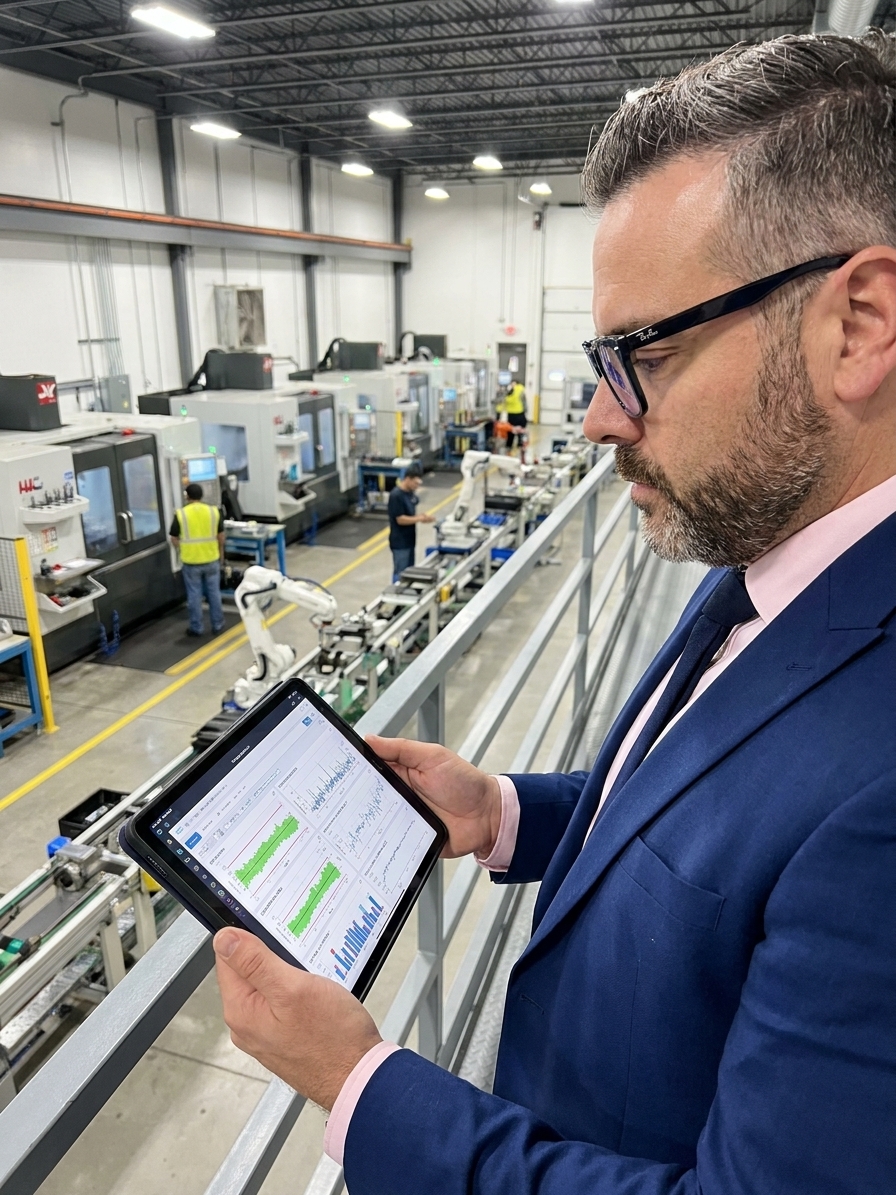
You’ve seen it happen. The control chart shows a trend — seven points
drifting upward, one after another, like a slow tide coming in. The
operator notices. The supervisor notices. The quality engineer who
reviews the charts every morning notices. And yet nobody does anything.
Not because they’re lazy. Not because they don’t care. But because the
process has always recovered before. Because the last time this
happened, it resolved itself. Because, in the history of this production
line, things have always worked out. So why would today be any
different?
This is the normalcy bias — one of the most dangerous cognitive traps
in manufacturing quality. It’s the deeply ingrained belief that because
nothing bad has happened yet, nothing bad will happen. It’s the
assumption that the future will resemble the past, that the absence of
catastrophe is evidence of impossibility, that the warning signs your
data is screaming at you are just noise because the consequences haven’t
arrived yet.
And in manufacturing plants around the world, it is quietly
dismantling quality systems from the inside out.
What Is Normalcy Bias?
Normalcy bias is a cognitive distortion that causes people to
underestimate both the likelihood of a disaster and its potential
effects. It was first studied in the context of natural disasters —
people who live in flood zones who don’t evacuate, communities near
volcanoes who treat eruption warnings as false alarms, entire cities
that go about their business while the data says a catastrophe is hours
away.
The mechanism is simple and insidious: your brain treats the familiar
as the safe. If you’ve experienced a situation many times without
negative consequences, your brain downgrades the threat level of that
situation, regardless of what the objective data says. The longer
nothing bad has happened, the stronger the bias becomes. And the
stronger the bias, the more warning signs you need before you’ll act —
which means by the time you act, it’s often too late.
In manufacturing, this plays out constantly, and the consequences are
measured in scrap rates, warranty claims, customer defections, and
sometimes catastrophic product failures that make headlines.
The Symptoms on Your Factory
Floor
How do you know if normalcy bias has infected your organization? Look
for these patterns — they’re more common than you think.
The Trend
That Everyone Sees and Nobody Addresses
Your SPC charts show a clear trend. Points are moving toward the
control limit, maybe even approaching the specification limit. The data
is unambiguous. But the response is muted: “We’ve seen this before. It
always comes back.” The operator adjusts the process slightly, maybe not
even enough to register on the chart, and moves on. The trend continues.
Nobody escalates. Nobody initiates a formal investigation. The deviation
becomes the new normal, and the new normal becomes the baseline from
which the next deviation is measured.
This is how a process that was once capable of Cpk 1.67 slowly drifts
to Cpk 1.10, and nobody can tell you exactly when it happened — because
each incremental step seemed unremarkable in isolation, and the normalcy
bias prevented anyone from connecting the dots.
The
Recurring Nonconformance That Nobody Takes Seriously
Every month, the same defect code appears in your nonconformance
report. Not at crisis levels — just enough to be noticeable. Five units
here, eight units there. Always the same root cause category. Always the
same corrective action that gets assigned and never fully implemented.
The problem has been around so long that it’s become part of the
landscape. People talk about it the way they talk about the weather — a
fact of life rather than a problem to solve.
Normalcy bias has turned an active quality failure into background
noise. The organization has stopped seeing it as a defect and started
seeing it as a characteristic. And the cost accumulates quietly: rework
hours, material waste, inspection overhead, the occasional customer
complaint that gets handled individually without anyone connecting it to
the pattern.
The Customer
Complaint That Gets Explained Away
A customer reports a problem. Your team investigates — sort of. They
look for reasons why the customer might be wrong, or why this is an
isolated incident, or why the existing controls should have caught it.
The investigation concludes with reassurances rather than root causes.
“We’ve never had this issue before. Must be a handling problem on their
end.” The complaint gets closed. Nothing changes.
The normalcy bias here operates on two levels. First, it convinces
your team that because you haven’t seen this defect, it doesn’t exist —
even though your detection systems may not be designed to catch it.
Second, it creates a perverse incentive to close complaints quickly
rather than thoroughly, because a closed complaint reinforces the
narrative that everything is fine.
The Audit Finding That
Gets Downgraded
Your internal auditor identifies a significant gap in your process
controls. The finding is documented. The corrective action request is
issued. And then the organization’s immune response kicks in — not to
fix the problem, but to downgrade the finding. “That’s not really a
major issue. We’ve been operating this way for years without any
problems.” The finding gets reclassified. The corrective action becomes
a preventive action, then a suggestion, then a footnote.
The auditor’s objectivity is no match for the collective weight of
organizational normalcy bias. The plant has operated this way without
incident, so the risk must be acceptable — never mind that the absence
of incidents may be due to luck, not due to control.
Why
Normalcy Bias Is So Hard to Overcome in Manufacturing
Several factors make manufacturing environments especially vulnerable
to this bias.
First, manufacturing processes are complex and variable. Small
changes in output are normal — expected, even. This creates a background
level of variation that genuine warning signs can hide in. When your
process is inherently noisy, it’s easy to convince yourself that the
signal you’re seeing is just more noise.
Second, manufacturing organizations develop institutional memory. The
experienced operators, the veteran engineers, the long-tenured
supervisors — they’ve seen fluctuations come and go. Their experience is
valuable, but it’s also the breeding ground for normalcy bias. “I’ve
been running this machine for fifteen years. Trust me, this is normal.”
And most of the time, they’re right. But the time they’re wrong is the
time that matters.
Third, the cost of responding to false alarms is visible and
immediate — overtime, production delays, investigation resources — while
the cost of ignoring a real warning is invisible and deferred. The
supervisor who stops production to investigate a suspicious trend pays
the price now, in missed targets and annoyed managers. The supervisor
who ignores the trend pays nothing now and may never pay anything at
all, if the trend reverses on its own. But when the trend doesn’t
reverse, the cost is catastrophic.
Fourth, manufacturing metrics often reinforce the bias. Your scrap
rate is 1.2%. It’s been 1.2% for months. That feels stable, even
comfortable. But what if the 1.2% includes a slow shift in the types of
defects — from cosmetic issues that don’t affect function to dimensional
issues that do? The aggregate number hasn’t changed, so the normalcy
bias tells you nothing has changed. But the underlying risk profile has
shifted dramatically.
The Real-World Consequences
Let me describe a scenario I’ve witnessed more than once in my
career.
A precision machining operation produces shafts for automotive
transmissions. The process has been running for three years with a
defect rate of 0.3% — well within acceptable limits. The control charts
show occasional trends, but they always reverse. The operators are
experienced and confident. The quality system is in place and
functional.
Then one Monday, the CMM results come back and 12% of the shafts from
last week’s production are out of specification on a critical diameter.
Not slightly out — significantly out. The parts are scrap. The
customer’s order is late. The containment activity is expensive. The
root cause investigation reveals that a tooling wear pattern had been
developing for six weeks, visible in the SPC data as a slow upward trend
in the measured diameter. Everyone had seen it. No one had acted.
The normalcy bias had been building for three years of uneventful
production. Every previous trend had resolved. Every previous warning
had been a false alarm. The process had earned its reputation for
reliability, and that reputation became the lens through which all data
was interpreted — even the data that said the process was failing.
The cost: $180,000 in scrap, $45,000 in expediting fees, one very
unhappy customer, and a quality alert that went into the permanent
record. All because six weeks of data was interpreted through the filter
of “this is normal” rather than “this is what it looks like when the
data tells us something is changing.”
How to Fight Back
Against Normalcy Bias
Overcoming this bias requires deliberate structural changes to how
your organization processes information and makes decisions. Willpower
and awareness are not enough — the bias is too deeply wired into human
cognition to be defeated by good intentions alone.
Separate Observation
From Interpretation
Train your people to report what they observe without interpreting
it. “The diameter trend has moved upward for seven consecutive points”
is an observation. “It’s probably nothing” is an interpretation. The
observation should always trigger the response; the interpretation
should come later, as part of the investigation, not as a filter that
prevents the investigation from happening.
Make this a formal rule: predefined data patterns trigger predefined
responses, regardless of anyone’s opinion about whether the pattern is
“real.” Seven points trending up? Investigate. Period. Not “investigate
if you think it’s warranted.” Investigate. The investigation may
conclude that no action is needed, but the investigation must
happen.
Rotate Perspectives
Bring fresh eyes to your processes regularly. This doesn’t mean
hiring new people — it means creating structured opportunities for
people to look at data they don’t normally see. Have the machining
supervisor review the assembly line’s quality data. Have the quality
engineer from Plant B audit Plant A. Have the new hire present their
observations about the process in their first month, before they’ve been
assimilated into the organization’s normalcy narrative.
Fresh perspectives are the antidote to normalcy bias because normalcy
bias is, by definition, the inability to see what’s become familiar.
People who aren’t familiar with the baseline are much better at noticing
when something is off.
Conduct Premortems
Before a production run, gather the team and ask: “Imagine this run
produced a major quality failure. What went wrong?” This exercise forces
people to think about failure scenarios before they happen, which breaks
the normalcy bias’s core assumption that failure is unlikely. It also
surfaces risks that might otherwise go unmentioned because mentioning
them feels like pessimism or alarmism.
Make premortems a regular part of your production planning process —
not a one-time event, but a habit that keeps the possibility of failure
active in everyone’s thinking.
Track Near-Misses
Aggressively
A near-miss is a warning sign that didn’t result in a defect — this
time. Most organizations ignore near-misses because the outcome was
fine. But near-misses are the early warning system that normalcy bias is
designed to silence. Every near-miss is a data point that says “the
system nearly failed.” Collect them, analyze them, trend them. A rising
near-miss rate is the clearest possible signal that your normalcy is
degrading.
Create a no-blame near-miss reporting system. Celebrate near-miss
reports the way you’d celebrate defect catches — because they are defect
catches, just earlier in the timeline.
Redefine Your Baseline
Regularly
Every quarter, recalculate your process baselines from scratch. Don’t
compare this month’s data to last month’s — compare it to your original
process capability study. Don’t ask “is this normal for us?” Ask “is
this what the process was designed to do?” The gap between your current
normal and your designed normal is the measure of how much normalcy bias
has allowed your standards to erode.
Use External Benchmarks
Your process has never failed? That’s nice. What about similar
processes in your industry? What about the processes you read about in
case studies and failure reports? Normalcy bias thrives on isolation —
the belief that your situation is unique and your experience is
universal. External benchmarks break that isolation and remind your
organization that the failures you haven’t experienced are the failures
other organizations have.
The Paradox of Reliability
Here is the cruel paradox of normalcy bias in quality management: the
better your quality system works, the more vulnerable you become. A
plant that has been defect-free for two years is a plant where the
normalcy bias is at maximum strength. The absence of problems has become
the strongest argument against the possibility of problems. The quality
system’s success has become the reason nobody trusts the quality
system’s warnings.
This is why the best quality organizations I’ve worked with maintain
a posture of productive paranoia — a phrase borrowed from Jim Collins,
and one that applies perfectly here. They treat every data point as
potentially meaningful. They investigate trends even when they’re
probably nothing. They conduct audits even when everything looks fine.
They challenge their own assumptions even when those assumptions have
been validated by experience.
Not because they’re fearful. Because they understand that the moment
you stop believing a catastrophe can happen is the moment you become
most vulnerable to it.
What to Do Tomorrow Morning
Open your SPC system. Look at the charts you haven’t reviewed in
weeks — the ones for the processes that “always run fine.” Look at the
trends, the shifts, the patterns that you’ve been mentally categorizing
as noise. Ask yourself: if this exact data came from a process that had
failed catastrophically last month, would I interpret it
differently?
If the answer is yes — and it usually is — then you’ve found your
normalcy bias. Now you know where to start fighting it.
The warning signs are almost always there. The data is almost always
sufficient. The control charts, the nonconformance reports, the customer
complaints, the audit findings — they’re all speaking. The question is
whether your organization is listening, or whether it has decided that
because everything has always been fine, everything will continue to be
fine.
That assumption is the most expensive quality failure you will ever
have. And it’s the one your quality system can’t detect, because the
system you need to fix isn’t the one on the factory floor — it’s the one
between your ears.
Peter Stasko is a Quality Architect with over 25
years of experience in manufacturing quality management, process
optimization, and organizational transformation. He has helped
organizations across automotive, aerospace, electronics, and heavy
industry sectors build quality systems that don’t just detect defects —
they prevent the cognitive and organizational failures that allow
defects to happen in the first place.