Quality
Digital Twin: When Your Process Gets a Mirror That Doesn’t Lie — and
Every Defect Reveals Itself Before It Exists
What if you could run your production line a thousand times in a
virtual world before committing a single resource to the real one? What
if every process parameter, every material variation, every
environmental shift could be simulated, stress-tested, and optimized —
without scrap, without downtime, without risk? The quality digital twin
isn’t science fiction anymore. It’s the most powerful quality tool
you’ve never fully deployed.
The Mirror That Changed
Everything
I remember standing in a Tier 1 automotive plant in Bavaria, watching
a CNC machining center produce crankshaft housings at a rate that made
the floor vibrate. The quality engineer next to me — let’s call him
Markus — pulled up a control chart on his tablet. Cpk 1.67. Beautiful.
By the book, everything was fine.
Then he switched screens.
What appeared was a three-dimensional, real-time replica of the exact
same machining center — but this one was running five minutes ahead. Not
the same process. A simulation. A digital twin. And in that simulation,
the tool was beginning to drift in a way the physical sensors hadn’t
detected yet. The digital model had absorbed the last six months of
thermal data, tool wear patterns, material batch variations, and spindle
vibration signatures. It knew something the real machine didn’t know
about itself yet.
“Thirty-seven minutes,” Markus said calmly. “That’s when the first
out-of-spec bore will appear. We’ll change the tool at thirty.”
He was right. I stayed to watch. At minute thirty, they swapped the
tool. The control chart never flinched. The scrap bin stayed empty. And
I realized I was looking at something that would fundamentally change
how we think about quality.
This was a quality digital twin in action. And most manufacturing
organizations still don’t have one.
What Is a Quality Digital
Twin, Really?
Let’s cut through the hype. The term “digital twin” has been
stretched so thin by marketing departments that it now covers everything
from a 3D CAD model to a real-time physics-based simulation with machine
learning feedback loops. For our purposes — quality purposes — we need
precision.
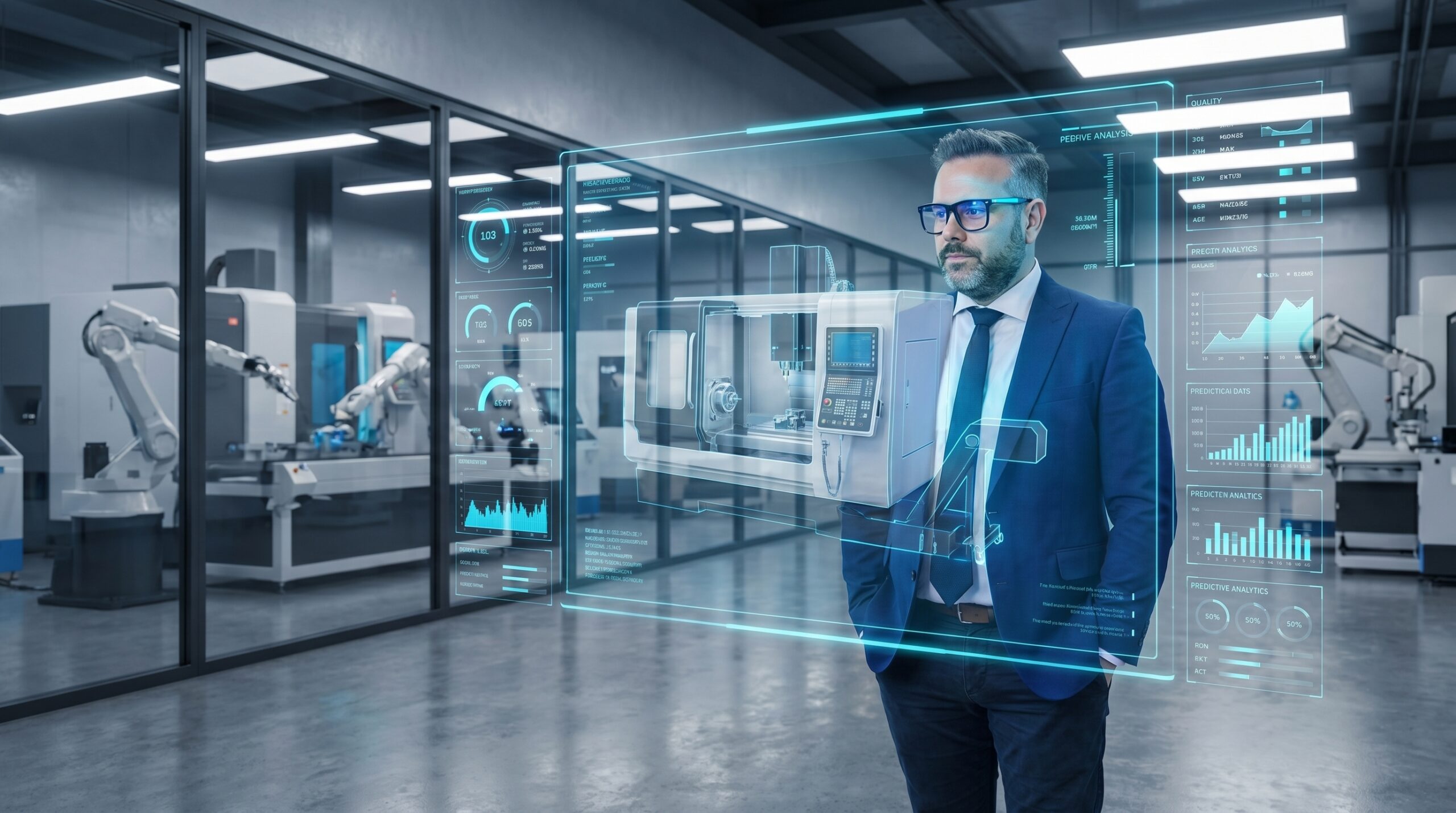
A quality digital twin is a dynamic, data-driven
virtual representation of a manufacturing process, product, or system
that:
- Mirrors the real-world entity in sufficient detail
to predict quality outcomes - Updates in real time (or near-real time) from
physical sensors and inspection data - Simulates future states under different conditions
— before those conditions occur - Prescribes actions to prevent defects, optimize
parameters, or recover from deviations
It’s not a static model. It’s not a dashboard. It’s not a digital
render of your factory floor that looks impressive in board
presentations. It’s a living, breathing simulation that learns from your
process and predicts what happens next.
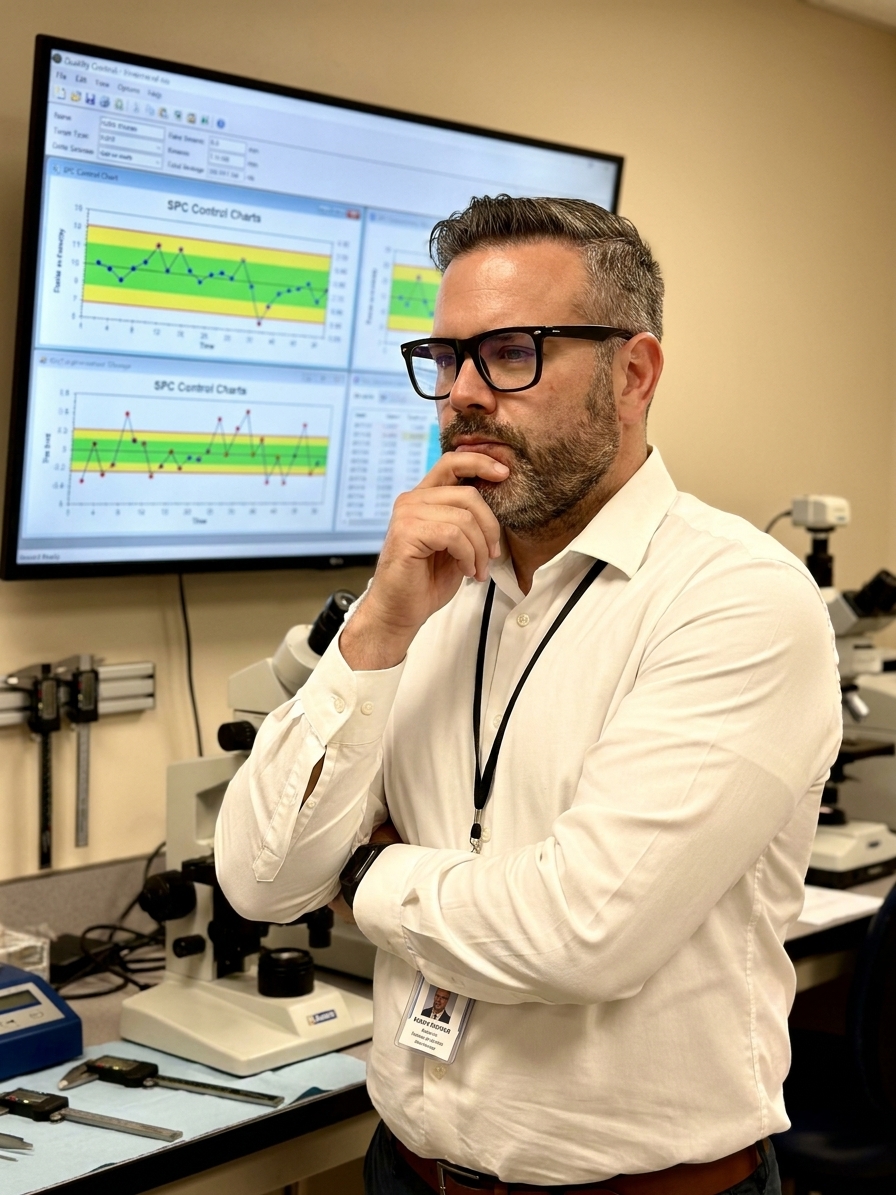
Think of it this way: your SPC control chart tells you what has
happened. Your FMEA tells you what might happen. Your
quality digital twin tells you what will happen — and what to
do about it.
Why Traditional
Quality Tools Hit a Ceiling
Don’t get me wrong. I’ve built my career on SPC, FMEA, control plans,
and the full IATF 16949 toolkit. These tools are foundational. But they
have limits, and those limits are becoming more painful as manufacturing
complexity increases.
SPC is reactive. By the time your control chart
detects a trend, the process has already shifted. You’re catching the
wave after it breaks, not before it forms. Control charts answer “Is the
process stable right now?” They don’t answer “Will it be stable in two
hours given the current trajectory?”
FMEA is theoretical. Your failure mode and effects
analysis is only as good as the team’s imagination. You list what you
think can go wrong. But what about the failure modes that
emerge from the interaction of three process parameters you never
thought to connect? FMEA is a brainstorming tool, not a simulation
engine.
Design of Experiments is expensive. DOE is powerful
— I use it constantly. But running a full factorial experiment on a
production line means interrupting production, consuming material, and
accepting the risk of producing scrap. You learn, but you pay.
100% inspection is an illusion. Even automated
inspection systems have blind spots. And inspection catches defects
after they’re made — it doesn’t prevent them.
The quality digital twin doesn’t replace these tools. It amplifies
them. It takes the process knowledge captured in your FMEA, the
statistical rigor of your SPC, the experimental structure of your DOE,
and wraps them in a simulation that can run a thousand scenarios in
seconds.
The Architecture of
a Quality Digital Twin
Building one isn’t trivial. Let me walk you through the layers — not
in theoretical abstraction, but in the practical sequence that actually
works.
Layer 1: Process Modeling
This is the foundation. You need a mathematical or physics-based
model that describes how your process transforms inputs into outputs.
For a machining operation, that means understanding how cutting speed,
feed rate, tool geometry, material hardness, and thermal expansion
interact to produce dimensional outcomes. For an injection molding
process, it means modeling melt temperature, injection pressure, cooling
time, and mold temperature against part geometry and material flow.
The model doesn’t have to be perfect. It has to be useful.
I’ve seen quality digital twins built on response surface models derived
from DOE data that outperformed elaborate finite element simulations
simply because they were calibrated to real production data.
Start with what you know. You probably already have process models
hiding in your DOE results, your engineering calculations, and your
operators’ experience. The digital twin begins by making that knowledge
explicit and computable.
Layer 2: Real-Time Data
Integration
A model without live data is a textbook — interesting, but
disconnected from reality. The quality digital twin needs to ingest data
from the physical world:
- Process parameters: Temperature, pressure, speed,
force, vibration — whatever your process dictates - Material data: Batch properties, supplier
certificates, incoming inspection results - Environmental conditions: Ambient temperature,
humidity, cleanliness levels - Equipment state: Tool wear counters, maintenance
history, calibration status - Quality measurements: In-process gauging, CMM
results, vision system outputs
This is where most organizations stumble. Not because the technology
is hard — modern IoT platforms make data collection straightforward. The
challenge is data quality, data alignment, and data context. A
temperature reading without a timestamp, a sensor ID, and a process
context is noise, not information.
The most successful quality digital twins I’ve seen started small:
one critical process, ten key sensors, one quality characteristic. They
proved value, earned trust, and then expanded.
Layer 3: Simulation and
Prediction
This is where the magic happens. With a process model and real-time
data, the digital twin can simulate forward in time. It can answer
questions like:
- “Given the current tool wear rate and the batch material properties,
what will the bore diameter distribution look like at the end of this
shift?” - “If the ambient temperature rises by 3°C over the next two hours
(the weather forecast says it will), which dimensions will drift out of
tolerance first?” - “What happens to my paint thickness uniformity if I increase line
speed by 10%?”
These aren’t guesses. They’re predictions grounded in your process
model and calibrated by your data. And they’re generated in seconds, not
days.
Layer 4: Prescriptive
Analytics
The final layer — and the one most organizations haven’t reached yet
— is prescription. Not just “here’s what will happen” but “here’s what
you should do about it.”
The digital twin can run optimization algorithms: Given the current
state and the desired quality outcome, what parameter adjustments will
maximize the probability of conformance? It can recommend tool change
intervals, process parameter tweaks, maintenance timing, and even batch
sequencing strategies.
At the Bavarian plant I mentioned, the digital twin didn’t just
predict the tool drift — it calculated the optimal tool change moment
that balanced quality risk against tool utilization. It turned a
judgment call into a data-driven decision.
Where
Quality Digital Twins Deliver the Most Value
Not every process needs a digital twin. And not every digital twin
needs to be a multi-million-euro investment. Here are the applications
where I’ve seen the highest return:
New Product Introduction
This is the low-hanging fruit. When you’re launching a new product,
you have limited production data, tight timelines, and enormous pressure
to achieve quality targets from day one. A digital twin built from
process engineering models and validated with pilot runs can simulate
production scenarios before you commit to full-scale manufacturing.
I worked with a medical device manufacturer that used a quality
digital twin to optimize the sealing parameters for a new sterile
packaging line. They simulated over 500 parameter combinations
virtually, identified the optimal window, and then validated it with a
30-run DOE on the physical line. First-pass yield was 98.7% on day one
of production. Without the twin, their typical first-pass yield on new
lines was 85-90%.
Process
Optimization Without Production Disruption
Every quality engineer knows the frustration: “I know we can improve
this process, but I can’t justify shutting down production to run
experiments.” The digital twin lets you experiment virtually. Run the
DOE in the simulation. Identify the promising regions. Then validate
with minimal physical runs.
This alone can justify the investment. I’ve seen companies reduce
their physical DOE runs by 60-80% by pre-screening with a digital twin.
Same quality of results. Fraction of the cost and disruption.
Predictive Quality
The holy grail. Instead of inspecting products after they’re made,
the digital twin predicts quality outcomes based on process conditions
and flags potential nonconformances before the product is even
finished.
This is what Markus showed me in Bavaria. The digital twin predicted
a dimensional drift 37 minutes before it happened. The control chart
never saw it coming. The inspection system would have caught it after
the fact — but by then, you’ve made scrap.
Predictive quality doesn’t eliminate inspection. But it dramatically
reduces the probability that inspection finds anything. And that’s the
point.
Supplier Quality Management
Here’s an application most people overlook. If your suppliers have
digital twins of their processes (or if you help them build simplified
ones), you can simulate incoming material quality before the shipment
arrives. You can predict how a batch with specific material properties
will perform in your process and adjust your parameters proactively.
One automotive OEM I advised uses incoming material data from their
steel supplier to pre-adjust stamping parameters. The digital twin
predicts the springback behavior for each coil, and the press parameters
are set before the coil is loaded. Springback variation dropped by
70%.
The Human
Factor: Why Most Digital Twin Projects Fail
I’ve been brutally honest about the technical architecture because I
want you to know what you’re getting into. But the technology isn’t the
main reason quality digital twin projects fail. People are.
The Excel trap. Many quality engineers are so
comfortable with spreadsheets that they resist moving to simulation
platforms. The digital twin feels like black-box magic, and they don’t
trust what they can’t build themselves. The solution isn’t to force
adoption — it’s to build the twin transparently, showing every
calculation, and letting the engineers validate predictions against
their experience until trust develops.
The perfection trap. Some teams try to build a
perfect model before deploying anything. They spend years calibrating,
refining, and adding complexity. Meanwhile, the process changes, the
organization loses patience, and the project gets cancelled. Ship a
useful twin, not a perfect one. Iterate.
The silo trap. The quality digital twin needs input
from process engineering, maintenance, production, and IT. In
organizations where these functions don’t communicate (which is most of
them), the twin becomes a battleground of competing priorities and data
access disputes. Executive sponsorship isn’t optional here — it’s the
prerequisite.
The “set and forget” trap. A digital twin is not a
piece of software you install and walk away from. It’s a living model
that needs continuous calibration, validation, and updating. Processes
drift. Equipment ages. Materials change. If the twin doesn’t evolve with
the process, it becomes a liar — confidently making predictions based on
an outdated reality.
A Practical Roadmap
If you’re reading this and thinking, “We should do this,” here’s how
to start without drowning:
Month 1-2: Choose one critical process. Not your
most complex one — your most painful one. The process where
quality problems are chronic, expensive, and resistant to traditional
methods. This is where the twin will earn its credibility fastest.
Month 2-3: Build the process model. Start with your
existing knowledge. Your FMEA, your DOE results, your engineering
calculations. Build a mathematical model that predicts at least one
critical quality characteristic from process parameters. Validate it
with historical data.
Month 3-4: Connect live data. Identify the 5-10
process parameters that most influence your target quality
characteristic. Connect them to the model via your existing data
infrastructure. Don’t wait for perfect sensors — use what you have.
Month 4-5: Start predicting. Run the twin alongside
production. Don’t act on its predictions yet — just record them and
compare against reality. Build the accuracy track record. This is where
you earn trust.
Month 5-6: Begin prescribing. Once the predictions
are reliable, start using them to inform decisions. Tool change timing.
Parameter adjustments. Batch prioritization. Measure the impact.
Month 7+: Expand. Add more quality characteristics.
Expand to related processes. Connect supplier data. Build the
ecosystem.
The Future Is Already
Running
The quality digital twin isn’t a future technology. It’s running
right now in the best manufacturing organizations in the world. BMW uses
digital twins to simulate paint shop quality before a single car body
enters the booth. Siemens models their turbine blade manufacturing so
precisely that first-article inspection is almost a formality. Samsung’s
semiconductor division simulates wafer quality at a level of detail that
would make most quality engineers weep with envy.
But here’s the thing that gives me hope: you don’t need to be BMW or
Siemens to benefit. The tools are becoming more accessible. Cloud
computing has democratized simulation power. Open-source machine
learning frameworks have made predictive analytics available to anyone
willing to learn. And the manufacturing community is getting better at
sharing knowledge.
The quality digital twin is the next evolution of everything we’ve
been doing in quality management for the last fifty years. It takes the
rigor of statistical methods, the systematic thinking of FMEA, the
experimental discipline of DOE, the continuous improvement philosophy of
kaizen, and amplifies them with computational power that was
unimaginable a decade ago.
Markus showed me the future that day in Bavaria. His process didn’t
just have a control chart. It had a conscience — a simulation that
watched over every part and whispered warnings before anyone could see
trouble coming.
That’s not science fiction. That’s quality engineering in 2026.
And the question isn’t whether you’ll build a quality digital twin.
It’s how soon you’ll start.
Peter Stasko is a Quality Architect with 25+ years
of experience in automotive, manufacturing, and industrial quality
systems. He specializes in bridging the gap between traditional quality
methods and emerging digital technologies — helping organizations build
quality systems that are as intelligent as the products they
produce.