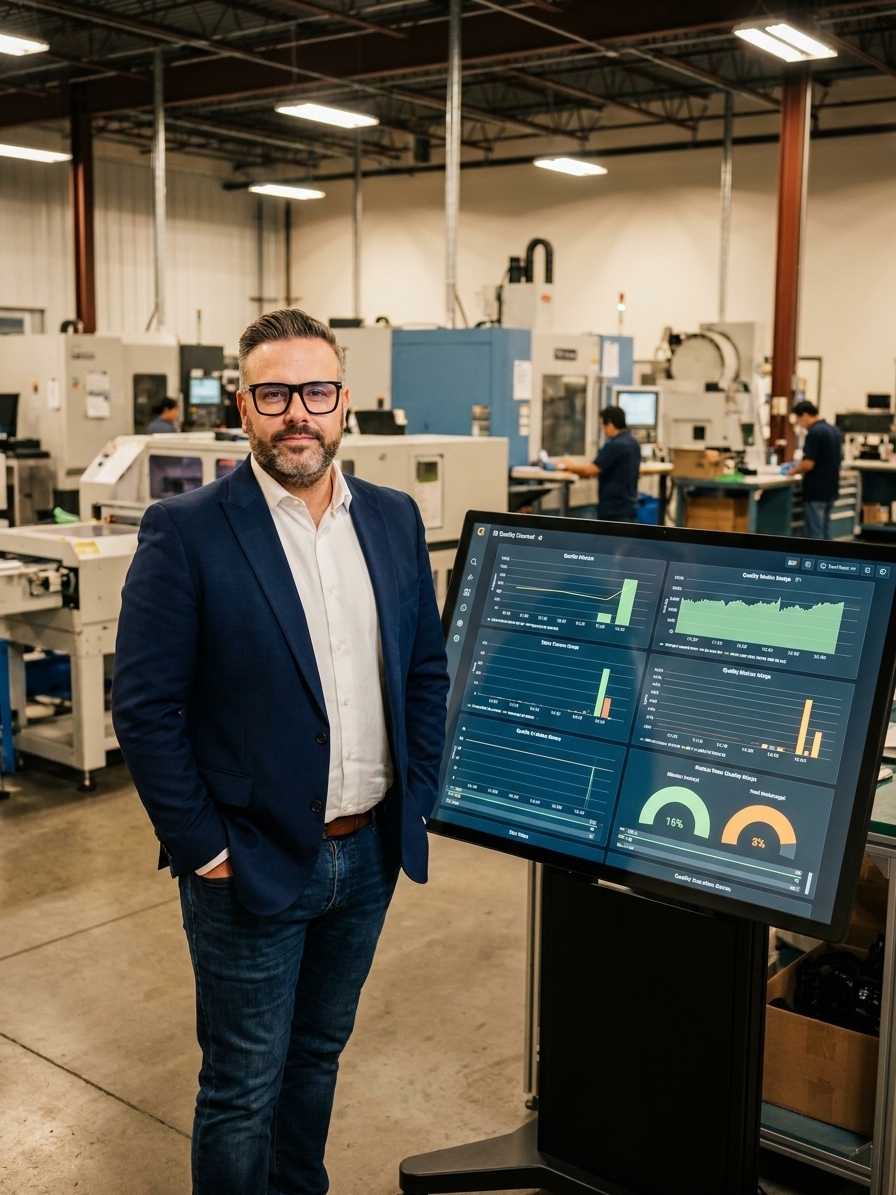
Quality During Production Ramp-Up: When Your Factory’s Most Dangerous Phase Is the One Nobody Prepared For
You’ve spent months in development. The design is frozen. The process has been validated. Control plans are written, FMEAs are done, PPAP packages sit in neat binders. Your team celebrated the successful trial run — 50 parts, zero defects, Cpk through the roof.
Then production starts for real. And within 72 hours, everything falls apart.
Scrap rates triple. Operators struggle with fixtures that worked perfectly in the lab. Material from a different batch behaves nothing like the samples you tested. The customer calls on day five wanting to know why their first shipment is late. Your quality engineer is working 16-hour shifts trying to contain defects that nobody predicted.
Sound familiar? It should. This happens in every industry, on every continent, in organizations both large and small. The production ramp-up — that critical window between validated process and steady-state manufacturing — is where quality systems face their most brutal test. And most organizations fail it.
Not because they lack tools. Not because their people are incompetent. But because they treat ramp-up as a production problem when it is, above all else, a quality problem.
The Ramp-Up Illusion
Here’s what most organizations believe: if the process is validated, if the control plan is solid, if operators are trained, then ramp-up is simply a matter of scaling volume. Turn the dial from 10 parts per hour to 100. What could go wrong?
Everything. That’s what.
The validation run is a controlled experiment. Same operator. Same material batch. Same machine settings. Same environmental conditions. Same supervisor watching like a hawk. It’s the quality equivalent of studying for a test with the exact same questions you’ll see on the exam.
Production ramp-up is nothing like that. It’s a different operator on a different shift using material from a different supplier lot while the ambient humidity swings 20% and the maintenance team just replaced a worn bushing that nobody documented. The exam questions change while you’re writing the answers.
The fundamental illusion is believing that process validation proves your process works. It doesn’t. It proves your process works under specific conditions. Ramp-up is the moment those conditions evaporate.
Why Ramp-Up Kills Quality
Let’s break down the specific mechanisms that turn a validated process into a scrap generator during ramp-up.
1. The Human Factor Multiplies Exponentially
During validation, you had your best operator. The one with ten years of experience, steady hands, and an intuitive feel for the process. During ramp-up, you need three shifts of operators, some of whom were reassigned from a completely different line last week.
Training transfer is one of the most underestimated challenges in manufacturing. An operator can watch a procedure, pass a knowledge test, and still make fundamentally different decisions under production pressure. The gap between “I understand the standard” and “I can execute the standard reliably while the line is running at full speed” is enormous.
Add the cognitive load of a new process — unfamiliar fixtures, different gauge interfaces, new reaction plans — and you create a perfect storm for human error. Not because people are careless, but because their working memory is saturated.
2. Material Variation Reveals Itself
Your validation used material from one batch. Maybe two, if you were thorough. Production ramp-up pulls from multiple batches, multiple suppliers (if dual-sourced), and material that may have sat in the warehouse for different durations.
Every material lot is a new experiment. Slight differences in hardness, moisture content, surface roughness, or chemical composition can push a process that was comfortably within specification to the edge of capability. And because you’re ramping up volume, these variations appear faster than your reaction plans can handle.
3. Equipment Behavior Changes Under Load
A machine that ran perfectly for 50 validation parts is not the same machine after 500 production parts. Thermal expansion accumulates differently. Tool wear follows an unexpected curve. Coolant systems that were adequate for intermittent runs can’t maintain temperature during continuous operation.
These aren’t equipment failures in the traditional sense — the machine is still running. But the process it’s running has drifted, and your control charts won’t detect it until you’ve already produced a batch of borderline product.
4. The Speed-Quality Trap
Ramp-up has an implicit mandate: get to full volume as fast as possible. Customer commitments. Revenue targets. Capacity utilization metrics. Everything pushes toward speed.
Quality is the brake. Every containment action, every line stop for investigation, every additional inspection point slows the ramp. And in the pressure cooker of ramp-up, speed almost always wins. Not because anyone consciously chooses quality over delivery, but because the organizational incentives are structurally misaligned.
The plant manager’s bonus depends on hitting ramp-up milestones. The quality engineer’s job depends on catching defects. These two objectives exist in permanent tension, and during ramp-up, the tension becomes a breaking point.
The Ramp-Up Quality Framework
After 25 years of watching ramp-ups succeed and fail across automotive, electronics, medical devices, and industrial manufacturing, I’ve developed a framework that treats ramp-up as a distinct quality phase — not just a volume scaling exercise.
It has five pillars.
Pillar 1: Pre-Ramp Quality Readiness Assessment
Before the first production part runs, conduct a formal readiness review. Not a production readiness review — those focus on equipment, tooling, and scheduling. A quality readiness review that asks:
- Have we validated with worst-case conditions? Not nominal material, nominal operators, and nominal environment. Worst case. Softest material. newest operator. End-of-shift fatigue. Humidity at the upper tolerance.
- Do we have a defined ramp-up curve? Not just “start at 50%, go to 100%.” A specific schedule: Day 1 at 30% rate with 200% inspection. Day 3 at 50% with 100% inspection. Day 7 at 75% with enhanced monitoring. Day 14 at full rate with standard control plan.
- Are our reaction plans ramp-up specific? Standard reaction plans assume a stable process. During ramp-up, the process is inherently unstable. You need escalation triggers that are tighter, response teams that are pre-assembled, and containment procedures that are pre-staged.
- Is operator competency verified, not just trained? There’s a difference between attending training and demonstrating competence. During ramp-up, every operator should produce a qualification sample under production conditions before being released to run independently.
Pillower 2: Enhanced Monitoring Protocol
During steady-state production, statistical process control is your primary monitoring tool. During ramp-up, SPC is necessary but insufficient. You need an enhanced monitoring protocol that operates in three layers:
Layer 1: 100% Inspection at Critical Characteristics
For the first defined period (typically 1-2 weeks or until statistical stability is demonstrated), inspect 100% of parts at every critical characteristic. Yes, it’s expensive. Yes, it’s slow. But it serves two purposes: it provides complete containment during the highest-risk phase, and it generates the data you need to understand process behavior under real conditions.
Layer 2: Increased Measurement Frequency on Non-Critical Characteristics
For characteristics that are normally checked every 50th part or every hour, increase to every 10th part or every 30 minutes during ramp-up. This catches drift earlier and builds a richer data set for capability analysis.
Layer 3: Qualitative Process Observation
Numbers don’t tell the whole story during ramp-up. Assign quality engineers or team leaders to observe the process in real time. Not audit — observe. Watch how operators handle parts. Notice if they’re struggling with fixtures. See if they’re developing workarounds that deviate from standard work. These observations catch problems that control charts miss, because they catch the causes of variation before the effects show up in the data.
Pillar 3: Defect Triage and Rapid Response
During ramp-up, defects will happen. The question isn’t whether they’ll appear — it’s how fast you respond when they do.
Establish a dedicated ramp-up response team with a single mandate: triage every defect within 2 hours and determine whether it’s a random occurrence, a systematic process issue, or a fundamental design-process mismatch.
Random occurrences happen. Even a perfectly validated process will produce occasional outliers during ramp-up as conditions vary. Contain, document, and monitor. Don’t overreact.
Systematic process issues require immediate action. Material batch problem? Switch to an alternate lot and verify. Operator technique issue? Provide hands-on coaching immediately. Machine drift? Investigate and correct, then re-qualify.
Fundamental mismatches are the nightmare scenario. The process worked in validation but can’t produce consistently in production because the fundamental interaction between design, process, and materials doesn’t work under real conditions. This requires escalation to engineering — and it happens more often than anyone wants to admit. Catching it early, in the first week of ramp-up, is infinitely cheaper than discovering it after three months of production.
Pillar 4: Controlled Acceleration
Ramp-up should follow a predefined acceleration curve with quality gates between each phase. No phase transition happens without meeting specific criteria:
Phase Gate 1: From initial run to low-rate production – All critical characteristics demonstrated at Cpk ≥ 1.33 over minimum 100 consecutive parts – Zero escapes (defects that reached containment boundary or customer) – All operators qualified on actual production output – All measurement systems verified under production conditions
Phase Gate 2: From low-rate to mid-rate production – Process capability sustained at Cpk ≥ 1.33 for minimum 500 parts – Reaction plans tested and validated (at least one real event successfully contained) – Scrap rate trending below target threshold for 5 consecutive days – No unresolved open quality issues
Phase Gate 3: From mid-rate to full-rate production – SPC charts demonstrate statistical control (no special cause patterns) – Capability sustained at full rate with standard inspection frequency – Customer feedback on initial shipments is positive – Formal ramp-up review signed off by quality and production leadership
Each gate is a deliberate decision point. If the criteria aren’t met, you don’t advance. Period. This is where most organizations fold — the pressure to hit volume targets overrides the discipline to wait for quality readiness. The organizations that hold the line consistently produce better long-term results.
Pillar 5: Ramp-Up Retrospective and Knowledge Capture
When the ramp-up is complete and the process reaches steady state, conduct a formal retrospective. This isn’t a celebration or a blame session — it’s a structured learning exercise.
Document: – What defects occurred and why – Which reaction plans worked and which didn’t – What the gap between validation conditions and production conditions taught you – What you’d do differently in the next ramp-up
This retrospective becomes input for the next program launch. And the one after that. Over time, it builds an organizational capability for ramp-up excellence that compounds with every new product introduction.
The Hidden Cost of Rushing Ramp-Up
I worked with an automotive supplier that compressed a planned 8-week ramp-up into 3 weeks to meet a customer milestone. They hit the volume target on time. Then spent the next 6 months firefighting quality issues that cost 4x what the delayed revenue would have cost.
The defects that escaped during the compressed ramp-up weren’t dramatic — no safety recalls, no catastrophic failures. They were subtle dimensional variations that accumulated into assembly problems at the customer. Problems that were invisible at the component level but devastating at the system level.
The root cause? The enhanced monitoring phase was skipped. Those defects would have been caught in 100% inspection. Instead, they flowed through for weeks before the pattern was detected.
The lesson isn’t that you should never accelerate ramp-up. It’s that acceleration must be earned through demonstrated quality readiness, not demanded by schedule pressure.
Ramp-Up Quality Metrics
If you want to manage ramp-up quality, you need metrics designed for the phase. Standard production metrics are too lagging. Here’s what to track:
First Pass Yield (FPY) Trend — Not just the absolute value, but the trend. Is it improving day over day? Flat? Declining? The trend tells you more than the number.
Defect Discovery Rate — How quickly are defects detected after they’re produced? During early ramp-up, detection should be near-instantaneous (100% inspection). As you progress, the rate should remain fast but shift from inspection-dependent to process-control-dependent.
Ramp-Up Quality Rate — A metric I developed that tracks the ratio of quality-gate criteria met on schedule versus delayed. A rate below 80% means your ramp-up is in trouble regardless of what the output numbers say.
Containment Effectiveness — Of the defects that occurred, what percentage was caught before leaving the controlled area? Target: 100% during early ramp-up, transitioning to the standard containment rate as you reach steady state.
Operator Competency Velocity — How quickly do new operators reach qualification on the process? This metric predicts future quality performance because it measures the robustness of your training system and the process’s tolerance for human variation.
The Ramp-Up Quality Culture
Frameworks and metrics are tools. Culture is the foundation. And during ramp-up, culture is tested more severely than at any other time.
The defining cultural question is simple: When a quality issue threatens the ramp-up schedule, what happens?
In organizations with a strong quality culture, the line stops. The issue is investigated. The schedule adjusts. And leadership supports the decision, even when it’s painful.
In organizations where quality culture is aspirational rather than actual, the line keeps running. The issue gets a “quick fix.” Containment is applied but root cause investigation is deferred. And the schedule holds — until the accumulated debt of unresolved issues collapses into a crisis.
Ramp-up doesn’t create cultural weakness. It reveals it. If your organization cuts quality corners during ramp-up, it was going to cut them eventually — ramp-up just provides the first credible excuse.
The Paradox of Preparation
Here’s the ultimate paradox of ramp-up quality: the more thoroughly you prepare, the less dramatic the ramp-up feels. A well-prepared ramp-up looks boring. Defects are caught quickly. Operators gain confidence steadily. The process stabilizes on schedule. Nobody works 16-hour shifts. Nobody sends emergency emails at midnight.
Because nothing dramatic happens, organizations conclude that the preparation was excessive. “We over-engineered the ramp-up. Next time, we can go faster.”
So they do. And the drama returns.
The organizations that sustain ramp-up excellence understand that boring ramp-ups are the goal. They resist the temptation to trim preparation based on past successes, because they understand that the success was caused by the preparation — not evidence that it was unnecessary.
Practical Starting Point
If you’re approaching a ramp-up and want to apply this framework, start with one thing: the quality readiness assessment. Gather your quality team, your process engineers, and your production leadership. Lock yourselves in a room for two hours and honestly answer the readiness questions I outlined in Pillar 1.
If you can’t answer them confidently, you’re not ready. And knowing you’re not ready is infinitely more valuable than believing you are.
The ramp-up will teach you things that validation never could. The question is whether you’ll learn from it — or just survive it.
Peter Stasko is a Quality Architect with 25+ years of experience transforming quality systems across automotive, industrial, and manufacturing sectors. He specializes in making complex quality frameworks practical and actionable for organizations at every maturity level. His approach combines deep technical expertise with real-world understanding of what happens when theory meets the production floor.