Quality
Feedback Loops: When Your Organization Discovers That the Speed of
Closing the Loop Determines the Speed of Everything — and the Delay
Between What Happened and What You Learned About It Becomes Your Most
Expensive Quality Tax
The
Quality Problem That Travels Faster Than Your Information
There is a moment in every manufacturing operation where a defect is
born — and a separate, much longer moment before anyone knows about it.
The gap between those two moments is where organizations lose fortunes,
customers, and sometimes entire markets.
I have watched a CNC operator produce out-of-tolerance parts for
forty-seven minutes because the SPC chart was updated once per shift. I
have seen an assembly line ship three hundred defective units to a
customer before the first complaint arrived, because the feedback loop
was measured in weeks instead of minutes. I have stood in a plant where
the quality department issued a corrective action report sixty-two days
after the nonconformance was discovered — by which time the root cause
had already mutated into three new problems.
In every case, the technology was there. The people were competent.
The procedures were documented. What was missing was velocity — the
speed at which information about a quality event traveled back to the
people who could do something about it.
That speed is determined by your feedback loops. And if you have
never deliberately designed them, they are almost certainly too
slow.
What a
Feedback Loop Actually Is — and What It Isn’t
Let me be precise, because the term has been diluted by corporate
jargon until it means almost nothing.
A feedback loop in quality is a closed circuit with four
components:
- A signal is generated. A measurement is taken. A
defect is detected. A customer complains. A process parameter
drifts. - The signal is transmitted. The information moves
from where it was generated to where it can be interpreted. - The signal is interpreted and a decision is made.
Someone — or something — compares the current state to the desired state
and determines what action is needed. - Corrective action is taken and its effect is
verified. The process is adjusted, and the adjustment’s impact
is confirmed.
If any of those four steps is slow, unreliable, or missing, you do
not have a feedback loop. You have a feedback hope — the vague
wish that somehow, eventually, the right information will reach the
right person and something will be done about it.
Most organizations operate on feedback hopes, not feedback loops. The
difference is not semantic. It is the difference between catching a
drift at part number twelve and discovering it at part number twelve
thousand.
The Three Speeds of
Quality Feedback
Not all feedback loops need to operate at the same speed. But every
quality system needs all three speeds to function, and most
organizations have only one — the slowest one.
Real-Time Feedback:
Milliseconds to Seconds
This is the fastest loop, and it lives inside your process. It is the
machine that shuts down when torque drops below threshold. It is the
vision system that rejects a part before the operator touches it. It is
the temperature alarm that triggers an automatic adjustment.
Real-time feedback does not involve human judgment. It is automated,
immediate, and binary — in-spec or out-of-spec, go or no-go. Every
process that can produce defects faster than a human can respond needs
real-time feedback. If your cycle time is under ten seconds and you are
relying on an operator to catch deviations, you are running without a
net.
Near-Real-Time
Feedback: Minutes to Hours
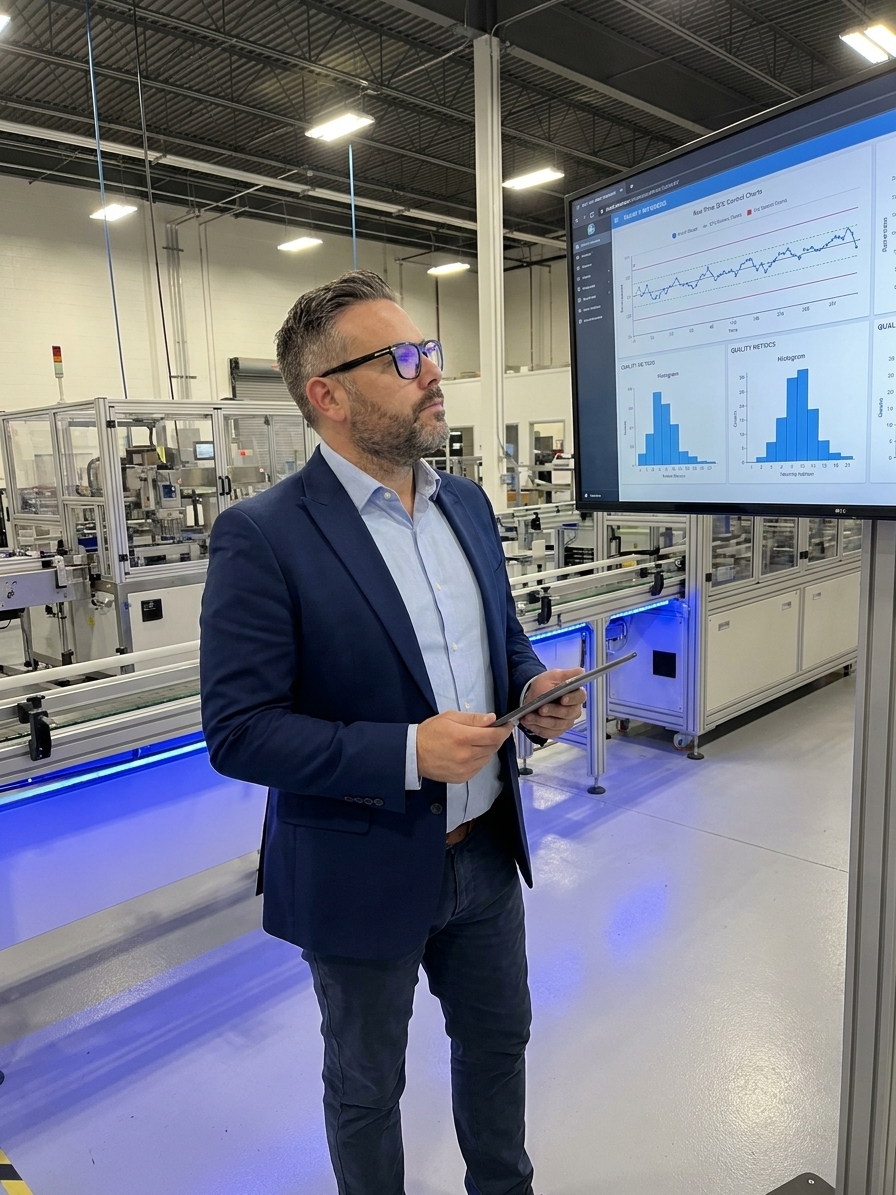
This is the SPC control chart that the operator reviews every hour.
It is the quality alert board updated at every break. It is the team
lead who walks the line every ninety minutes, checking the last fifty
parts against the standard.
Near-real-time feedback involves human interpretation but still
operates within the same shift the deviation occurs. This is where most
of your detectable process drift gets caught — or where it doesn’t,
because the information is sitting in a database that nobody looks at
until tomorrow.
Strategic Feedback: Days to
Weeks
This is the customer complaint that arrives five business days after
shipment. It is the supplier quality report reviewed in the monthly
meeting. It is the warranty data analyzed quarterly to identify emerging
failure modes.
Strategic feedback is essential — it catches the problems that
real-time and near-real-time loops miss. But it is catastrophically
expensive when it is the only loop you have. If the first time
you learn about a defect is when the customer tells you, your feedback
loop is not a quality system. It is an apology system.
The Anatomy of a Broken Loop
Broken feedback loops do not look broken from the outside. They look
like normal operations. People are busy. Reports are generated. Meetings
are held. The illusion of control is maintained by the volume of
activity, not the velocity of learning.
Here is how to recognize the broken loops in your organization:
The signal is generated but never transmitted. The
operator notices something unusual but does not record it because the
reporting system takes twelve minutes per entry and production is
behind. The measurement is taken but the data sits in a gauge that must
be manually downloaded once a week. The signal dies at the source
because the cost of transmitting it exceeds the perceived value of the
information.
The signal is transmitted but never interpreted. The
SPC data is collected diligently and emailed to the quality engineer,
who receives two hundred emails per day and has time to review control
charts on Tuesdays. The customer complaint is logged in the system but
the assigned investigator is covering three other lines and will not get
to it until next week. The information arrives but sits in a queue,
aging like produce, losing relevance by the hour.
The signal is interpreted but no action is taken.
The quality engineer identifies the root cause and writes a corrective
action request. The request goes to maintenance, where it is prioritized
behind three emergency breakdowns. The supervisor knows the fixture is
worn but the replacement has not been approved because purchasing needs
three quotes and the lowest one is not from the preferred supplier. The
decision is made but the execution is trapped in a bureaucratic holding
pattern.
Action is taken but the effect is never verified.
The adjustment is made. The fixture is replaced. The training is
delivered. And nobody goes back to check whether the corrective action
actually fixed the problem. The loop appears closed because the
paperwork is signed, but the process is still drifting, because the fix
addressed a symptom, not the cause, and nobody verified the result.
If any one of these fractures exists, the loop is open. And an open
loop is worse than no loop at all, because it creates the illusion that
the system is working.
The Mathematics of Feedback
Delay
Here is a calculation that changed how I think about quality
systems:
If your process produces a defect at a rate of one per hundred, and
your feedback loop detects it within one cycle, your maximum defect
escape is one unit.
If the same process has a feedback delay of fifty cycles, your
maximum defect escape is fifty units — and your average escape is
twenty-five.
The defect rate did not change. The process capability did not
change. The only thing that changed was the speed of the loop. And the
cost of the resulting quality failure increased by a factor of
twenty-five.
Now multiply that across every process in your plant, every shift,
every day, every week. The cumulative cost of feedback delay is
staggering, and it is almost never tracked, because the accounting
system does not have a line item for “information velocity.”
But your customer’s rejection rate has one. And your warranty budget
has one. And your scrap report has one.
Designing
Feedback Loops: A Practical Framework
If you want to close the gap between what happens and what you know
about it, you need to design your loops deliberately. Here is the
framework I use with organizations:
Step 1: Map Your Critical
Parameters
Not every process parameter needs a feedback loop. But the ones that
directly affect product quality, customer requirements, or regulatory
compliance do. List them. For each one, document the current time
between when a deviation occurs and when it is detected. This is your
feedback latency, and it is the number you need to shrink.
Step 2: Classify by Speed
Requirement
For each critical parameter, determine the maximum acceptable
feedback latency. If a deviation can produce a safety-critical defect in
ten cycles, your feedback loop must operate in fewer than ten cycles. If
the drift is slow and the consequence is minor, a longer loop may be
acceptable. But make this classification explicit. Do not leave it to
chance.
Step 3: Close the Gap
For every parameter where the current feedback latency exceeds the
acceptable latency, identify which part of the loop is slow. Is
detection slow? Is transmission slow? Is interpretation slow? Is action
slow? Is verification missing?
Attack the bottleneck. If detection is slow, add sensors or increase
measurement frequency. If transmission is slow, automate the data flow.
If interpretation is slow, build decision rules that do not require
expert analysis for common deviations. If action is slow, empower
operators to stop and adjust without managerial approval. If
verification is missing, add it.
Step 4: Measure Loop Velocity
Once you have designed the loop, measure how fast it actually runs.
Track the time from deviation detection to corrective action to
verification. This is your loop cycle time, and it should be a key
quality metric — as important as your defect rate, because it determines
your defect rate.
Step 5: Iterate
Feedback loops degrade. The sensor drifts. The operator gets
complacent. The software update breaks the automated alert. The new
supervisor does not know about the quality board. Review your loop
performance regularly and repair the broken ones before they produce the
kind of defect that gets remembered in a customer audit.
The Cultural
Dimension: Feedback Without Blame
The fastest feedback loop in the world will not work if the people at
the receiving end are afraid to activate it.
I have seen organizations where operators would rather hide a defect
than report it, because the last person who reported a problem got
blamed for causing it. I have seen quality engineers who stopped issuing
corrective actions because every CAR became a political battle with
production. I have seen supervisors who manually adjusted control chart
limits to avoid triggering alerts, because exceeding the alert threshold
meant a mandatory investigation that nobody had time for.
In every case, the feedback loop was technically functional. The
signal could be generated, transmitted, interpreted, and acted upon. But
the culture had built a dam across the circuit, and information flowed
only when the pressure became unbearable.
Designing feedback loops is an engineering problem. Operating them
effectively is a cultural one. And the culture question is simple: When
someone in your organization detects a deviation, what happens to them?
Are they rewarded for catching it early, or punished for being the
messenger?
If the honest answer is the latter, your feedback loops will always
be slower than your defects.
The
Feedback Loop Hierarchy: From Reactive to Predictive
As organizations mature, their feedback loops evolve through four
levels:
Level 1: Reactive. The defect reaches the customer.
The customer complains. The organization investigates. The corrective
action takes weeks. This is where most organizations start, and
unfortunately, where many remain.
Level 2: Detective. The defect is caught at
inspection — final, in-process, or incoming. The feedback loop operates
within the plant, but after the defect has already been produced. You
are not preventing defects; you are filtering them. Expensive, but
better than Level 1.
Level 3: Preventive. The process parameter drifts,
and the feedback loop detects the drift before it produces a defect. The
SPC chart triggers an alarm. The automated gauge adjusts the machine.
The operator sees the trend and makes a correction. The defect is
prevented, not detected.
Level 4: Predictive. The feedback loop detects
patterns that indicate a future deviation. The machine learning model
identifies a vibration signature that precedes tool failure by two
hundred cycles. The historical data shows that a certain supplier lot
characteristic correlates with dimensional drift after five hundred
parts. The loop closes before the deviation even occurs.
Most organizations have a few Level 2 loops, a handful of Level 1
loops they would rather not admit to, and aspirations of Level 4. The
gap between aspiration and reality is usually found in the speed and
reliability of their Level 2 and Level 3 loops — the foundation that
Level 4 is built on.
The Hidden
Cost of Slow Feedback: Knowledge Decay
There is one more dimension to feedback speed that most organizations
overlook: the relationship between feedback delay and learning.
When an operator makes an adjustment and sees the result within
seconds, the connection between action and outcome is burned into their
mental model. They learn. They improve. The next time they see the same
pattern, they respond faster and more accurately.
When the feedback arrives three days later, the connection is lost.
The operator has processed hundreds of other decisions since then. The
learning moment has passed. The corrective action is applied
mechanically — following the instruction, not understanding the reason.
And the next time the same deviation occurs, the response is no faster
than the first time.
Slow feedback loops do not just produce more defects. They produce
slower learners. And slower learners produce more defects. It is a
reinforcing loop — the wrong kind.
Closing the Loop: Your Action
Plan
If you have read this far, you already know whether your organization
has a feedback loop problem. The symptoms are unmistakable: recurring
defects that should have been caught, corrective actions that take
longer to implement than the problem took to cause, quality meetings
where people discuss data that is already weeks old.
Here is what to do about it:
- Audit your current loops. For your top five quality
issues, trace the feedback path from deviation to detection to action to
verification. Time each step. You will find your bottlenecks. - Prioritize by impact. Fix the slowest loops that
affect your most critical quality characteristics first. The ROI on
feedback acceleration is immediate and measurable. - Automate what you can. If a human does not need to
interpret the signal, remove the human from the loop. Every manual step
adds latency and introduces the possibility of inaction. - Empower the people closest to the process. The
operator who sees the drift should be able to stop and adjust without
asking permission. Every layer of approval adds delay. - Verify every loop. A corrective action without
verification is an open loop. An open loop is a quality debt that
compounds until the next audit — or the next customer complaint — forces
it closed. - Measure and report loop velocity. Make feedback
speed a visible metric. Put it on the same board as your defect rate.
Because it is the same thing, measured at a different point in
time.
The Final Measurement
At the end of every quality system, there is a customer. And the
customer does not care about your control charts, your corrective action
procedures, or your management review minutes. The customer cares about
whether the product works.
The distance between a deviation in your process and a defect in your
customer’s hands is determined entirely by the speed and reliability of
your feedback loops. Every hour of delay is a bet — a bet that the
deviation was small enough, the batch was limited enough, and the
customer was forgiving enough to absorb the consequence of your slow
learning.
Most of the time, you win that bet. But the times you lose it are the
ones that define your quality reputation, your warranty costs, and your
market position.
Close the loop. Close it fast. Close it reliably. And when you think
it is closed, verify that it is.
Because the defect you did not catch today is the customer you will
not have tomorrow.
Peter Stasko is a Quality Architect with 25+ years
of experience transforming organizations across automotive, aerospace,
and pharmaceutical industries. He has spent decades studying how
information flows through manufacturing systems — and why the speed of
that flow determines everything from scrap rates to market survival.