Quality Gemba Kaizen Events: When Your Organization Stops Planning Improvement and Starts Doing It — In Five Days, On the Shop Floor, With the People Who Actually Do the Work
You have heard the word “kaizen” so many times it has lost its teeth. It sits on posters above coffee machines. It appears in PowerPoint decks during quarterly reviews. It gets mentioned in leadership speeches right between “synergy” and “paradigm shift.” Somewhere along the way, your organization turned one of the most powerful ideas in manufacturing into wallpaper.
But there is a version of kaizen that still has teeth. It happens in a single week. It happens on the shop floor, not in a conference room. It involves the people who actually run the process — not the people who designed it on paper three years ago and haven’t visited it since. It produces measurable results by Friday afternoon, not promises for Q3. And it changes the way your people think about their work forever.
It is called a Gemba Kaizen Event — also known as a Kaizen Blitz, a Rapid Improvement Event, or a Kaizen Workshop. And if you have never run one properly, you are sitting on one of the highest-ROI activities available to any quality professional.
What a Gemba Kaizen Event Actually Is
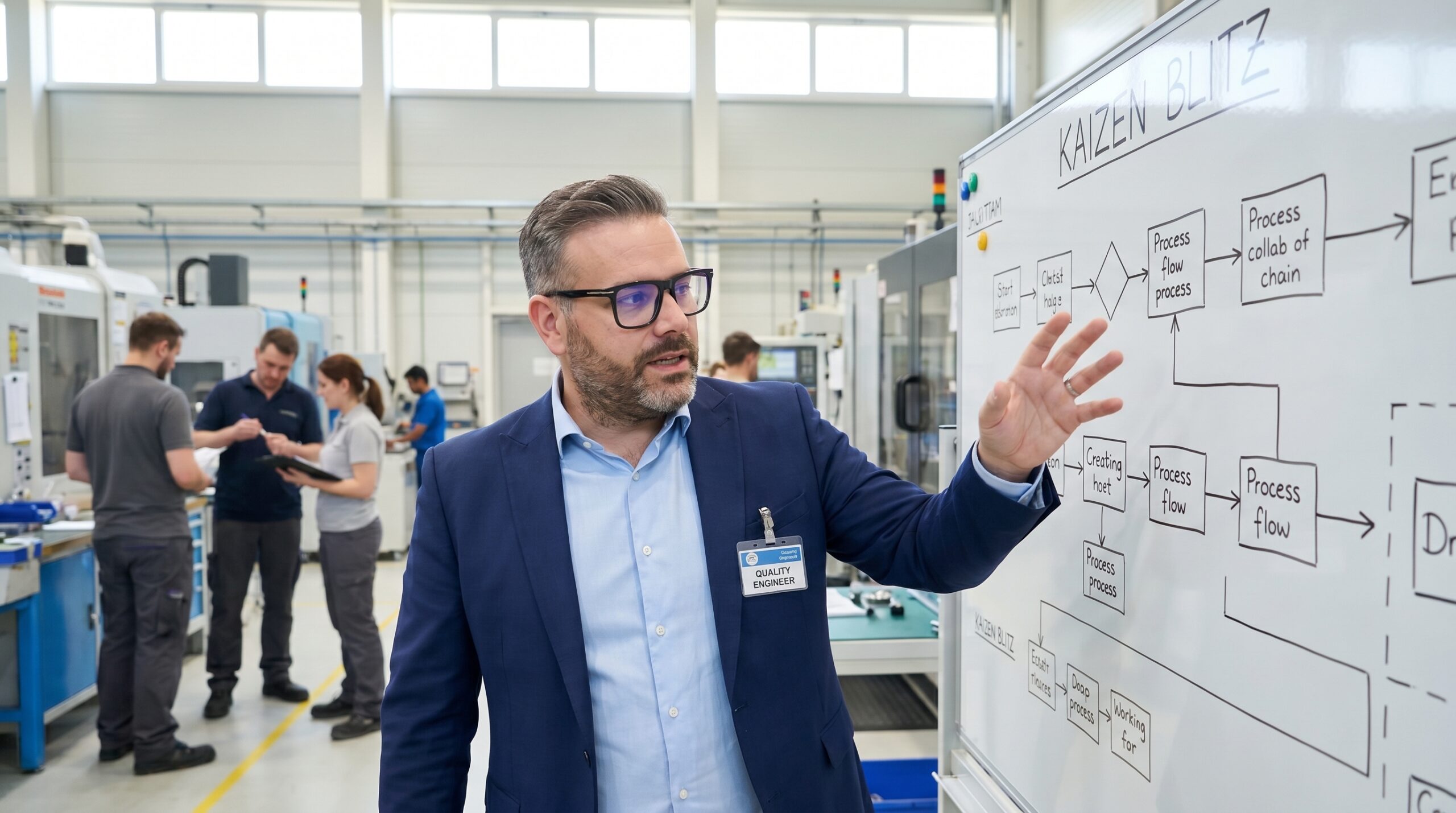
A Gemba Kaizen Event is a structured, time-bounded improvement workshop — typically three to five days — where a cross-functional team focuses intensely on a single process, identifies waste and quality problems, implements countermeasures on the spot, and validates the results before the week is over.
The word gemba means “the real place” — the shop floor, the production line, the warehouse, wherever the actual work happens. The event happens there, not in a meeting room. The team observes, measures, questions, redesigns, implements, and verifies — all within the same week.
This is not a brainstorming session. It is not a suggestion scheme. It is not a kaizen “activity” where people write improvement ideas on sticky notes and someone files them in a drawer. A Gemba Kaizen Event produces tangible, implemented, verified change before the team goes home on the last day.
Why Most Organizations Get It Wrong
Before we talk about how to do it right, let us talk about what goes wrong — because the list is long and painful.
Mistake #1: The Conference Room Kaizen. The team meets in a meeting room, looks at process maps on a projector, debates theoretical improvements, and leaves with an action plan that nobody executes. The gemba was never visited. The actual process was never observed. The action items die in someone’s inbox by the following Tuesday.
Mistake #2: The Management-Only Team. The event is staffed with engineers, managers, and supervisors. The operators — the people who run the process eight hours a day, five days a week — are not invited. The team redesigns a process they do not understand and wonders why operators revert to the old method within a week.
Mistake #3: The Perpetual Pilot. The team identifies improvements, documents them in a report, and schedules implementation for “next month.” Next month becomes next quarter. Next quarter becomes next year. Nothing actually changes during the event itself. The energy dissipates. People learn that kaizen events are just meetings with a different name.
Mistake #4: The Scope Creep Disaster. The team tries to fix the entire production line in five days. They end up fixing nothing. The scope was too broad, the problems too interconnected, and by Wednesday the team is overwhelmed and demoralized.
Mistake #5: The No-Follow-Up Event. The event produces real change. The new layout is implemented. The process improves. Then the facilitator leaves, nobody monitors sustainability, and within six weeks the process has drifted back to exactly where it was before — except now everyone is more cynical.
Every single one of these mistakes is common. Every single one is preventable. Let us build the event that prevents them all.
The Anatomy of a Proper Gemba Kaizen Event
Phase 0: Selection and Preparation (One to Two Weeks Before)
The event does not start on Monday morning. It starts weeks before with careful selection and preparation.
Select the right target. The ideal target for a Gemba Kaizen Event is a bounded process with visible waste and measurable output — a single production cell, a specific assembly station, a material flow between two operations, a changeover process, a packing area. It should be important enough to matter but bounded enough to tackle in a week.
Use your quality data to guide selection. Where are defect rates highest? Where is cycle time longest? Where is rework most frequent? Where have customer complaints clustered? Your Pareto chart will point you toward the highest-impact target.
Form the right team. A proper kaizen event team includes: – Two to three operators from the target process — the people who do the work every day – One process engineer or quality engineer who understands the technical side – One maintenance technician who knows the equipment – One facilitator trained in kaizen methodology (this may be you) – One person from outside the area — a fresh pair of eyes with no assumptions – Optional: a representative from upstream or downstream operations
Keep the team at five to eight people. Larger teams fragment. Smaller teams lack perspective.
Secure management support. Before the event, get explicit commitment from leadership for three things: 1. The team has authority to make changes during the event week 2. Resources (tools, materials, equipment modifications) will be available 3. Management will attend the final presentation on Friday afternoon
If you cannot get these three commitments, postpone the event. A kaizen event without management backing is theater.
Collect baseline data. Before Day One, measure the current state. Cycle time. Defect rate. Changeover time. Walking distance. WIP inventory. Scrap cost. Document it. Photograph it. Video it. You need a clear “before” picture — both to guide your improvement and to prove your results.
Phase 1: Understanding the Current State (Day 1 — Monday)
Monday is about seeing reality — not assuming, not recalling, not reading documentation. Seeing.
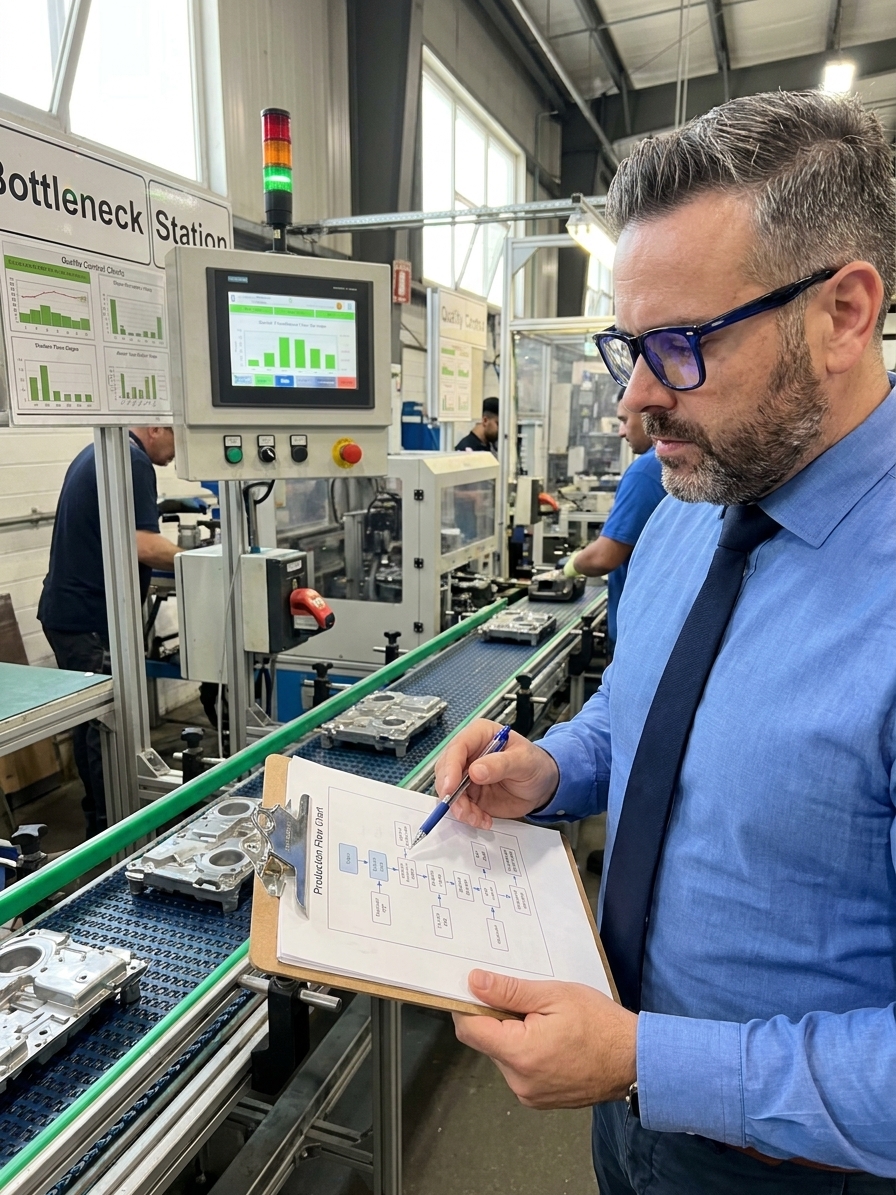
Start at the gemba. The team goes to the actual process. Not a meeting room. The floor. The team walks the process from beginning to end, following the product’s journey. They observe every step, every handoff, every wait, every motion.
Conduct a waste walk. Using the seven wastes of lean (overproduction, waiting, transport, overprocessing, inventory, motion, defects) plus the eighth waste of unused human creativity, the team identifies and documents every instance of waste they can find. They mark locations on a floor plan. They take photographs. They time operations with a stopwatch.
Map the process. The team creates a detailed process map — not a high-level value stream map, but a spaghetti diagram showing the actual physical movement of people and materials, and a step-by-step process observation sheet documenting what happens at each station, how long it takes, what goes wrong, and how often.
Talk to the operators. The operators on the team share what frustrates them daily. What is hard? What takes too long? Where do mistakes happen? What workarounds have they invented that nobody documented? This is gold — and it only surfaces when operators feel safe enough to speak honestly.
By the end of Monday, the team should have a comprehensive, data-driven understanding of the current state — including all the problems that the official process documentation conveniently omits.
Phase 2: Root Cause Analysis and Solution Design (Day 2 — Tuesday)
Tuesday is about diagnosing causes and designing countermeasures.
Prioritize the problems. The team reviews everything documented on Monday and prioritizes using a simple Pareto analysis: which problems cause the most defects, the most lost time, the most cost? Focus on the vital few.
Drill to root causes. For each priority problem, the team uses the Five Whys, cause-and-effect diagrams, or the IS/IS NOT method to move past symptoms and identify root causes. This is not academic exercise — it is targeted investigation. The goal is to reach causes the team can actually do something about.
Generate countermeasures. For each root cause, the team brainstorm countermeasures. The criteria are pragmatic: – Can we implement this by Friday? – Do we have (or can we get) the resources? – Will it actually address the root cause — or just the symptom? – Can we test it quickly?
Design the future state. The team sketches the improved process: new layout, revised sequence, eliminated steps, new visual controls, mistake-proofing devices, standardized work instructions. They draw it on paper. They simulate it with cardboard and tape on the floor. They walk through it physically to catch flaws before committing.
By the end of Tuesday, the team has a clear plan for what to change and how to change it.
Phase 3: Implementation (Days 3-4 — Wednesday and Thursday)
This is where most improvement initiatives die on paper. In a Gemba Kaizen Event, this is where the magic happens — because you implement during the event itself.
Make physical changes. The team moves equipment. Relocates tools. Reorganizes workstations. Installs simple fixtures and jigs. Creates visual markings on the floor. Sets up shadow boards for tools. Installs poka-yoke devices. These are not permanent-engineering-change-order-level modifications — they are practical, immediate improvements made with available materials.
Revise the standard work. The team writes new standardized work documents reflecting the improved process. These are simple, visual, one-page instructions — not twenty-page procedures. Operators on the team co-author them because they will be the ones following them.
Test and iterate. The team runs the improved process and observes. Does it actually work? Where are the problems? What did the paper design miss? They iterate in real-time — adjusting, tweaking, fixing. This rapid cycle of implement-test-adjust is the core advantage of doing everything in one concentrated week.
Train the operators. Every operator who works in the area — not just the ones on the kaizen team — receives training on the new process during Wednesday and Thursday. They practice. They ask questions. They raise concerns. They become comfortable with the new method before the facilitator leaves.
By the end of Thursday, the improved process should be implemented, tested, and documented. It is not perfect. It is not final. But it is real, it is running, and it is measurably better than what existed on Monday.
Phase 4: Verification and Presentation (Day 5 — Friday)
Friday is about proving the results and building sustainability.
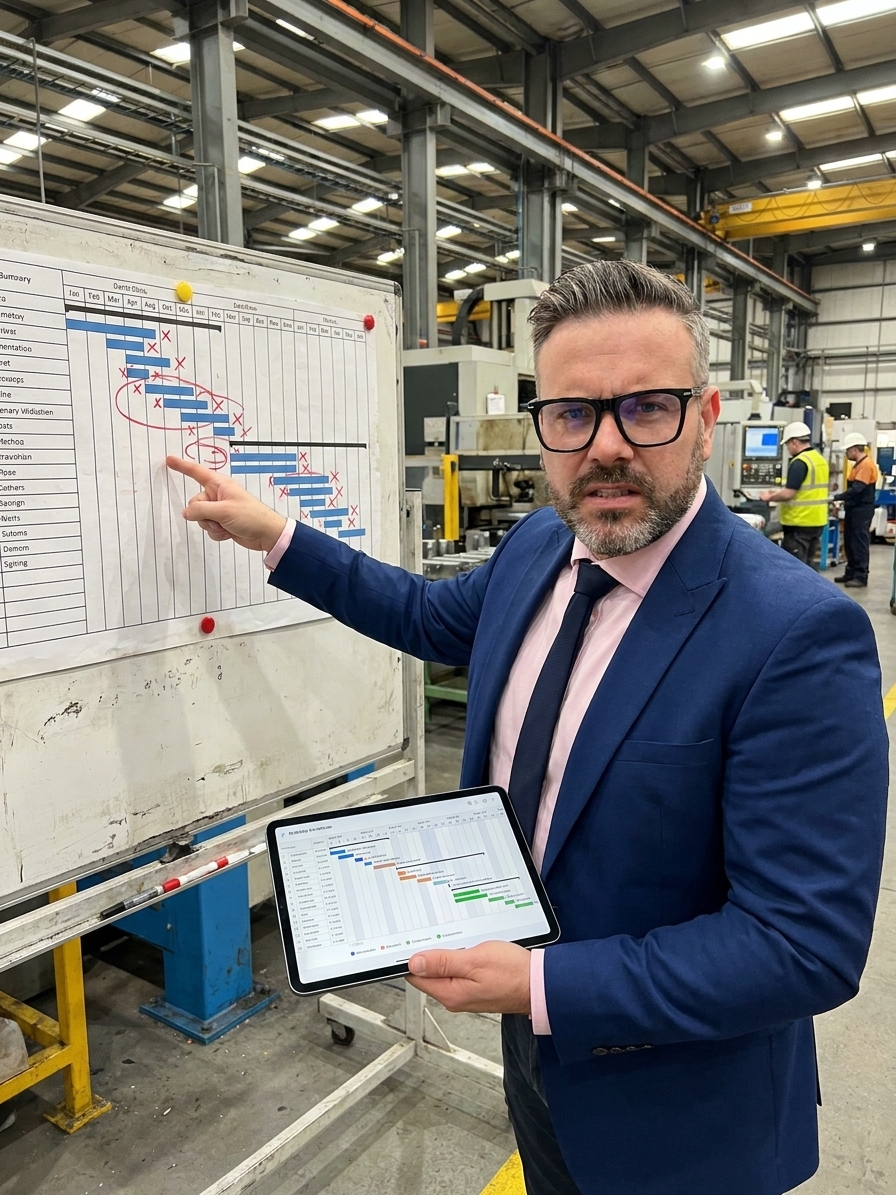
Measure the new state. Using the same metrics collected during baseline, the team measures the improved process. Cycle time. Defect rate. Walking distance. WIP. Scrap. The comparison between Monday’s baseline and Friday’s results is the most powerful part of the event.
Document everything. Before- and after-photos. Before- and after-metrics. Before- and after-spaghetti diagrams. Standardized work documents. A one-page summary of what changed and why. This documentation serves three purposes: it proves the results, it supports the sustainability plan, and it becomes a template for future events.
Present to leadership. On Friday afternoon, the team presents their work to management. This is not a formality — it is critical. The operators present alongside the engineers. The team shows the data. They tell the story. They ask for what they need to sustain the improvement. Management sees the results, hears from the people who made them happen, and gives public recognition.
This presentation does something important: it signals to the entire organization that this kind of rapid, shop-floor-driven improvement is valued, supported, and noticed. It builds momentum for the next event.
Establish the sustainability plan. Before the team disperses, they define: – Who monitors the process daily for the next 30 days? – What metrics are tracked and at what frequency? – When does the team reconvene to check sustainability (typically 30-day follow-up)? – What additional improvements were identified but could not be implemented this week?
The Numbers: What You Can Realistically Expect
Gemba Kaizen Events are not theoretical. They produce concrete, measurable results — consistently, across industries, when done properly.
- Cycle time reductions of 30-70% are common for targeted processes
- Defect rate reductions of 50-80% are achievable when the event focuses on a quality problem
- Changeover time reductions of 50-90% are typical when the target is a setup process
- Floor space savings of 20-50% emerge from layout optimization
- WIP reductions of 40-70% result from flow improvements
These are not aspirational targets from a consultant’s brochure. These are conservative expectations from thousands of documented events across automotive, electronics, medical devices, food processing, and heavy manufacturing.
The ROI is dramatic. A one-week event with a team of six to eight people costs roughly 300-400 labor hours. The savings from a single successful event — in reduced defects, shorter cycle times, lower inventory, freed floor space — typically pay back that investment within weeks, sometimes days. And the improvements compound over time.
The Hidden Benefit You Cannot Measure on a Spreadsheet
The process improvements are valuable. The cost savings are real. But the most important outcome of a well-run Gemba Kaizen Event is something no spreadsheet captures: it transforms how people think about their relationship to their work.
When an operator spends Monday identifying problems, Tuesday designing solutions, Wednesday building those solutions with their own hands, Thursday testing and refining them, and Friday presenting results to management — something fundamental shifts. They stop seeing themselves as cogs in a machine. They start seeing themselves as architects of their own process.
They learn that improvement is not something done to them by engineers from an office. It is something they can do themselves, with the right structure and support. They learn that their knowledge — the intimate, hands-on, thousand-hours-of-observation knowledge that only a shop-floor operator possesses — is the most valuable input in any improvement activity.
And they carry that mindset forward. Long after the kaizen event ends, those operators notice waste, identify problems, and suggest improvements — because the event taught them that noticing, identifying, and suggesting actually leads to action.
This is how you build a quality culture. Not with posters. Not with slogans. Not with annual training modules. You build it by giving people the experience of making real change and seeing it work.
Common Pitfalls and How to Avoid Them
“We don’t have time for a week-long event.” You do not have time not to. The process you target has been bleeding defects, time, and money for months — possibly years. One week of concentrated effort eliminates or dramatically reduces that bleeding. The net time savings is positive within the first month.
“Our people won’t participate.” They will — if you create the right conditions. Operators participate enthusiastically when they see that their input leads to real change, when they are treated as experts rather than labor, and when they see management take the results seriously. The first event is the hardest. After that, word spreads, and people volunteer.
“We tried kaizen events before and they didn’t stick.” The sustainability failed, not the method. Review the five mistakes at the beginning of this article. Which ones did you commit? The most common failure mode is lack of follow-up: the event produces improvement, the team disbands, and nobody monitors the process for the next 30-60 days. Build the follow-up mechanism into the event itself.
“We can’t make changes that fast — we need approval cycles.” This is a management commitment issue, not a method issue. If management pre-authorizes the team to implement changes within a defined scope during the event week, the approval cycle is handled before the event begins. Where safety or regulatory compliance is concerned, define those boundaries upfront and get pre-approval for the types of changes within scope.
“We don’t have a facilitator.” Train one. The facilitator role is learnable. Send a quality engineer or continuous improvement leader through a hands-on kaizen facilitation course — or bring in an external facilitator for the first two to three events and have your internal person shadow them. By the third event, your internal person can co-facilitate. By the fifth, they can lead independently.
Scaling: From One Event to an Improvement System
A single Gemba Kaizen Event is a project. A program of regular events — one per month, or one per quarter — is a system. And a system transforms organizations.
Here is what a mature kaizen event program looks like:
A rolling calendar of events, planned six to twelve months in advance, targeting the highest-priority processes based on quality data, cost data, and strategic objectives.
A trained pool of facilitators — not one person, but three to five people capable of leading events, so the program does not depend on a single individual.
A standard event template — a documented, repeatable structure for preparation, execution, and follow-up that any trained facilitator can deploy.
A results database — a log of every event, the metrics achieved, the lessons learned, and the sustainability status. This becomes organizational knowledge — and it demonstrates the cumulative impact of the program to leadership.
A recognition system — public acknowledgment of teams, celebration of results, sharing of success stories across the organization. This builds the cultural momentum that sustains the program over years.
Organizations that run regular Gemba Kaizen Events do not just improve processes. They build an improvement muscle — a collective organizational capability to identify problems, solve them quickly, implement solutions, and sustain the gains. That muscle gets stronger with every event.
A Final Word
The beauty of a Gemba Kaizen Event is its radical simplicity. There is no expensive software. No complex statistical methodology. No certification required. What it demands instead is something far harder to find in most organizations: the willingness to go to the actual place where work happens, listen to the people who actually do it, trust their knowledge, and give them the time, authority, and support to make it better.
The shop floor is not a problem to be managed from above. It is a system to be understood from within. The people who operate that system every day understand it better than anyone. A Gemba Kaizen Event simply gives them the structure and the permission to act on that understanding.
Do it once. Do it right. Watch what happens to your quality, your efficiency, and your people.
Peter Stasko is a Quality Architect with 25+ years of experience in automotive and manufacturing quality management. He specializes in building practical, shop-floor-driven quality systems that deliver measurable results — not just compliant documentation.