Quality
Hoshin Kanri: When Your Organization Stops Cascading Goals Like a
Waterfall and Starts Aligning Them Like a Compass — and Every Level of
the Company Finally Points in the Same Direction
The Strategy That Died
in a PowerPoint
It happens in every organization. The leadership team spends three
days at an off-site retreat. They drink bad coffee, argue about mission
statements, and emerge with a strategic plan printed on glossy paper.
The plan gets distributed to every department. It gets framed and hung
on lobby walls. And then nothing changes.
Six months later, someone finds the glossy document buried under a
stack of inspection reports. The strategic priorities it described were
never translated into action. The shop floor never heard about them.
Middle management interpreted them in twelve different directions. And
the quality department kept doing what it had always done — fighting
fires, chasing defects, running audits that nobody read.
This is not a failure of strategy. This is a failure of deployment.
And it is one of the most expensive, most common, and most invisible
problems in modern manufacturing.
The Japanese management system called Hoshin Kanri
was built to solve exactly this problem. And unlike most management
frameworks that sound profound in a seminar and fall apart on the shop
floor, Hoshin Kanri has been proving itself in the most demanding
manufacturing environments on earth for over fifty years.
What Hoshin Kanri Actually
Means
The name is deceptively simple. Hoshin means “direction” or
“compass needle.” Kanri means “management” or “control.”
Together, they describe something that most organizations desperately
need and almost none actually have: a management system that ensures
every person in the organization is moving in the same direction, with
the same priorities, and with feedback loops that tell them whether
they’re making progress.
Hoshin Kanri is not a goal-setting exercise. It is not a performance
review framework. It is not a Balanced Scorecard with Japanese branding.
It is a comprehensive system for taking three to five strategic
priorities, translating them into specific improvement targets at every
level of the organization, and then using structured review cycles to
ensure that the strategy is actually being executed — not just
discussed.
The system was developed in Japan during the 1950s and 1960s, drawing
on the work of quality thinkers like W. Edwards Deming and Joseph Juran,
but it was companies like Toyota, Bridgestone, and Komatsu that refined
it into the discipline we recognize today. The term “Policy Deployment”
is the closest English equivalent, but like most translations of
Japanese management concepts, it captures the mechanics while losing the
philosophy.
The Problem
Hoshin Kanri Was Designed to Solve
Before you can appreciate what Hoshin Kanri does, you need to
understand the problem it was built to address. And that problem is not
a lack of strategy. Most organizations have plenty of strategy. The
problem is that strategy exists at one level of the organization while
execution happens at a completely different level, and the translation
between the two is either nonexistent or catastrophically distorted.
Think about how strategy typically flows through a manufacturing
company. The CEO and the executive team set a strategic priority:
“Reduce customer complaints by forty percent this year.” This priority
gets passed to the VP of Operations, who interprets it as “Improve final
inspection catch rates.” The VP passes it to the Plant Manager, who
interprets it as “Add more inspectors to the final line.” The Plant
Manager tells the Quality Manager, who interprets it as “Increase
sampling frequency on outgoing product.” The Quality Manager tells the
Shift Supervisor, who interprets it as “Stop the line every time you see
something questionable.”
By the time the strategic priority reaches the people who actually do
the work, it has been translated, reinterpreted, and distorted so many
times that the original intent is unrecognizable. The CEO wanted to
reduce customer complaints. The shift supervisor is stopping the line so
frequently that production has ground to a halt. Customer complaints
haven’t decreased — they’ve increased, because deliveries are now late.
And nobody in the chain can explain how the original goal got so badly
mangled.
This is the telephone game of corporate strategy, and it happens in
every organization that doesn’t have a systematic method for strategy
deployment. Hoshin Kanri is that systematic method.
The Structure: How Hoshin
Kanri Works
Hoshin Kanri operates on a principle that most organizations find
uncomfortable: fewer priorities, pursued more rigorously. The system is
built around three to five breakthrough objectives per year — not
twenty, not fifty, not a spreadsheet with a hundred initiatives. Three
to five. The logic is simple and brutal: if everything is a priority,
nothing is a priority.
The process follows a cycle that looks deceptively like PDCA
(Plan-Do-Check-Act), because it is built on PDCA. But Hoshin Kanri
applies PDCA at two levels simultaneously, and this dual structure is
what makes it different from everything else.
Level One: The Strategic PDCA
At the strategic level, the leadership team identifies the three to
five breakthrough objectives that will move the organization toward its
two-to-five-year vision. These are not incremental improvements. They
are step-change priorities that require focused resources and
cross-functional coordination. Reducing scrap by fifty percent. Breaking
into a new market with zero customer quality complaints. Reducing new
product launch defects by seventy percent.
These strategic objectives are then broken down into annual targets
with specific measures and resources allocated. This is the Plan phase
at the strategic level.
The Do phase involves deploying these targets throughout the
organization using a process called “catchball” — a structured dialogue
between levels of management where goals are tossed back and forth,
refined, and translated into specific action plans. Catchball is not a
one-way cascade. It is a negotiation. Senior leadership proposes a
direction; middle management pushes back with reality checks; the
dialogue continues until both sides agree on targets that are both
ambitious and achievable.
The Check phase happens through structured review cycles — typically
monthly at the executive level and more frequently at lower levels.
These reviews are not status meetings. They are rigorous examinations of
whether the strategy is producing the expected results, using data and
analysis rather than anecdotes and optimism.
The Act phase involves adjusting the strategy based on what the
reviews reveal. Sometimes the targets need to be recalibrated. Sometimes
the approach needs to change. Sometimes the original strategy was wrong
and needs to be abandoned. Hoshin Kanri gives leadership permission to
change direction — but only based on evidence, not mood.
Level Two: The Daily PDCA
While the strategic PDCA runs at the top, every department and every
team runs its own PDCA cycle for the daily management activities that
keep the organization functioning. These are the routine processes —
production scheduling, inspection protocols, maintenance routines,
supplier management — that don’t need executive attention but absolutely
need to be managed systematically.
The genius of Hoshin Kanri is that these two levels are connected.
The daily management system feeds information upward into the strategic
review process, and the strategic priorities influence how resources are
allocated at the daily level. There is no gap between “strategy” and
“operations” because the system was designed to eliminate that gap
entirely.
Catchball:
The Conversation Most Organizations Never Have
If there is one element of Hoshin Kanri that separates it from every
other strategy deployment method, it is catchball. And it is also the
element that most organizations resist the most.
Catchball is a structured dialogue between levels of management where
strategic priorities are proposed, challenged, refined, and ultimately
agreed upon. The name comes from the metaphor of playing catch: one
person throws an idea, the other catches it, examines it, adds to it,
and throws it back. The game continues until both sides have something
they can commit to.
In practice, it works like this. The CEO proposes that reducing
warranty claims by thirty percent should be one of the company’s five
breakthrough objectives for the year. This goal is thrown to the VP of
Engineering, who catches it and pushes back: “We can get thirty percent
reduction, but only if we also invest in improved validation testing,
which will delay two product launches by four months.” The VP throws
this back to the CEO, who has to decide whether the warranty reduction
is worth the launch delay. The CEO modifies the target: “Twenty percent
reduction with no launch delays, or thirty percent reduction with delays
on non-critical launches only.” The dialogue continues until a
realistic, agreed-upon target emerges.
This is not how most organizations set goals. In most companies,
goals are handed down from above with minimal input from below. The
result is targets that are either too aggressive (because leadership
doesn’t understand operational reality) or too timid (because middle
management lowballs to protect itself). Catchball corrects both problems
by forcing a genuine dialogue.
The reason organizations resist catchball is that it requires a kind
of honesty that most corporate cultures don’t support. It requires
senior leaders to admit that their targets might be unrealistic. It
requires middle managers to push back on directives from above. It
requires a level of organizational trust that takes years to build and
seconds to destroy. Hoshin Kanri works best in organizations with high
psychological safety — which is one of the reasons it is so hard to
implement well.
The X-Matrix: Strategy
on a Single Page
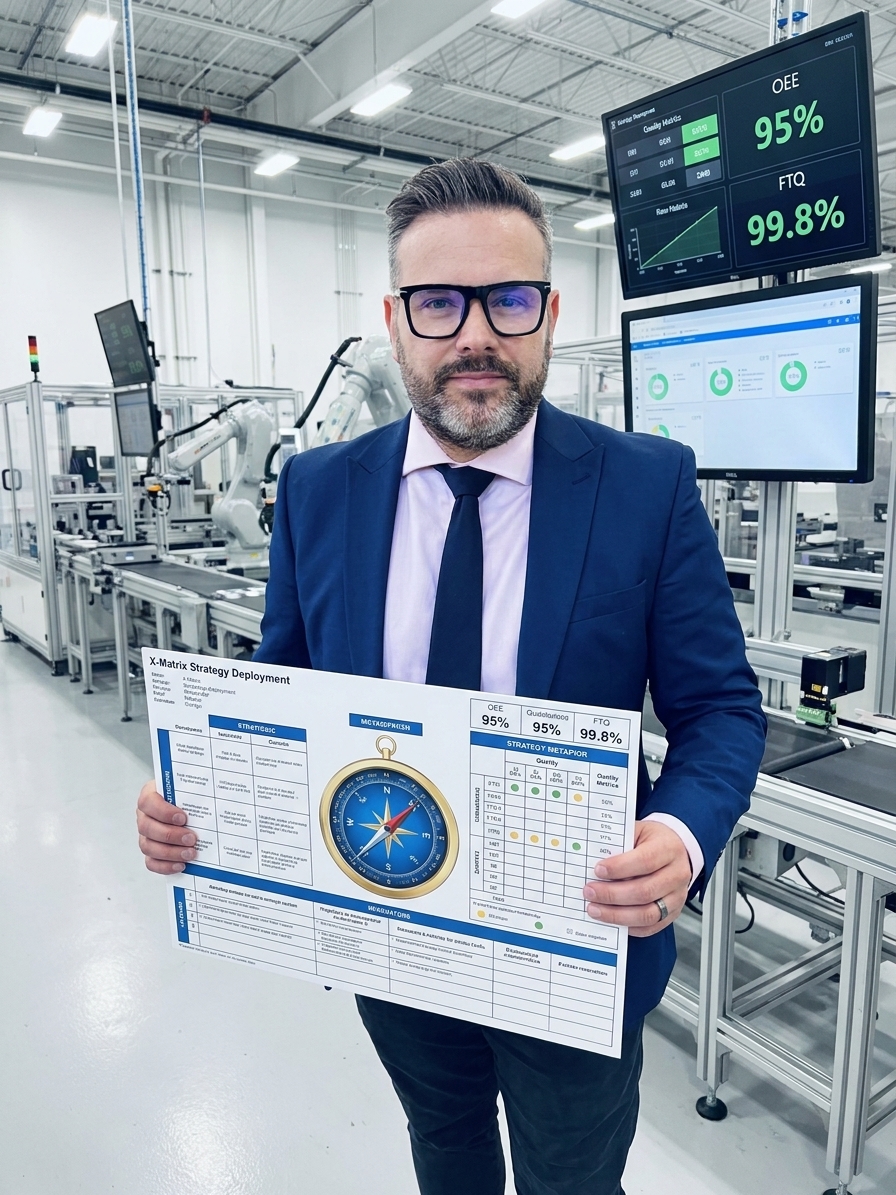
One of the most practical tools in the Hoshin Kanri toolkit is the
X-Matrix, also known as the Hoshin Planning Matrix. It is exactly what
it sounds like: a single-page document shaped like an X that captures
the entire strategy deployment on one sheet of paper.
The X-Matrix has four quadrants connected by a central cross:
- South quadrant: Long-term strategic objectives (two
to five years out) - West quadrant: Annual breakthrough objectives (this
year’s priorities) - North quadrant: Improvement targets and measures
(specific, measurable goals) - East quadrant: Resource allocation and action plans
(who does what, with what)
The intersections between quadrants show the relationships: which
annual objectives support which long-term goals, which measures track
which annual objectives, which action plans deliver which improvement
targets. The beauty of the X-Matrix is that it forces the entire
leadership team to see how their strategy fits together — or doesn’t.
When a strategic objective has no corresponding annual target, the gap
is visible immediately. When an action plan doesn’t connect to any
strategic priority, it becomes obvious that someone is working on
something that doesn’t matter.
The X-Matrix is not a reporting tool. It is a thinking tool. The
value is not in the finished document — it is in the conversation that
produces it. When a leadership team fills out an X-Matrix together, they
are forced to confront contradictions, resolve conflicts, and make
explicit trade-offs that would otherwise remain unspoken.
The Review
Process: Where Most Implementations Fail
The most common failure mode in Hoshin Kanri is not in the planning.
It is in the review. Organizations that excel at setting ambitious
targets often collapse when it comes to honestly evaluating whether
those targets are being met.
Hoshin Kanri requires regular, structured reviews — typically monthly
at the executive level. These reviews are not supposed to be
celebrations of progress or excuses for delays. They are supposed to be
forensic examinations of what is working, what is not working, and what
needs to change.
The review process follows a discipline that most organizations find
uncomfortable. Each breakthrough objective is reviewed against its
measures. Progress is displayed visually — typically using A3 reports or
control charts. The review asks three questions: Are we on track? If
not, why not? What are we going to do about it?
The critical discipline is in the second question. Hoshin Kanri
reviews do not accept vague explanations. “The market was unfavorable”
is not a root cause. “We didn’t have enough resources” is not an answer.
The review demands the same rigor that a good 8D investigation demands:
evidence-based analysis, root cause identification, and corrective
action plans with specific owners and deadlines.
This is where organizational culture matters enormously. If the
review process is used to assign blame, people will hide problems. If it
is used to identify obstacles and mobilize support, people will bring
problems forward. The review process is a mirror that reflects the
organization’s culture — and most organizations do not like what they
see.
What Hoshin Kanri
Looks Like in Practice
Consider a mid-sized automotive components manufacturer that I worked
with several years ago. They were producing precision-machined parts for
three major OEMs, and they had a persistent problem: every year, they
set a target to reduce customer PPM (parts per million defective), and
every year, they missed it. Not by a little — by a lot. The target would
be 50 PPM, and they would finish the year at 180 PPM.
The problem wasn’t the target. The problem was the deployment. The
quality department owned the PPM target, but the factors that influenced
PPM — incoming material quality, machine capability, operator training,
tooling maintenance, production scheduling pressure — were spread across
six different departments, none of which had PPM reduction as a priority
in their own objectives.
When we implemented Hoshin Kanri, the first thing we did was make PPM
reduction a company-level breakthrough objective — not a
department-level target. The CEO sponsored it. The X-Matrix showed that
reducing PPM required coordinated action from Quality, Manufacturing,
Maintenance, Engineering, Purchasing, and HR.
The catchball process was revealing. Purchasing pushed back: “We can
improve incoming material quality, but we need authority to reject
non-conforming material without production breathing down our necks
about schedule.” Manufacturing pushed back: “We can improve process
control, but we need maintenance to respond within four hours when a
machine goes out of tolerance.” HR pushed back: “We can improve
training, but we need three months to develop the program and four weeks
of dedicated training time per operator.”
The result of the catchball was a set of interconnected action plans
that no single department could have created on its own. The monthly
reviews kept everyone honest. When incoming material quality didn’t
improve in the second month, the review didn’t let Purchasing off the
hook — but it also revealed that the root cause was a specification
change that Engineering hadn’t communicated to the supplier. The problem
was fixed in weeks, not months.
By the end of the year, customer PPM had dropped from 180 to 35. Not
because anyone worked harder. Because the organization had finally
aligned its resources, its priorities, and its feedback loops around a
single objective.
The
Seven Common Mistakes in Hoshin Kanri Implementation
Over the years, I have watched dozens of organizations attempt Hoshin
Kanri. The ones that succeed share certain characteristics, and the ones
that fail tend to make the same seven mistakes:
Too many priorities. Organizations that cannot
narrow their strategic focus to three to five breakthrough objectives
will spread their resources too thin to accomplish any of them. Hoshin
Kanri requires the discipline of saying no.
Skipping catchball. When leadership simply cascades
targets downward without the back-and-forth dialogue, the result is the
same distortion that plagues every other goal-setting method. The magic
is in the conversation, not the document.
Treating the X-Matrix as a form. Filling out the
X-Matrix is the least important part of the process. The thinking,
debating, and aligning that produces it is what matters. Organizations
that delegate the X-Matrix to a staff assistant have missed the point
entirely.
Weak review discipline. Monthly reviews that become
status updates rather than forensic analyses are worse than no reviews
at all, because they create the illusion of control without the
substance.
No connection to daily management. Hoshin Kanri that
exists only at the strategic level is just another management framework
on a shelf. The connection between breakthrough objectives and daily
PDCA is what makes the system work.
Ignoring organizational culture. Hoshin Kanri
requires trust, honesty, and psychological safety. Organizations that
attempt to implement the mechanics without building the cultural
foundation will find that the system produces compliance, not
commitment.
Giving up after the first year. Hoshin Kanri is a
discipline, not a project. It takes two to three years for the system to
become embedded in an organization’s DNA. Most companies abandon it
after the first difficult year, just before it starts producing
results.
The
Deeper Insight: Strategy Is a Process, Not an Event
The most important thing that Hoshin Kanri teaches is that strategy
is not something that happens at an off-site retreat. Strategy is a
continuous process of alignment, execution, review, and adaptation. The
glossy document on the lobby wall is not strategy. Strategy is what
happens when the leadership team sets a direction, the organization
debates it, the shop floor translates it into action, the data reveals
whether it’s working, and the leadership team adjusts based on what they
learn.
This cycle — direction, deployment, review, adjustment — is the
heartbeat of organizational improvement. And like any heartbeat, it
needs to be regular, it needs to be disciplined, and it needs to be
connected to every part of the body. Hoshin Kanri provides the structure
for that heartbeat. The organization provides the will.
In a world where competitive advantage is increasingly temporary,
where customer expectations rise every year, and where the cost of
quality failure continues to escalate, the ability to align an entire
organization around its most critical priorities is not a nice-to-have.
It is a survival skill. Hoshin Kanri is not the only way to develop that
skill. But after watching it transform organizations for decades, I am
convinced it is one of the most reliable.
The compass needle points. The question is whether your organization
is willing to follow it.
Peter Stasko is a Quality Architect with 25+ years
of experience transforming organizations across automotive, aerospace,
and pharmaceutical industries. He specializes in building management
systems that don’t just meet standards — they create competitive
advantage. His approach combines deep technical expertise in lean, Six
Sigma, and regulatory compliance with a practical understanding of how
real organizations actually change.