Quality
Jidoka: When Your Organization Stops Passing Defects Down the Line and
Starts Stopping the Moment Something Goes Wrong — and the Courage to
Halt Production Becomes Your Most Powerful Quality Tool
The Line That Should Have
Stopped
In 2018, a Tier 1 automotive supplier in Slovakia produced 14,000
defective door panels before anyone said anything. Not because the
defect was invisible. Not because the detection system failed. The
automated vision system caught the first bad part at 6:47 AM, flagged
it, and logged it. The shift supervisor saw the alert on her screen. The
operator at station three noticed the dimensional variation with his own
hands. The quality technician walking the floor observed the trend
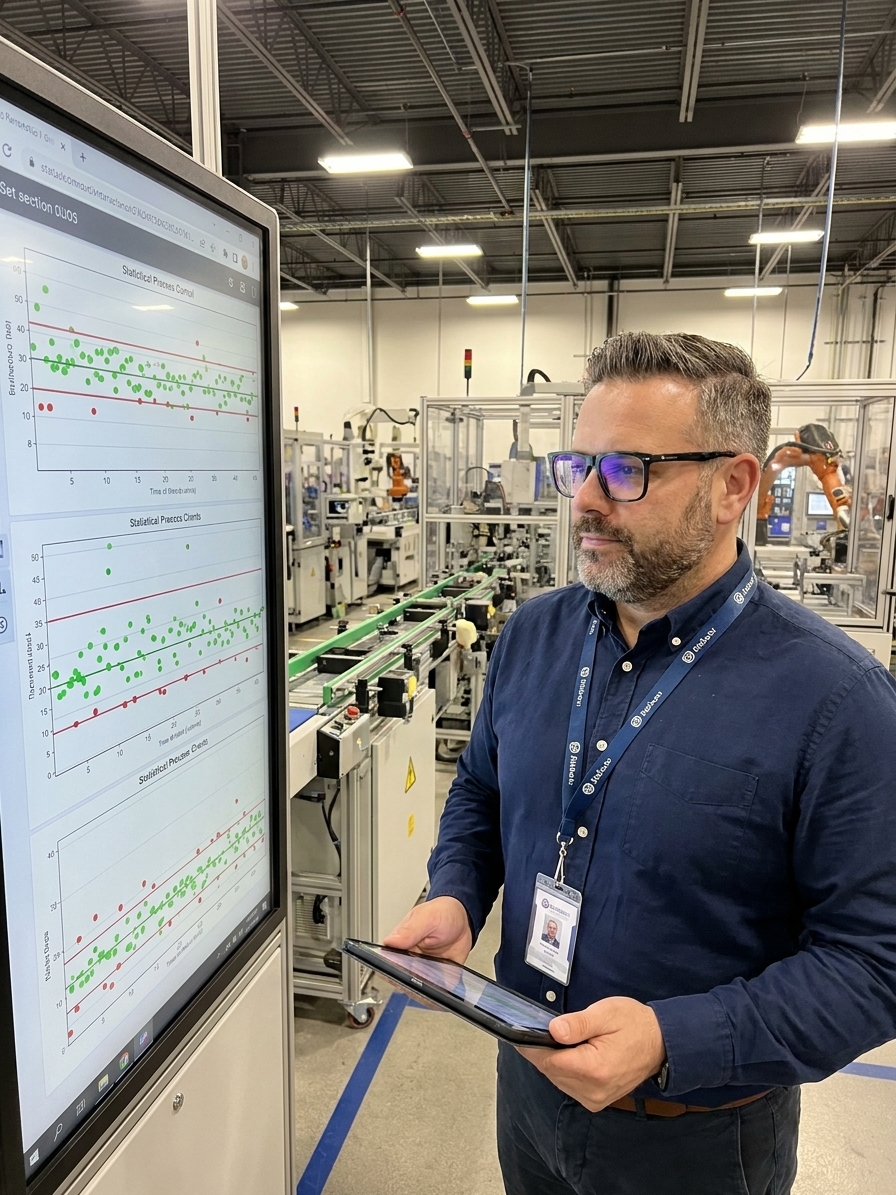
building on the SPC chart.
Fourteen thousand parts later, a customer complaint arrived. By then,
the rework cost had exceeded €280,000. The line had never stopped.
When the investigation team reconstructed the timeline, they found
something unsettling: every single person who could have stopped the
line had a reason not to. The supervisor was covering for a missing team
leader and didn’t want to fall behind schedule. The operator assumed the
next station would catch it. The quality technician filed a report but
didn’t have the authority to halt production. The vision system logged
the defect but wasn’t configured to trigger an automatic stop.
Fourteen thousand defects. Zero line stops. Not because the system
couldn’t detect the problem — because the system wasn’t designed to act
on what it detected.
This is the Jidoka problem. And if you think your organization
doesn’t have it, you’re probably not looking hard enough.
What Jidoka Actually Means
Jidoka is one of the two pillars of the Toyota Production System,
alongside Just-In-Time. It is often translated as “automation with a
human touch” or “autonomation,” but those translations, while
technically accurate, miss the point so completely that they might do
more harm than good.
The concept originated with Sakichi Toyoda, who in 1896 invented a
loom that would automatically stop when a thread broke. Before this
invention, a broken thread meant the loom kept weaving — producing
defective fabric that had to be discarded or reworked. An operator had
to watch multiple looms constantly, scanning for breaks, pulling
defective fabric out, and restarting. The process was exhausting,
unreliable, and expensive.
Toyoda’s invention was elegantly simple: when the thread breaks, the
machine stops. Not “logs an alert.” Not “flags it for later review.”
Stops. Immediately. The defective condition cannot propagate. The
problem becomes visible. And the operator — freed from constant
vigilance — can manage more machines and focus on the root cause rather
than the symptom.
This is the essence of Jidoka: building the intelligence to
detect an abnormality and the authority to stop the process into the
work itself.
At Toyota, this evolved into a comprehensive system with four
principles:
- Detect the abnormality
- Stop the process
- Fix the immediate problem
- Investigate the root cause and implement a
countermeasure
The sequence matters. Detection without stopping is just monitoring.
Stopping without fixing is just disruption. Fixing without investigating
is just firefighting. All four steps, in order, constitute Jidoka.
Why Organizations Resist
Stopping
If Jidoka is so obviously correct — stop the line when something goes
wrong — why don’t more organizations do it?
The answer is not ignorance. Most quality professionals know about
Jidoka. Most have read about Toyota’s andon cords. Most nod approvingly
when the concept is explained in training sessions. The resistance is
not intellectual. It is emotional, cultural, and economic.
The Production Pressure Problem. Every minute a line
stops, it produces zero output. In organizations measured on throughput,
utilization, and OEE, a line stop is a visible failure that appears on
dashboards, triggers meetings, and invites scrutiny. The cost of
stopping is immediate, visible, and quantifiable. The cost of not
stopping — the defects that propagate downstream — is delayed, hidden,
and often absorbed into rework budgets that nobody scrutinizes with the
same intensity.
The Slovakian door panel supplier had a dashboard that tracked line
stops as a key performance indicator. The target was zero. Not “zero
defects” — zero stops. The message to every operator and supervisor was
clear: stopping the line is failure. Passing defects downstream is
invisible.
The Authority Problem. In many organizations, the
authority to stop production is reserved for managers. Operators are
expected to report problems, not act on them. Quality technicians are
expected to document issues, not halt lines. The people closest to the
work — the ones who first detect abnormalities — are precisely the
people with the least authority to do anything about it.
This creates a fatal delay. The operator sees the defect. They call
the team leader. The team leader calls the supervisor. The supervisor
calls the quality engineer. The quality engineer calls the production
manager. By the time someone with authority decides to stop the line,
the defect has propagated through hundreds of units.
Toyota gives every operator the authority to stop the line. Not after
getting permission. Not after filling out a form. By pulling a cord.
Immediately. The andon cord is not a suggestion box — it’s an emergency
brake.
The False Alarm Problem. Organizations that do
implement line stops often abandon them after a wave of false alarms.
New operators pull the cord for conditions that aren’t actually
abnormal. Sensitive detection systems trigger on noise. The line stops
too often, production falls behind, and management concludes that the
system is too disruptive.
This is a maturity problem, not a design problem. At Toyota, new
operators are trained to pull the cord at the slightest uncertainty.
False alarms are expected and welcomed in the early stages. Each false
alarm is a coaching opportunity — a chance to calibrate the operator’s
judgment, refine the abnormality criteria, or improve the detection
system. Over time, the false alarm rate drops while the detection rate
stays high. But this requires patience that most organizations don’t
have.
The Hidden Cost of Not
Stopping
Organizations that don’t practice Jidoka pay for it in ways they
rarely track.
Defect multiplication. When a process starts
producing defects and keeps running, every additional unit compounds the
problem. A defect caught at the source costs one unit to fix. A defect
caught at the next station costs three to five times as much. A defect
caught at final inspection costs ten times. A defect caught by the
customer costs a hundred times or more. The math is relentless and
unforgiving.
The door panel supplier’s €280,000 rework bill would have been
roughly €40 if the line had stopped at the first defect.
Problem obscuration. When defects are allowed to
propagate, the root cause becomes harder to identify. By the time the
defective parts reach downstream processes, they’ve been mixed with good
parts, handled by multiple operators, and processed through additional
operations. The evidence is contaminated. The trail is cold. Root cause
analysis becomes archaeology rather than science.
Cultural erosion. Every time a defect passes through
without consequence, the organization learns a lesson: defects are
tolerable. Not explicitly — nobody posts “defects are fine” on the wall.
But implicitly, the organization learns that detecting a defect doesn’t
require acting on it. Over time, this erodes the sensitivity to
abnormalities altogether. People stop seeing defects because seeing them
leads to nothing.
The normalization of deviance. This is the most
insidious cost. When lines don’t stop for defects, the organization
gradually recalibrates its definition of “normal.” What was once clearly
defective becomes borderline acceptable. What was borderline becomes
standard. The goalposts move not because the specifications changed, but
because the organization’s willingness to enforce them deteriorated.
Building Jidoka Into Your
System
Implementing Jidoka is not about installing andon cords. It’s about
designing a system where stopping is safe, expected, and rewarded.
Here’s how to build it.
Step 1: Define
What Constitutes an Abnormality
You cannot stop for everything, and you cannot stop for nothing. The
first step is defining, clearly and specifically, what conditions
warrant a line stop.
This is not a top-down exercise. The best abnormality definitions
come from the people who do the work. Sit with operators. Watch the
process. Ask: “What tells you something is wrong?” Their answers — the
sound of a press that’s cycling too slowly, the color of a weld that’s
slightly off, the feel of a part that doesn’t seat properly — become
your abnormality catalog.
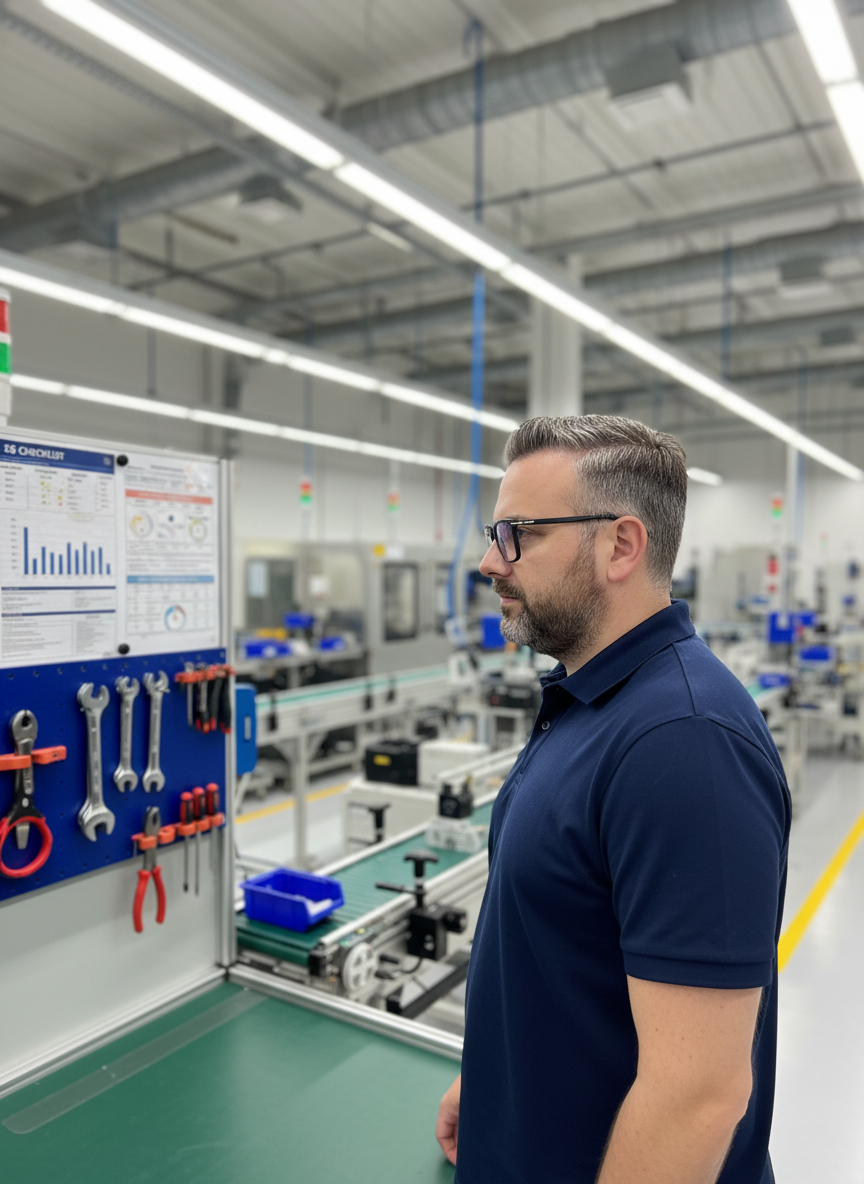
Write these down. Make them visual. Post them at the workstation. The
operator should be able to glance at a reference and know: “This
condition means I stop.”
At one automotive plant I worked with, we created a two-column visual
guide for each station. Left column: “Normal — Keep Running,” with
photos and descriptions of acceptable conditions. Right column:
“Abnormal — Stop and Call,” with photos of the specific defects and
variations that warranted a stop. The guide was laminated, mounted at
eye level, and updated monthly based on new defect patterns.
Step 2: Make Stopping Easy
and Safe
The mechanism for stopping must be immediate, accessible, and
unambiguous. Physical andon cords or buttons at every station. Software
interlocks that automatically halt equipment when sensors detect
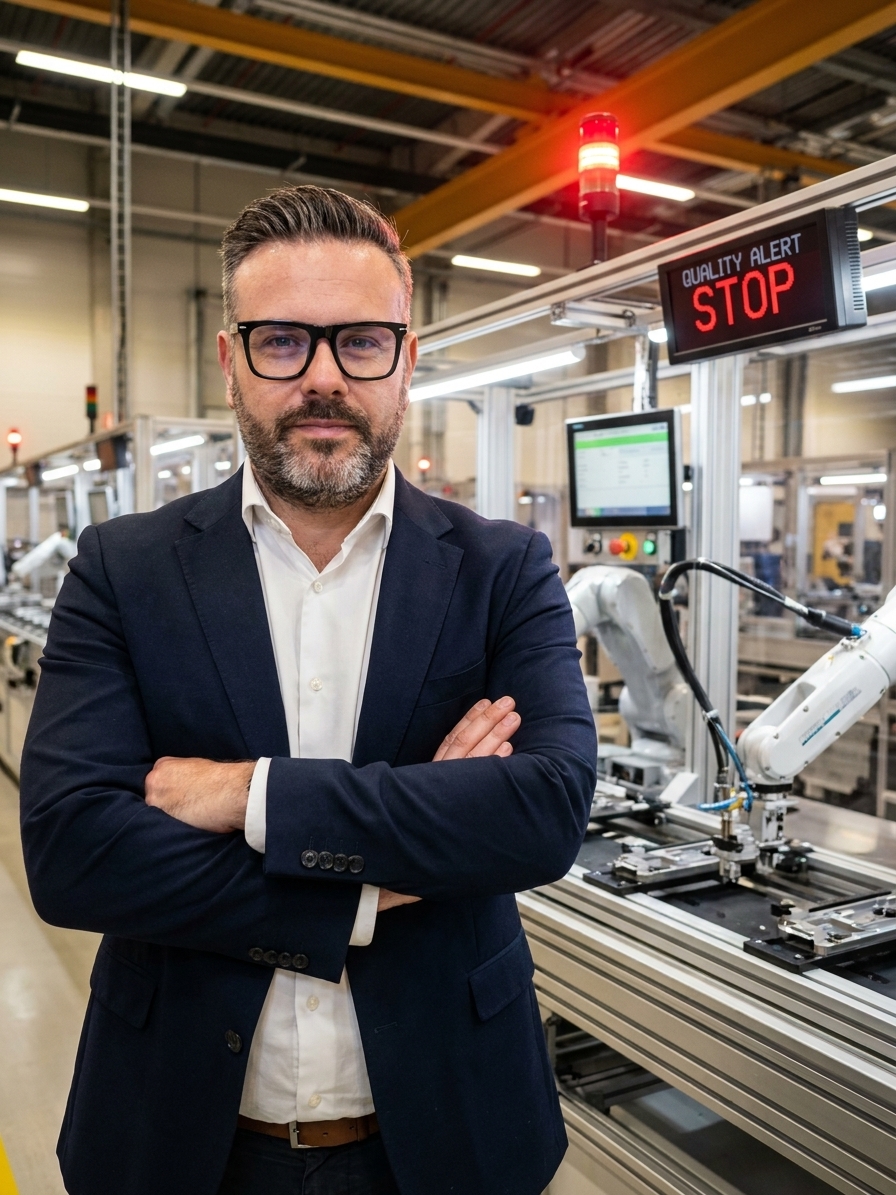
out-of-spec conditions. Clear visual signals — lights, alarms, displays
— that announce the stop to the entire area.
The stopping mechanism must also be culturally safe. If pulling the
andon cord results in public shaming, collective punishment, or even a
disapproving look from a supervisor, the cord will never get pulled. The
organization must celebrate stops, not tolerate them.
Toyota’s famous practice: when an operator pulls the andon cord, the
team leader arrives within seconds. Not to ask “why did you stop the
line?” but to ask “how can I help?” The presumption is that the operator
made the right call. If it turns out to be a false alarm, the response
is coaching, not criticism.
Step 3: Fix Fast,
Investigate Thoroughly
When the line stops, the immediate priority is to fix the problem and
resume production. This is not root cause analysis — this is triage.
Contain the defect. Clear the abnormal condition. Restart the
process.
But the fix is only the beginning. After the line is running again,
the investigation begins. This is where most organizations fail. They
fix the symptom and declare victory. The same defect returns next week
because nobody asked why it happened in the first place.
Build a structured rapid-response process. At the line stop: 5 Whys
at the gemba. Within 24 hours: a more thorough analysis using whatever
tools fit — fishbone diagrams, fault trees, is-is not analysis. Within
one week: a countermeasure implemented and verified.
Step 4: Automate What You Can
Sakichi Toyoda’s insight was that humans are imperfect monitors. We
get tired, distracted, and desensitized. The best Jidoka systems combine
human judgment with automated detection.
Poka-yoke devices that physically prevent defects from proceeding.
Vision systems that compare every part to a golden standard. Sensors
that detect tool wear, temperature drift, or dimensional variation in
real time. These don’t replace human judgment — they supplement it by
catching the abnormalities that human eyes miss and triggering stops
that human hands might hesitate to initiate.
But here’s the critical point: automated detection without automated
stopping is just expensive monitoring. If your vision system flags
defects but doesn’t trigger a line stop, you’ve built a very
sophisticated logging tool, not a Jidoka system. The action must follow
the detection. Automatically.
The Maturity Curve
Jidoka is not an on/off switch. It’s a maturity curve that unfolds
over years.
Level 1: Reactive. Defects are caught at final
inspection or by the customer. The line never stops during production.
Quality is something that happens after the work is done.
Level 2: Detecting. Defects are caught at the
station where they occur, but the line doesn’t stop. Operators flag
problems, quality technicians document them, but production continues.
Detection without action.
Level 3: Stopping. The line stops when abnormalities
are detected. But stops are treated as failures. Operators are reluctant
to stop. Supervisors are frustrated by stops. The system works, but it
works against the culture.
Level 4: Learning. The line stops routinely, and
each stop is treated as a learning opportunity. Root causes are
investigated. Countermeasures are implemented. The false alarm rate
decreases. The detection accuracy increases.
Level 5: Preventing. The detection and response
system is so refined that most abnormalities are caught and corrected
before they produce a single defective unit. Line stops are rare because
the process itself has been redesigned to prevent the conditions that
cause defects.
Most organizations are at Level 2. They detect well. They act poorly.
They have the sensors, the SPC charts, the inspection protocols. What
they lack is the mechanism and the culture to translate detection into
immediate action.
The Paradox of Productivity
Here is the paradox that prevents most organizations from embracing
Jidoka: stopping the line to fix defects actually increases throughput
over time.
This seems counterintuitive. How can stopping production lead to more
production? The answer is that the time saved by not producing,
reworking, sorting, and scrapping defective parts more than compensates
for the time spent stopping and fixing the process.
Toyota’s lines stop far more frequently than their competitors’. And
Toyota’s productivity, quality, and cost metrics consistently outperform
those same competitors. The line stops are not a cost — they are an
investment in a process that runs right the first time.
The door panel supplier in Slovakia ran for 14,000 parts without a
stop. Their effective throughput that day — after deducting rework,
sorting, scrap, customer complaint handling, root cause investigation,
corrective action implementation, and the second shift needed to make up
the lost production — was lower than if they had stopped at the first
defect and spent an hour fixing the root cause.
Jidoka is not the enemy of productivity. It is the precondition for
sustainable productivity.
Getting Started Monday
Morning
If you want to begin implementing Jidoka, start here:
-
Walk the floor and ask operators: “What defects
do you see that you can’t stop the line for?” Their answers will tell
you exactly where your Jidoka gaps are. -
Pick one station. Don’t try to implement Jidoka
across the entire factory at once. Choose one workstation with a known
defect problem. Define the abnormality criteria. Install a stopping
mechanism. Train the operator. And then — this is the hard part — defend
their right to pull it. -
Track stops, not just defects. Add “line stops
for quality” to your daily management board. Celebrate them. Discuss
what was learned. Show the organization that stopping is not failure —
it’s the fastest path to a process that doesn’t need to stop. -
Measure the cascade. Track the cost of defects
that propagate through your process versus the cost of line stops. The
numbers will make your case for you. -
Build the investigation habit. Every stop must
lead to a root cause investigation. If stops don’t lead to learning,
they’re just disruptions. The investigation is what transforms a stop
from an expense into an investment.
The most powerful quality system in the world is not the one that
catches every defect. It’s the one that makes it impossible for a defect
to survive past the station where it was born. That’s Jidoka. And it
starts with a simple, radical act: having the courage to stop.
Peter Stasko is a Quality Architect with 25+ years
of experience transforming organizations across automotive, aerospace,
and pharmaceutical industries. He has implemented Jidoka systems on
production lines across Europe and North America, and has seen firsthand
the difference between organizations that detect defects and
organizations that refuse to let them propagate. His work focuses on
building quality systems where stopping is celebrated, problems are
visible, and the courage to halt production is recognized as the highest
form of quality professionalism.