Quality
Obeya: When Your War Room Becomes the Brain of Your Quality System — and
Every Wall Starts Thinking With You
The Room That Changed
Everything
It was a Monday morning in March, and the plant manager at a German
automotive supplier in Stuttgart was staring at yet another customer
complaint. Third one that month. The usual cycle was about to begin:
emails would fly, meetings would multiply, reports would proliferate,
and three weeks later, someone would produce a root cause analysis that
the customer had already stopped caring about.
But this time, something was different.
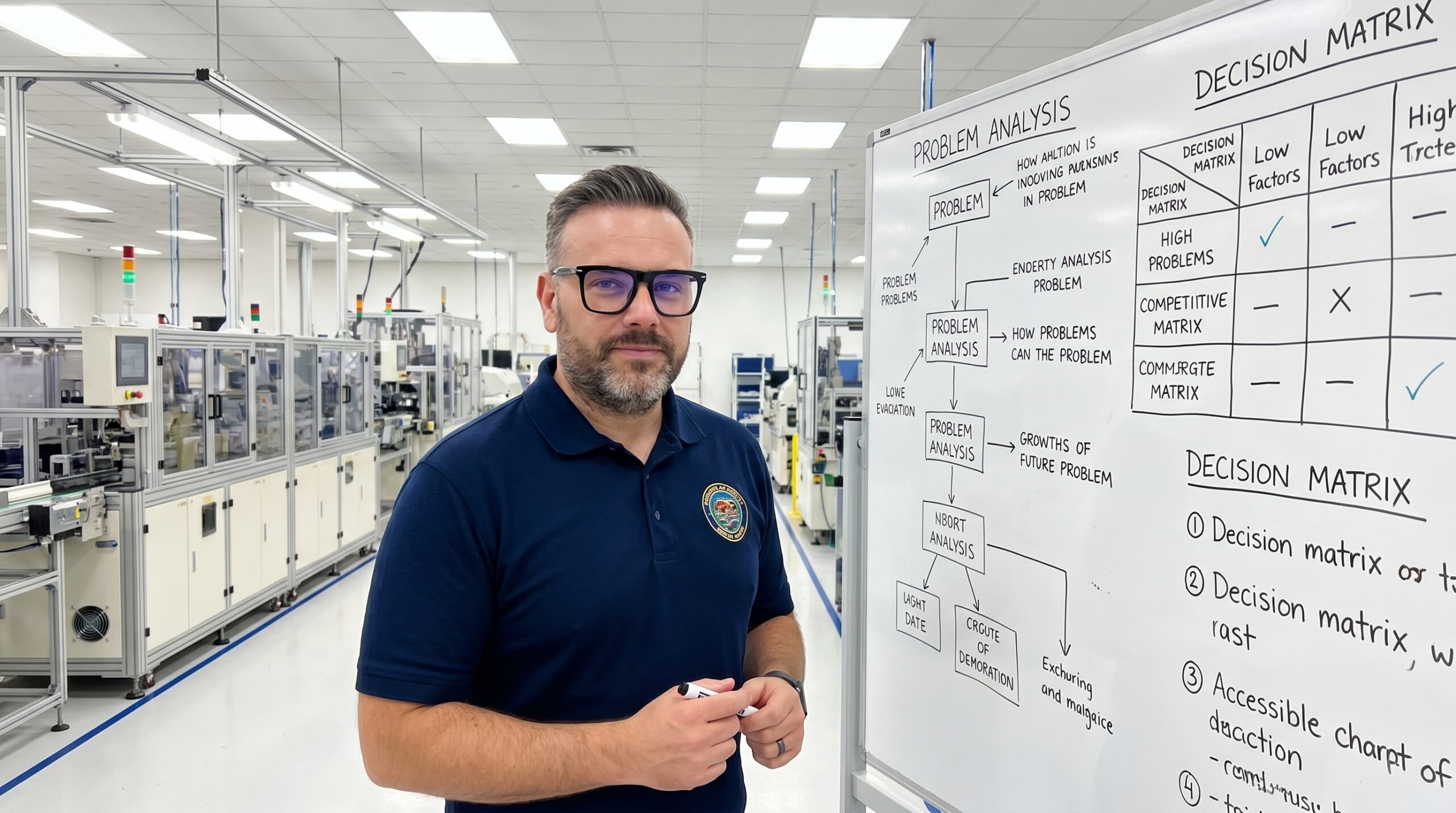
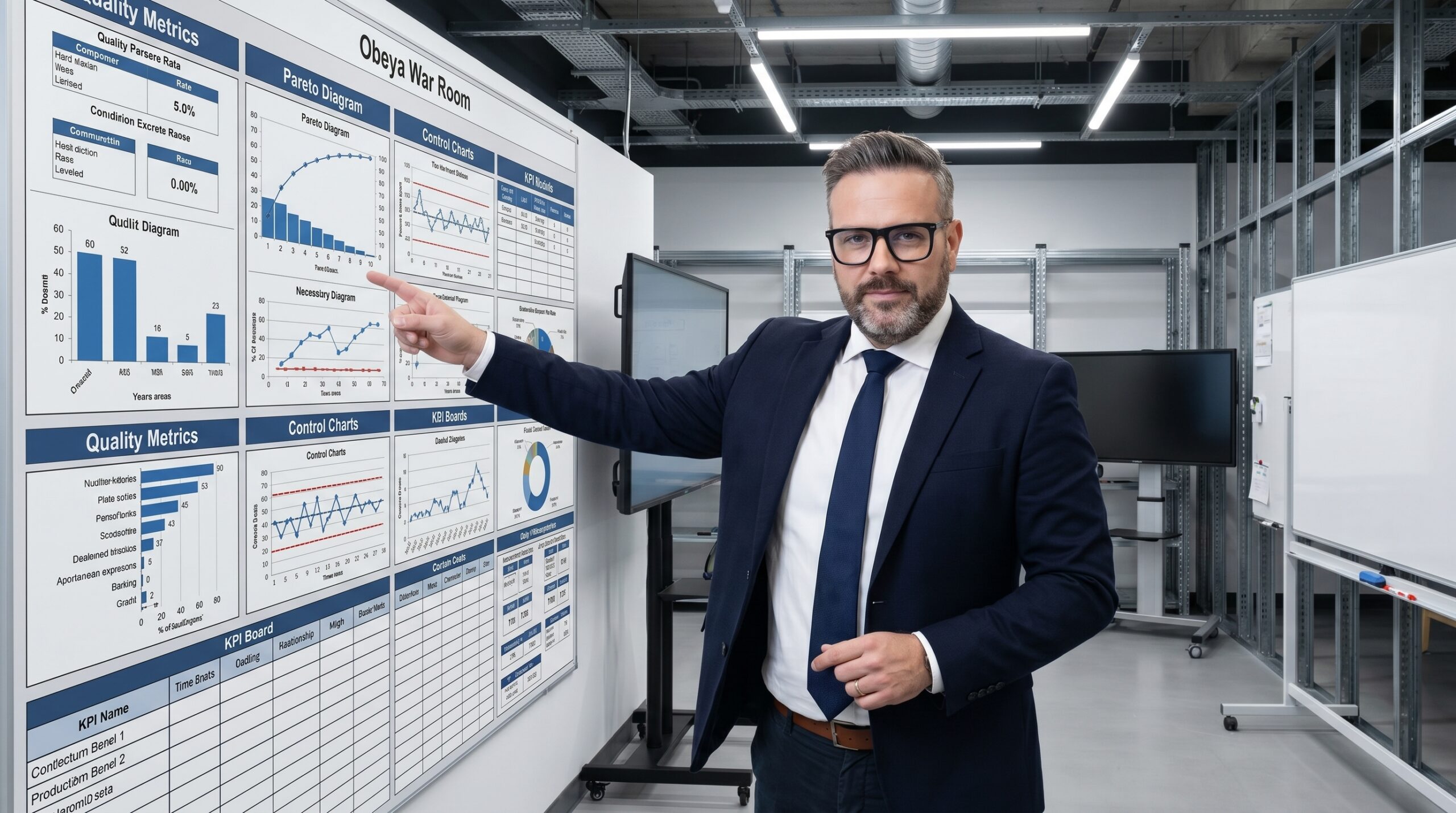
The quality director had spent the weekend transforming an unused
conference room near the production floor. She covered the walls with
control charts, Pareto diagrams, a live scrap tracker, a
voice-of-customer board, and a giant red “Days Since Last Customer
Complaint” counter that read zero. She placed a table in the center with
nothing but a whiteboard, markers, and a clock. Then she sent a two-line
email to the leadership team: “Quality Obeya. Room B-12. 09:00.
Every day this week. Bring your data, not your excuses.”
By Friday, the team had identified the root cause of all three
complaints — a single stamping die that was drifting due to an
undocumented tool change procedure. They implemented a countermeasure
that afternoon. The customer received a response with verified
corrective action before the week ended.
That room — sparse, focused, alive — was a Quality Obeya. And it had
just compressed three weeks of organizational chaos into five days of
disciplined clarity.
What Is a Quality Obeya?
The word Obeya is Japanese for “big room.” It originated at
Toyota in the 1990s during the development of the Prius, where Chief
Engineer Takeshi Uchiyamada created a dedicated physical space where
cross-functional team members could gather, surround themselves with
visual information, and make decisions at the speed of conversation
rather than the speed of email.
A Quality Obeya adapts this concept specifically for
quality management. It is a dedicated physical space — not a virtual
dashboard, not a SharePoint site, not a slide deck — where a
cross-functional team visualizes quality performance, tracks critical
issues, conducts rapid problem-solving, and makes decisions in real
time.
It is not a meeting room. It is not a museum of posters. It is a
working environment where information lives on the
walls and decisions happen standing up.
Why Your Current
Approach Is Failing You
Most organizations manage quality through what I call the “iteration
tax.” Here is how it works:
- A problem is discovered (customer complaint, internal reject, audit
finding). - Someone writes an email describing the problem — incompletely.
- Three people reply with different interpretations of the
problem. - A meeting is scheduled for next Tuesday.
- At the meeting, half the attendees don’t have the data they
need. - Another meeting is scheduled for Thursday.
- Someone produces a preliminary root cause analysis that conflicts
with another team’s data. - A third meeting is called to resolve the discrepancy.
- Two weeks have passed. The customer is furious. The root cause is
still a hypothesis.
The Quality Obeya eliminates this tax by creating an environment
where information is always visible, the right people are always
present, and decisions are made in the moment.
The Anatomy of a Quality
Obeya
A well-designed Quality Obeya has several distinct zones, each
serving a specific purpose. Think of it as a quality system that you can
walk inside.
Zone 1: The Performance Wall
This is where your key quality metrics live — displayed visually,
updated daily, and impossible to ignore.
- Top scrap/reject Pareto for the current month,
updated in real time - Customer complaint tracker with status, owner, and
days open - SPC overview — not every chart, but the critical
few from your control plan - Delivery and PPM performance trending over 12
months - Open corrective actions with red/yellow/green
status
The rule is simple: if it matters to quality, it must be on this
wall. And if it is on this wall, it must be current. Stale data is worse
than no data — it breeds distrust.
Zone 2: The Problem-Solving
Wall
This is where active problem-solving lives. Every open quality issue
gets a dedicated space:
- A3 or 8D report in its current state — not hidden
in a file server - Ishikawa diagram evolving as the team learns
- 5 Why analysis visible for challenge and
refinement - Data and evidence pinned next to the analysis
- Action tracker with names, dates, and completion
status
When someone walks into the Obeya, they should be able to understand
every active problem in under five minutes by reading the walls.
Zone 3: The Customer Voice
Wall
This wall is the most underutilized and the most powerful:
- Customer complaints printed in full — not
summarized, not sanitized - Warranty data and field failure trends
- Customer audit findings and scorecards
- Direct quotes from customer communications — the
actual words, not interpretations - Competitor benchmarking where available
This wall exists to prevent the organizational tendency to distance
itself from the customer’s pain. When the complaint is printed in the
customer’s own words and pinned to the wall, it creates an emotional and
intellectual urgency that a PPM number never will.
Zone 4: The Process Wall
This wall connects quality outcomes to process reality:
- Flow diagram of the critical process with current
status indicators - FMEA summary highlighting the highest RPN
items - Control plan highlights — key characteristics,
reaction plans, sampling frequencies - Recent change log — what changed in the process and
when
This wall answers the question: “What is happening in our process
right now, and how is it connected to what our customer is
experiencing?”
Zone 5: The Action
and Accountability Wall
This is where decisions become commitments:
- Action register — who is doing what by when
- Decision log — what was decided, when, and why
- Escalation board — issues that need management
intervention - Lessons learned — completed problems with their
verified solutions
The critical discipline here is that every action has a single owner
and a specific date. “The team will investigate” is not an action.
“Maria will collect 50 consecutive pieces from Station 3 and measure
diameter by Thursday at 14:00” is an action.
The Operating Rhythm
A Quality Obeya without a rhythm is just a decorated room. The magic
happens when you establish a disciplined cadence of interaction.
Daily Stand-Up (10-15
minutes)
Every morning at the same time, the core quality team gathers in the
Obeya:
- What happened in the last 24 hours?
- Are we on track with open actions?
- Are there new issues that need to be added?
- Does anyone need help or escalation?
This is not a status meeting. It is a synchronization
event. Everyone leaves knowing what happened, what is
happening, and what needs to happen next.
Weekly Deep Dive (60 minutes)
Once a week, the team conducts a deeper review:
- Progress on active problem-solving
- Trend analysis — are we getting better or worse?
- Review of completed actions — did they work?
- Resource allocation — do we need additional support?
Issue-Driven Sessions (As
Needed)
When a critical issue emerges, the Obeya becomes the command center.
The team gathers, the problem gets a space on the Problem-Solving Wall,
and the team works through the methodology in real time. No scheduling
delays. No waiting for data that should already be on the wall.
The Rules That Make It Work
After implementing Quality Obeya rooms in more than a dozen plants, I
have learned that success depends on a handful of non-negotiable
rules.
Rule 1: The room is alive. If the data on the walls
is more than 24 hours old, the Obeya is dead. Stale visual management is
visual decoration — and everyone sees through it.
Rule 2: No chairs. Stand-up meetings are shorter,
more focused, and more energetic. If you need to sit for a deep
problem-solving session, use a stool. Comfort is the enemy of
urgency.
Rule 3: One source of truth. The Obeya walls are the
official record. If something is not on the wall, it does not exist.
This eliminates the “I sent you an email” problem and the “there are
three different versions of the truth” problem.
Rule 4: Cross-functional by design. The Obeya is not
the quality department’s room. It belongs to the entire value stream.
Production, maintenance, engineering, logistics — anyone who affects
quality must have a presence and a voice.
Rule 5: Decisions are made here. The Obeya is not a
reporting station for decisions made elsewhere. If you need approval
from someone not in the room, get them in the room. The goal is to
reduce the distance between data and decision to zero.
Rule 6: Respect the space. The Obeya is not a
storage room, a break room, or a generic meeting room. It has one
purpose: quality performance and problem-solving. Protect it.
Digital Obeya:
Evolution Without Dilution
A common question is whether a Quality Obeya can be virtual. The
honest answer is: partially, but with significant compromise.
Digital dashboards can display data. Video calls can connect people.
Collaboration tools can share documents. But what they cannot replicate
is the ambient awareness — the way someone walking past
the Obeya notices a trend on the Pareto chart, the spontaneous
conversation that starts when two people look at the same Ishikawa
diagram from different angles, the visceral impact of seeing “Days Since
Last Complaint: 0” in three-inch letters.
My recommendation is a hybrid model: physical Obeya for the core team
on-site, supplemented by a digital counterpart for remote team members
and multi-site coordination. But the physical space must remain the
heart of the system.
For organizations with multiple plants, a Virtual Obeya
Network can be powerful — each site maintains its own physical
Obeya, and weekly cross-site reviews are conducted via video from the
Obeya rooms, with cameras pointed at the walls so that everyone can see
each other’s data in context.
Common Mistakes
I have seen more failed Obeya implementations than successful ones.
Here are the patterns that kill it:
The Museum Effect. The team spends weeks designing
beautiful displays, then stops updating them. Within a month, the Obeya
becomes a showroom that visitors are shown but nobody uses.
The Exclusion Error. The Obeya becomes a
quality-only space. Production supervisors stop coming. Engineers don’t
bother. Maintenance never shows up. The quality team ends up talking to
itself.
The Complexity Trap. Every metric, every chart,
every process map gets put on the walls. The room becomes overwhelming
and people stop seeing anything because they are trying to see
everything.
The Hierarchy Problem. Managers treat the Obeya as a
reporting tool — standing at the front, asking questions, receiving
answers. The Obeya should feel like a war room, not a courtroom.
The Inconsistency Disease. The stand-ups happen for
two weeks, then get rescheduled, then become biweekly, then monthly,
then “when needed.” The rhythm dies, and the room dies with it.
Measuring the Impact
How do you know if your Quality Obeya is working? Here are the
metrics that matter:
- Time to root cause — measured from problem
detection to verified root cause - Time to corrective action — from root cause to
implemented and verified solution - Number of active open issues — trending down over
time - Repeat problem rate — are you solving problems
permanently or treating symptoms? - Customer complaint response time — from complaint
to verified response - Team engagement — attendance and participation in
Obeya activities
In my experience, a well-run Quality Obeya typically reduces
time-to-root-cause by 40-60% and time-to-corrective-action by 30-50%.
These are not theoretical numbers — they come from plants that committed
to the discipline and sustained it.
Getting Started: The
48-Hour Challenge
If you want to test the concept, do this:
Day 1: Find a room near the production floor. Clear
the walls. Print your top 5 quality issues, your current scrap Pareto,
and your last 3 customer complaints. Pin them to the walls. Invite the
cross-functional team for a 15-minute stand-up at the same time
tomorrow.
Day 2: Conduct the stand-up. Ask three questions:
What do we know? What don’t we know? Who is going to find out what we
don’t know — and by when? Write the answers on the wall.
Day 3-5: Repeat the stand-up every day. Update the
walls. Make decisions in the room. Track actions on the wall.
After one week, ask yourself: Did we learn more, decide faster, and
act more decisively than we would have with our normal approach?
The answer will tell you whether your organization is ready for a
Quality Obeya.
The Deeper Truth
Here is what I have come to believe after 25 years in quality: most
organizations do not have a knowledge problem. They have a
visibility problem. The data exists. The expertise
exists. The solutions exist. What does not exist is an environment where
all three converge simultaneously.
The Quality Obeya creates that environment. It makes quality visible,
urgent, and collective. It transforms quality from a department’s
responsibility into a shared mission that lives on the walls and in the
daily rhythm of the team.
When you walk into a well-run Quality Obeya, you can feel the pulse
of the quality system. The walls tell you what happened yesterday, what
is happening today, and what is being done about tomorrow. The people in
the room are not reporting — they are thinking, deciding, and
acting.
That is what a quality system is supposed to feel like.
Not a pile of procedures in a binder. Not a dashboard that nobody
looks at. Not a meeting that could have been an email.
A living, breathing space where quality is everyone’s business —
every single day.
Peter Stasko is a Quality Architect with over 25
years of experience in automotive and manufacturing quality management.
He specializes in building quality systems that work in practice — not
just on paper. His approach combines deep technical knowledge with
practical leadership, focusing on continuous improvement, statistical
methods, and building quality cultures that deliver measurable
results.