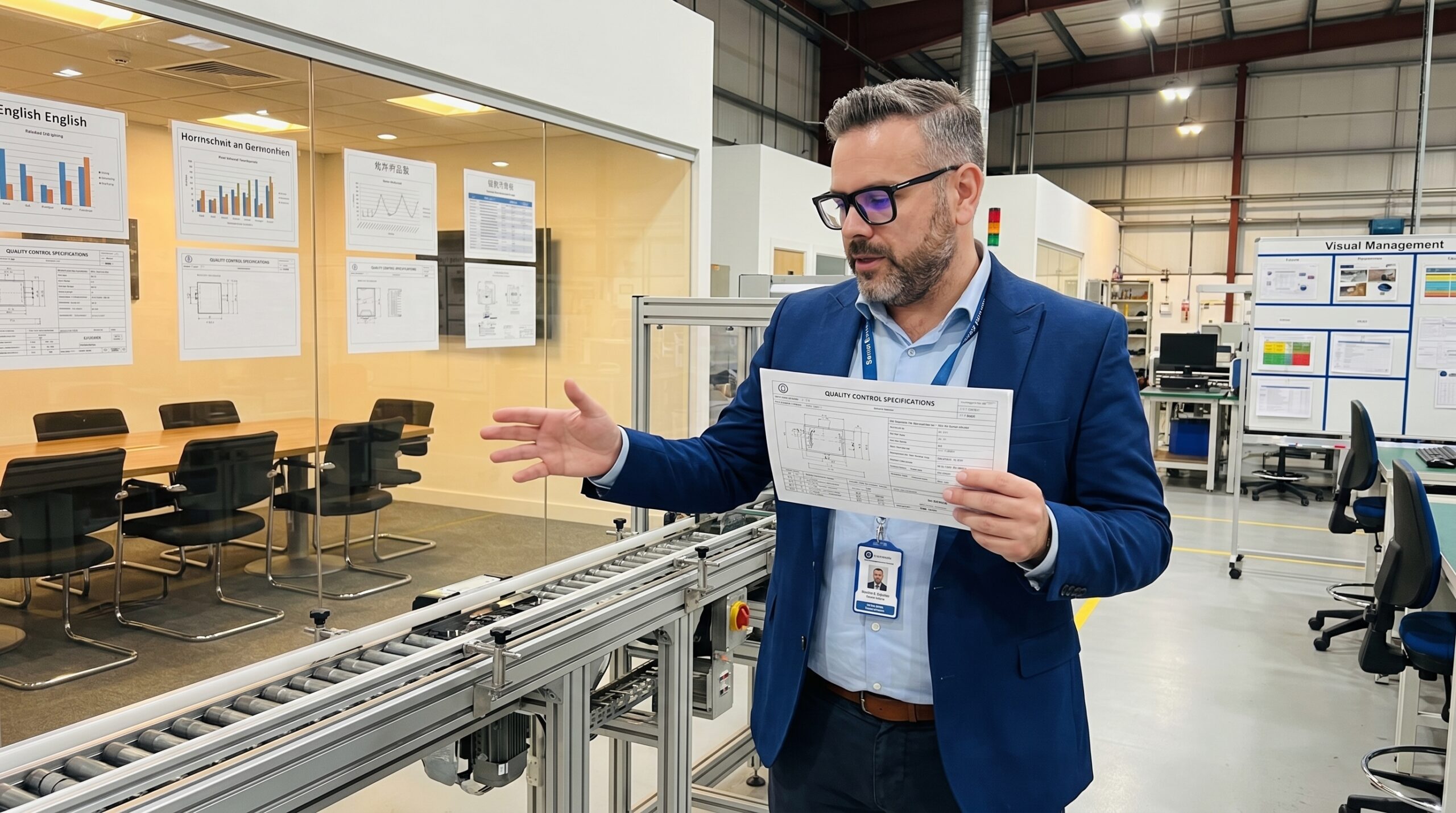
A customer tells your sales team what they need. The sales team tells your engineering department. Engineering writes a specification. The specification goes to purchasing, who interprets it for a supplier. The supplier builds a component. The component arrives at your factory, where a process engineer designs the production line. An operator runs the line. A quality inspector checks the part. The part ships to the customer.
And the customer rejects it. Not because anyone was incompetent. Not because anyone cut corners. Not because your IATF 16949 system failed in any measurable way. The rejection happens because somewhere in that chain, the meaning got lost. The requirement was translated six times, and each translation introduced a small, invisible drift. By the time it reached the operator's hands, the original intent was unrecognizable.
This is Quality Translation, and it is the single most underestimated source of defects in modern manufacturing. Not machine capability. Not operator error. Not supplier quality. The simple, devastating fact that organizations are terrible at moving meaning from one person to the next without corrupting it. I have audited plants where every box on the control plan was checked perfectly, yet the part still failed in the customer's assembly.
The Telephone Game in Manufacturing
A customer says they need the surface finish to feel smooth to the touch. The sales engineer writes down "smooth surface." The design engineer interprets that as Ra 1.6. The manufacturing engineer targets Ra 1.2 for safety margin. The CNC programmer sets the tool path for Ra 0.8 because that is what the machine naturally produces with that tool insert and material grade. The quality inspector measures Ra 0.8 and approves. The customer receives the part and says it does not feel right.
Everyone did their job. Everyone was rigorous. And the result is wrong. The problem is not incompetence. It is translation loss: the inevitable degradation of meaning that occurs every time information passes from one person, one function, or one discipline to another. In linguistics, this phenomenon is well understood. In manufacturing quality management, it is barely acknowledged.
Standard quality tools like PFMEA and control plans attempt to freeze requirements in place. They document what was agreed at a specific gate review. They do not verify that the downstream receiver actually understands the functional intent behind the requirement. A drawing callout for a specific hardness range is precise. It is also a proxy for microstructure, fatigue life, and impact resistance. If the heat treatment engineer optimizes only for the hardness number, the underlying engineering intent is lost.

Mapping the Seven Translation Zones
In my twenty years of quality management across automotive and aerospace, I have identified seven critical translation zones where meaning gets corrupted. Each one is a potential defect generator, and most standard quality systems do not even know they exist. They are not captured in an 8D root cause analysis because the defect they create looks like a normal process failure.
The first zone is customer voice to sales interpretation. The customer describes a need using their frame of reference. Your sales team hears it through their own filter of commercial priorities. A heavy equipment customer once told us they needed a bracket that could "take a beating." Sales wrote "high durability requirement." Engineering designed for high-cycle fatigue life. What the customer actually meant was impact resistance: the bracket needed to survive being struck by a wrench during field maintenance. The fatigue-optimized bracket cracked on the first day.
The second zone is sales interpretation to engineering specification. Informal, contextual descriptions must become formal, decontextualized specifications. A customer says the part needs to slide easily into the assembly. Engineering writes a dimensional tolerance on the mating surface. But the real concern was assembly ergonomics, requiring a low coefficient of friction with the mating material. The tolerance is correct, but the surface treatment is never specified.
The third and fourth zones happen inside your walls. Engineering specifications become manufacturing processes, and those processes become operator instructions. An engineer writes a work instruction stating: "monitor temperature and adjust if trend exceeds 2 degrees in 15 minutes." The operator reads this as "keep temperature steady." The first requires proactive trend analysis. The second requires maintaining an average value. The operator follows their interpretation faithfully, and the process drifts.
The Illusion of Objective Documentation
You might think that with comprehensive APQP, cross-functional reviews, and statistical process control, these translation losses would be caught and prevented. They should be. But they are not, for three structural reasons that are baked into how manufacturing organizations operate.
First, each function speaks a different language. Sales speaks in customer value. Engineering speaks in tolerances. Manufacturing speaks in cycle times. Quality speaks in variation. These languages overlap, but they are not the same. When an engineer says "robust," they mean capable across input variation. When a salesperson says "robust," they mean durable in the field. When the customer says "robust," they mean they have never had a problem with it. Same word, three different translations.
Second, organizational silos create translation gaps. Information does not flow continuously. It jumps across boundaries. Every handoff between departments is a translation event, and handoffs are where meaning goes to die. The salesperson who heard the customer's voice is not the person who designs the inspection plan. Each boundary is a filter that strips context and adds interpretation.
Third, we mistake documentation for understanding. Organizations are excellent at documenting requirements. We have specification sheets, drawing callouts, and quality agreements. We are terrible at verifying that the person reading the document understands the same thing the person writing it intended. A specification that says "surface finish Ra 1.6 max" is clear. But if the operator does not know why that surface finish matters, the document is just numbers on paper.
Building a Framework to Stop Translation Loss
After years of watching defects born from translation failures, I developed a practical framework to address them. It does not require new software or certification. It requires discipline and a willingness to slow down at the handoff points. The goal is to make translation loss visible before it becomes a physical defect.
The Reverse Translation Check Method
- 01Define the RequirementThe sender (e.g., design engineer) issues the specification, including the functional context and failure mode it prevents.
- 02Receiver InterpretationThe receiver (e.g., manufacturing engineer) reads the specification and prepares to execute the process planning.
- 03Reverse ExplanationThe receiver explains the requirement back to the sender in their own words, detailing how they will achieve it.
- 04Gap IdentificationThe sender identifies any drift between their original intent and the receiver's planned execution.
- 05Alignment and LockBoth parties agree on the exact meaning, locking the functional intent before production begins.
The most powerful technique in this framework is the reverse translation check. After a requirement passes through a translation zone, the receiver explains it back to the sender in their own words. Not by reading the document back, but by describing what they understood. If the engineer specifies a heat treatment for microstructure control, the manufacturing engineer should explain that they need to select a furnace cycle that controls both hardness and grain size.
This feels slow. It feels like overhead. It is neither. A ten-minute reverse translation check can prevent a ten-week corrective action loop. When I introduced Routing Verification KPIs at a major aerospace manufacturer, forcing these checks at critical handoffs cut internal lead time by 97 percent. We found that verifying understanding eliminated the hidden rework loops caused by acting on incomplete information.
The most dangerous defect is not the one that escapes inspection. It is the one built in before production starts.
Closing the Context Gap with Operators
Every critical specification should carry its context. Not just what the requirement is, but why it exists. What function does it serve? What failure mode does it prevent? What does the customer experience if it is wrong? This context is the ultimate translation safeguard for the production floor.
Specification vs. Context-Enriched Instruction
Standard Document
- Torque bolt to 47 Nm.
- Record value on control chart.
- Heat treatment cycle: 840C for 2 hours.
- Surface finish: Ra 1.6 max.
Context-Enriched Document
- Torque to 47 Nm to prevent oil leaks that destroy engines.
- Maintain 840C for specific grain structure ensuring impact resistance.
- Achieve Ra 1.6 to guarantee proper sealing with the mating flange.
When an operator understands that the torque specification exists because undertightening causes oil leaks, they translate that requirement differently into their daily work. They do not just hit the number on the torque wrench and move on. They understand what the number means. When deviations occur, they react with the correct urgency.
Many organizations resist this. They argue that specifications should be self-contained and objective. That is engineering thinking, not quality thinking. Quality is about ensuring the right outcome. The right outcome requires understanding intent. When I built the greenfield QA department at SNOP for a 900-employee plant, embedding the functional 'why' into the standard work instructions was the single most effective lever for reducing operator-attributed defects.
The Real Cost of Misunderstanding
The costs of translation failure are enormous, but they are almost never attributed to their true cause. They show up as warranty claims for failures that occurred because the specification captured the measurement but not the meaning. They show up as customer complaints about parts that pass every inspection but do not work in the assembly.
They show up as engineering changes that are really just corrections of translation errors, disguised as design improvements. They show up as supplier disputes where both sides are technically correct and functionally wrong. They show up as audit findings that identify nonconformances born not from negligence, but from pure misunderstanding.
I estimate that in a typical manufacturing organization, fifteen to twenty-five percent of all quality costs are attributable to translation failures. Not material defects, not process failures, not operator errors. Pure, preventable losses from the silent gap between what was meant and what was understood. In a global supply chain, a German engineering requirement interpreted by a US design team and executed in a Mexican plant offers endless opportunities for this kind of loss.
Quality Translation must be treated as a critical discipline that sits alongside MSA, SPC, and audit management. It requires verifying that specifications are understood, not just met. The most dangerous defect in your system is the one built into the product before production ever starts, born in the space between what someone said and what someone else heard.