The Setup Nobody Questioned
You implemented SMED. You read the books. You watched the videos. You
brought the consultants in. They walked your floor, stopwatch in hand,
shadowing operators during a die change. They produced a report with
cycle-time bars and a colorful “before and after” slide showing a
47-minute changeover reduced to 22 minutes. Leadership applauded. The
report was framed. And then, six months later, the changeover crept back
to 55 minutes. Nobody noticed. Nobody timed it. Nobody cared — because
the SMED project was “done.”
This is the story of SMED in most manufacturing plants. Not the
success story told at conferences. The real story. The one where a
powerful methodology for reducing changeover time becomes a one-time
optimization event that nobody sustains, where internal time balloons
back to its original size because nobody maintains the standardized
setup procedures, and where the flexibility you were supposed to gain —
the ability to run small batches, switch products quickly, respond to
customer demand — becomes the exact opposite: massive inventory built in
long runs because nobody wants to face the changeover.
Shigeo Shingo developed SMED in the 1950s and 1960s, revolutionizing
Toyota’s press shops by separating setup time into “internal” (done
while the machine is stopped) and “external” (done while the machine is
still running), then relentlessly converting internal time to external
time. The goal wasn’t a number. The goal was flow — the ability to
produce what the customer wanted, when they wanted it, without the
penalty of long changeovers forcing you into massive batch sizes. But
somewhere between Toyota’s press shop and your plant’s implementation,
the methodology lost its soul.
What
SMED Actually Is (Before We Talk About What Goes Wrong)
SMED — Single-Minute Exchange of Die — is a systematic approach to
reducing the time required to change a manufacturing process from
producing one product to producing another. The name “single-minute”
refers to the target: a changeover that takes less than ten minutes
(single-digit minutes), not literally one minute.
The methodology has four stages:
Stage 1: Separate internal and external setup.
Internal setup operations can only be performed while the machine is
stopped (removing dies, adjusting fixtures, bolting clamps). External
setup operations can be performed while the machine is still running the
previous product (preparing tools, pre-heating dies, fetching materials,
pre-staging fixtures). Most plants are terrible at this distinction.
Operators stop the machine, then go find the tools. They shut down the
line, then walk to the warehouse for the new die. That’s internal time
being wasted on what should be external preparation.
Stage 2: Convert internal setup to external setup.
This is where the real gains live. Can you pre-heat the die while the
current product is still running? Can you pre-position tools on a cart?
Can you pre-set gauges? Every second of internal time converted to
external time is a second of production capacity recovered.
Stage 3: Streamline remaining internal setup. For
what must be done while the machine is stopped, make it faster.
Eliminate bolts in favor of quick clamps. Standardize heights so no
adjustment is needed. Use locating pins instead of manual alignment.
Eliminate adjustments entirely — if you’re adjusting, your design is
wrong.
Stage 4: Eliminate adjustments entirely. This is the
stage most plants never reach. Adjustments are the enemy of quick
changeover. Every turn of a wrench, every tweak of a setting, every “let
me get that a little closer” is variation that eats time and quality.
The goal is definitive setup: the die drops in, the pins locate, the
clamps lock, you run. No adjustments. No iteration. No craftsmanship
required.
How SMED Dies in Practice
The One-Time Event Trap
Most SMED implementations are structured as events — a kaizen week, a
consulting engagement, a special project. A team is assembled. A
changeover is video-recorded and analyzed. Improvements are implemented.
The time drops. A celebration ensues.
Then the team disbands. The video camera goes back to the cabinet.
The stopwatch goes in a drawer. And slowly, imperceptibly, the
changeover time begins to creep back.
Why? Because the improvements were never standardized. The
quick-clamp bolts someone installed? When one broke, maintenance
replaced it with a standard bolt — “just to get it running.” The
pre-staging cart that held the next die? It got repurposed for something
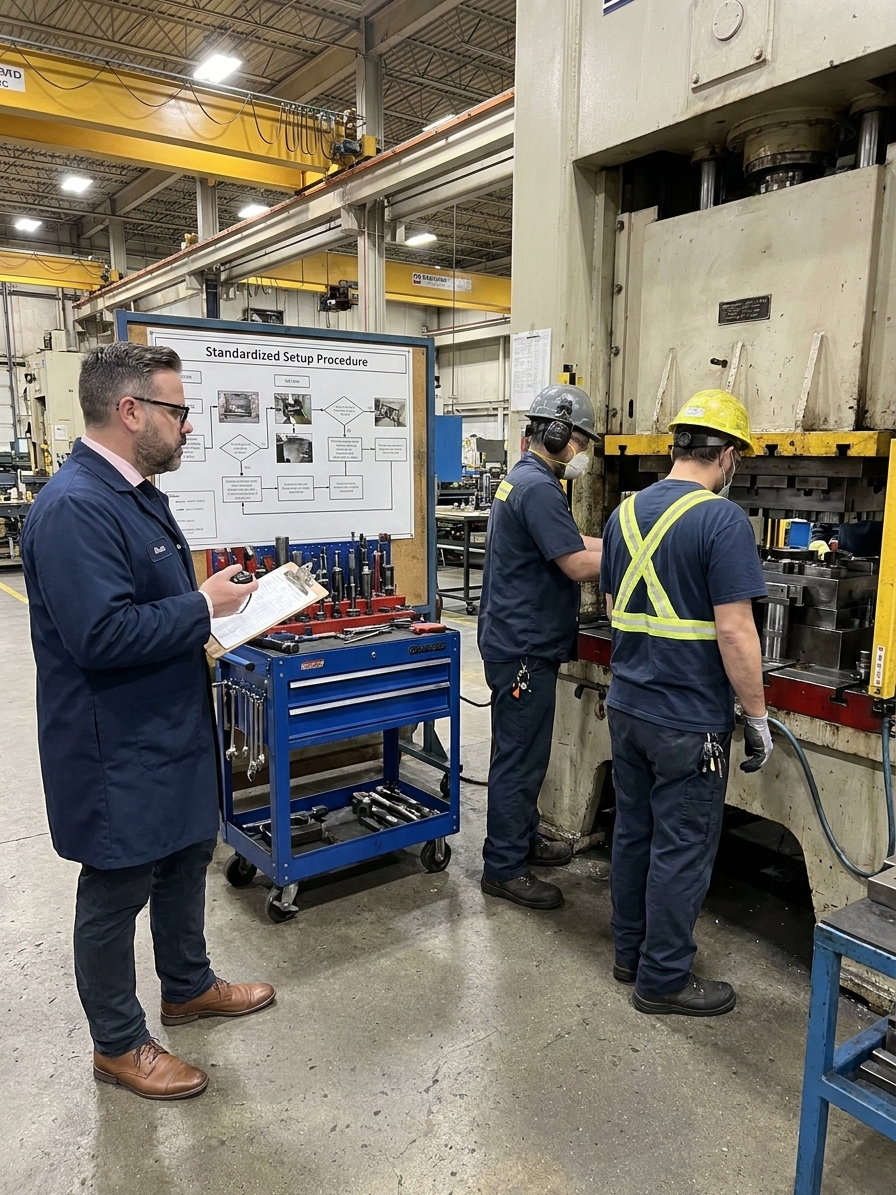
else because nobody owned the responsibility. The standardized tool
board? Tools went missing and were never replaced because nobody was
accountable for restocking.
SMED is not an event. It’s a discipline. And discipline is the one
thing most plants can’t sustain.
The “Good Enough” Plateau
You reduced the changeover from 90 minutes to 45 minutes. That’s a
significant achievement. And then you stopped.
Why? Because 45 minutes felt tolerable. The production scheduler
could live with it. The operators weren’t complaining anymore. The VP of
Manufacturing had a number for the quarterly review. So the pressure to
continue evaporated.
But 45 minutes is still a massive penalty. It still means the
scheduler builds large batches to amortize the cost. It still means the
plant can’t respond quickly to customer changes. It still means WIP
piles up between changeovers. The “good enough” plateau is the enemy of
continuous improvement — and it’s where most SMED initiatives die.
The Toyota plants that inspired SMED didn’t stop at “good enough.”
They continued reducing changeover times from hours to minutes, from
minutes to seconds. Press changes that once took hours were completed in
under three minutes. Not because they achieved some technical
breakthrough, but because they never stopped attacking the waste in the
process.
The Adjustment Addiction
Here’s a dirty secret of manufacturing: operators like adjustments.
Adjustments give them control. They can “dial it in.” They can
compensate for tool wear, material variation, temperature changes, and
the hundred other variables that make manufacturing unpredictable.
Adjustments are craftsmanship.
But adjustments are also the single biggest time sink in a
changeover. An operator who spends 20 minutes adjusting die positions,
tweaking pressures, and fine-tuning settings is an operator who’s
compensating for a process that was never properly standardized.
Plants that are serious about SMED eliminate adjustments. They design
dies that locate themselves. They use shims of known thicknesses instead
of trial-and-error positioning. They map the process parameters for
every product and load them as recipes — no operator judgment required.
But this requires engineering effort that most plants won’t invest. It’s
easier to let the operator “figure it out” on the floor than to engineer
the adjustment out of existence.
The External Setup That Isn’t
A common SMED failure: you claim external setup, but you don’t
actually do it.
The die is supposed to be pre-heated while the current product runs.
But the pre-heater is broken, has been for months, and nobody has
submitted a work order. The tools are supposed to be staged on a cart,
ready to go. But the cart is in use elsewhere because nobody designated
it as a SMED cart. The new material is supposed to be queued at the
line. But the warehouse hasn’t received the kanban signal because the
scheduling system is broken.
So what happens? The machine stops. The operator walks to find tools.
The die is cold. The material isn’t there. Internal time — the time you
thought you had eliminated — comes rushing back. And the 15-minute
changeover becomes 50 minutes, and nobody understands why because the
SMED report from last year said it was fixed.
The Measurement Gap
If you don’t measure changeover time consistently, you don’t manage
it. Period.
Most plants don’t measure changeover time consistently. They measure
it during the SMED event (because the consultant has a stopwatch). They
might measure it for a few weeks after the event (because the momentum
hasn’t died yet). But within a quarter, the measurement stops. The
operators go back to “just doing it.” The supervisors stop watching. And
without data, there’s no way to detect the creep.
Worse, many plants don’t even define what “changeover complete”
means. Is it when the last part of Product A comes off? When the first
good part of Product B comes off? When the operator says “we’re ready”?
Without a clear definition, the numbers are meaningless. And meaningless
numbers are the foundation of self-deception.
The Engineering Absence
SMED is often treated as an operator-floor activity. It’s not. Or
rather, it shouldn’t be.
The biggest gains in changeover reduction come from engineering
changes: redesigning dies so they’re self-locating. Installing
standardized clamping systems. Adding sensors that confirm proper
positioning. Building pre-set stations where off-line setup can be
performed. These are capital projects. They require engineering time,
budget approval, and management commitment.
Most plants won’t make that investment. They’ll rearrange tools,
reorganize the work area, and create standardized checklists — and then
wonder why their changeover reduction has plateaued. The answer is that
they’ve exhausted the organizational improvements and hit the
engineering wall. Further gains require engineering solutions, and
engineering solutions require resources that nobody wants to commit.
What Real SMED Looks Like
Real SMED — the version that actually transforms a plant — has
several characteristics:
It’s measured every single time. Every changeover is
timed. Not with a consultant’s stopwatch, but with the production
tracking system. The time is logged, trended, and reviewed. Deviations
are investigated. The data is visible on the shop floor — operators know
their changeover times, and so does everyone else.
Internal and external are truly separated. External
setup isn’t a suggestion; it’s a requirement. There’s a checklist,
there’s a staging area, and there’s verification before the machine
stops. If the external setup isn’t complete, the changeover doesn’t
start. Period.
Adjustments have been engineered out. This doesn’t
happen overnight. It’s a roadmap. Each adjustment is identified,
analyzed, and eliminated through design changes. Quick-clamp systems
replace bolts. Locating pins replace manual alignment. Recipe-driven
parameter control replaces operator judgment. The roadmap has a
timeline, an owner, and budget.
There’s a changeover team — or at least a changeover
owner. Changeover isn’t something that happens to operators.
It’s something that’s planned, rehearsed, and executed. In the best
implementations, changeovers are choreographed — each person knows their
role, their sequence, their timing. It’s like a pit crew. And like a pit
crew, the speed comes from practice and coordination, not from
individual heroics.
The culture rewards small batches. If your plant
runs large batches because “it’s more efficient,” you’ve already lost.
Large batches are efficient only when you ignore the cost of inventory,
the cost of obsolescence, the cost of delayed response to customer
demand, and the cost of quality issues that propagate through a large
run before anyone detects them. Real SMED enables small batches by
making the changeover penalty negligible — and the plant culture
actively exploits this advantage.
The Connection to Everything
Else
SMED doesn’t exist in isolation. It connects to every other quality
and lean initiative:
-
Standard Work: If your changeover doesn’t have a
standardized procedure with defined steps, times, and responsibilities,
you don’t have SMED. You have chaos that occasionally goes
quickly. -
Total Productive Maintenance: Dies and fixtures
that are poorly maintained stick, jam, and misalign. A well-maintained
die drops in cleanly; a neglected one requires hammering, prying, and
“persuasion.” TPM is a prerequisite for SMED. -
5S: A cluttered, disorganized work area makes
external setup impossible. If tools can’t be found in 10 seconds, your
external setup time is really internal time. 5S is not a janitorial
exercise — it’s the foundation of quick changeover. -
Kanban and Pull Systems: Small batches enabled
by SMED are what make pull systems work. If changeovers are long, kanban
becomes a push system because nobody wants to change over for a small
order. SMED is the enabler of true pull. -
OEE: Changeover time is a major contributor to
availability loss in OEE. Plants that claim high OEE while running long
batches to avoid changeovers are gaming the metric. Real OEE improvement
requires SMED — and the honest accounting that comes with it.
The Path Forward: SMED That
Sticks
If you’re going to implement SMED — or reinvigorate a dead
implementation — here’s what actually works:
1. Start with measurement. Before you change
anything, measure every changeover for 30 days. Not just total time, but
the breakdown: preparation time, machine-stopped time, adjustment time,
first-good-part time. You can’t improve what you can’t see, and you’ll
be shocked by where the time actually goes.
2. Map the current state. Video a changeover. Not
with a camera operator who’s never seen the process, but with someone
who knows what to look for. Watch the video with the operators. Let them
point out the frustrations. They know where the time goes. They’ve been
living with it.
3. Attack the obvious waste first. Walking to get
tools. Waiting for the crane operator. Searching for the right bolts.
These aren’t engineering problems — they’re organizational problems. Fix
them with staging, organization, and standardization. The first 30-40%
reduction comes from these changes alone.
4. Then invest in engineering. Quick-clamp systems.
Pre-set stations. Self-locating dies. These are the changes that take
you from “better organized” to “truly fast.” They cost money. They also
pay for themselves — usually within months, not years, when the
reduction in changeover time enables smaller batches and lower
inventory.
5. Make it standard work. Document the new
procedure. Train every operator on it. Post it at the changeover
station. And — critically — audit it. Not once. Regularly. If the
procedure drifts, and it will drift, correct it immediately. Standard
work that isn’t audited isn’t standard.
6. Measure forever. The changeover time goes on the
production board. It goes in the shift handover report. It goes in the
monthly operations review. The moment you stop measuring is the moment
the improvement starts dying.
7. Attack the adjustment. Every adjustment in your
changeover is a failure of engineering. Document them, prioritize them,
and eliminate them one by one. This is the long game — the work that
separates plants that are “doing SMED” from plants that have truly
transformed their changeover capability.
The Uncomfortable Truth
SMED isn’t about the die. It isn’t about the clamp. It isn’t about
the stopwatch.
SMED is about whether your plant has the discipline to take a
powerful methodology and sustain it past the point where the excitement
fades. Most plants can’t. The evidence is on every shop floor where a
quick-clamp system has been replaced with standard bolts, where a
staging cart has been repurposed, where the changeover procedure is a
faded document taped to a wall that nobody reads.
The plants that succeed with SMED are the plants that treat
changeover reduction as a permanent operational discipline — not a
project, not an event, not a slide in a quarterly review. They are the
plants where someone, every single day, asks: “How long did the
changeover take? Why? And what are we doing about it?”
That’s the question. Not “Did we do SMED?” but “Are we still doing
SMED?” The difference between those two questions is the difference
between a plant that gained flexibility and a plant that built inventory
because the setup took too long and nobody dared switch.
Peter Stasko is a Quality Architect with over 25
years of experience in manufacturing quality, process improvement, and
lean implementation. He has led SMED initiatives across automotive,
electronics, and heavy industry, and has seen every way a quick
changeover can become a long one. He writes about the gap between what
quality methodologies promise and what actually happens on the shop
floor.