Quality
Gemba Walk: When Your Organization Discovers That the Most Important
Quality Data Cannot Be Found in Any Report — and the Answers You’ve Been
Searching For Are Standing Right Where the Work Happens
The Report That Lied
The customer complaint landed on a Monday morning. Dimensional
variation on a critical bore — 127 parts rejected out of a shipment of
200. The quality engineer pulled the SPC charts: everything green. The
control plan review: compliant. The operator training records: current.
The gage R&R: acceptable. By every metric the quality system
tracked, this defect should not have happened.
And yet it did.
The plant manager called a meeting. The quality director opened his
laptop. The engineering manager brought spreadsheets. For two hours,
they debated root causes in a conference room forty meters from the
production line where the defect was born. Nobody walked to the
floor.
When the quality engineer finally went to the line — not because
anyone told him to, but because he was frustrated enough to stop
trusting his data — he found the answer in thirty seconds. The fixture
locating pin had worn down by 0.3mm. The operator knew about it. She had
mentioned it to her supervisor three weeks ago. The supervisor had
submitted a maintenance request. The request was sitting in a queue,
categorized as “low priority” because no defect had been detected
yet.
The defect was invisible to every dashboard, every chart, every
report. But it was obvious to anyone standing in front of the machine
with their eyes open.
This is the Gemba paradox: the closer you are to the data, the
farther you are from the truth.
What Gemba Actually Means
The word is Japanese. It means “the real place.” In manufacturing, it
means the shop floor — the location where value is created, where
products are formed, where defects are born. In healthcare, the Gemba is
the emergency room. In software, it’s the code repository. In logistics,
it’s the loading dock.
The concept comes from Toyota’s production system, where it was
elevated from a practice to a principle: before you make any decision
about a process, you must go and observe it with your own eyes. Not the
data from it. Not a report about it. The actual, physical process,
running in real time, with real people doing real work.
Taichi Ohno, the architect of the Toyota Production System, was
famous for drawing a chalk circle on the factory floor and making
managers stand in it for hours. They would watch. They would observe.
They would see things that no report could ever show them — the
hesitation in an operator’s movement, the slight wobble in a fixture,
the informal workaround that everyone knew about but nobody
documented.
Ohno wasn’t being theatrical. He was teaching a fundamental truth
about quality: data is a shadow of reality. The shadow is useful. But if
you want to understand the object, you have to look at the object.
Why Organizations Abandon
the Gemba
Most quality leaders intellectually understand the value of going to
the Gemba. They nod when it’s mentioned in training. They include it in
their quality philosophy statements. They might even schedule “Gemba
walks” on their calendars.
And then they don’t go.
The reasons are predictable:
Data addiction. Modern quality systems produce
staggering amounts of information. Dashboards update in real time. SPC
charts refresh automatically. Nonconformance reports generate
themselves. The illusion is complete: the screen shows you everything
you need to know. Except it doesn’t. It shows you what the system was
designed to measure. And the most important quality signals — the worn
fixture, the operator’s workaround, the ambient temperature shift that
nobody tracks — are the ones your system was never designed to see.
Time pressure. Managers are busy. A Gemba walk takes
45 minutes to an hour. A dashboard review takes five minutes. When your
inbox has 200 unread messages and three meetings start in the next hour,
the dashboard wins. Every time. The irony is that the 45 minutes on the
floor would prevent the crisis that consumes the next three weeks.
Comfort zones. Conference rooms are comfortable. The
shop floor is loud, hot, and requires personal protective equipment. It
demands that you engage with people who may challenge your assumptions.
It’s easier to discuss quality in abstract terms, surrounded by people
who speak your language and share your worldview.
Fear of what you’ll find. Walking the floor means
confronting reality. And reality doesn’t care about your metrics. It
doesn’t care about your improvement projects or your management reviews.
If there’s a problem on the floor, you will see it. And once you see it,
you own it. Some leaders find it easier not to look.
The Anatomy of a Real Gemba
Walk
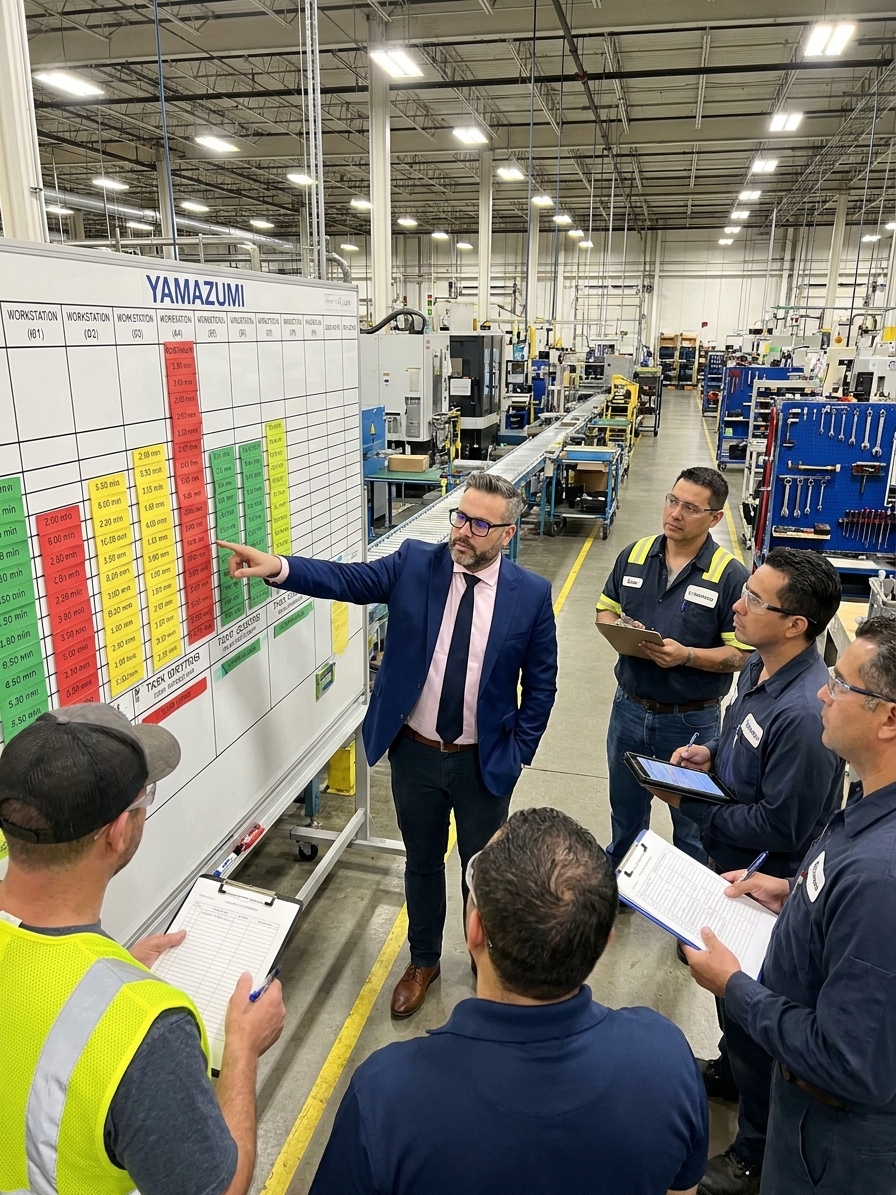
A Gemba walk is not a factory tour. It’s not an audit. It’s not an
inspection. It is a structured practice of observation, questioning, and
learning. Here’s how it works when it’s done right:
Preparation
You don’t walk randomly. Before going to the floor, you identify a
theme. What are you looking to understand? It might be a specific defect
trend, a process change, a new operator’s learning curve, or simply the
current state of standard work adherence. You review the relevant data
first — not to form conclusions, but to form questions.
The best Gemba walks start with a question, not an answer. “Why has
our first-pass yield on Line 3 dropped 2% this month?” is a Gemba
question. “Let’s check if operators are following the work instructions”
is an audit question. The difference matters. One seeks understanding.
The other seeks compliance.
Observation
When you arrive on the floor, you do something counterintuitive: you
shut up. You watch. You stand where you can see the whole process. You
follow the material flow. You notice the operator’s movements — not to
judge them, but to understand them.
What you’re looking for:
- Variation in the process. Does each operator
perform the task the same way? If not, why not? Variation is the seed of
defects, and it’s almost always visible to the trained eye. - Workarounds and improvisation. When an operator
reaches for a different tool, adjusts a fixture by hand, or checks
something that isn’t in the work instruction, they’re telling you
something. They’ve discovered a gap between the documented process and
the real process. That gap is where defects live. - Physical conditions. Lighting, noise, temperature,
tool organization, material staging. The environment shapes behavior,
and behavior shapes quality. - Body language. Frustration, confusion, fatigue,
pride — you can read all of these on the shop floor, and none of them
appear in a database.
Conversation
After observing, you engage. Not with a clipboard and a checklist,
but with genuine curiosity. “I noticed you check the bore twice before
loading the part. Can you tell me why?” “I saw you adjust the clamp
between cycles. What tells you it needs adjusting?” “What’s the most
frustrating thing about running this process?”
These conversations reveal the undocumented knowledge that keeps your
quality system alive. The operator who checks the bore twice does it
because she learned — through experience, not training — that the bore
sometimes drifts after tool changes. The operator who adjusts the clamp
can feel, through vibration, when the fixture isn’t seating properly.
This is tribal knowledge, and it’s worth more than any control plan.
The key principle: respect the operator. They are the expert on their
process. You are the guest. Ask. Listen. Learn.
Reflection
After the walk, you synthesize. What did you see that the data
doesn’t show? What questions did the observations raise? What
assumptions were challenged? What actions should follow?
This is where most organizations fail. They do the walk, they see
interesting things, they have good conversations — and then they go back
to their offices and nothing changes. The Gemba walk becomes an event,
not a practice. The insights evaporate. The fixture keeps wearing
down.
The Three Levels of Gemba
Maturity
Organizations evolve in their relationship with the Gemba. I’ve
observed three distinct levels:
Level 1: Event-Based Gemba
The organization goes to the floor only when there’s a crisis. A
customer complaint triggers a “go and see” exercise. A quality alert
sends engineers scrambling to the production line. The Gemba is
reactive, infrequent, and associated with trouble.
At this level, the shop floor perceives Gemba walks as
investigations. People become defensive. They hide problems. The walk
becomes a performance — everyone shows their best behavior, and the real
process disappears behind a mask of compliance.
Level 2: Scheduled Gemba
The organization recognizes the value of regular floor presence.
Gemba walks appear on calendars. Leaders commit to walking weekly or
daily. Standardized walk sheets guide observations. Themes rotate across
processes, shifts, and focus areas.
This is better, but it carries a risk: the walks become routine.
Leaders go through the motions. They follow the checklist, tick the
boxes, and return to their desks without genuine engagement. The form is
present, but the spirit is absent.
Level 3: Embedded Gemba
The Gemba is not an activity — it’s a mindset. Leaders go to the
floor because that’s where they do their thinking. Problems are
discussed at the point of occurrence, not in conference rooms. Stand-up
meetings happen next to the process, not in a meeting room. The boundary
between “office” and “floor” dissolves.
At this level, the organization has fundamentally restructured how
decisions are made. Data supports decisions; it doesn’t replace the
human judgment that comes from direct observation. Leaders spend 30-50%
of their time on the floor. And the quality metrics reflect it: fewer
escapes, faster response, deeper understanding.
The Data-Gemba Feedback Loop
Here’s the insight that transforms quality organizations: data and
Gemba are not alternatives. They’re partners.
Your SPC chart shows a trend. The Gemba tells you why. Your Pareto
analysis identifies your top defect. The Gemba shows you the mechanism.
Your customer complaint describes a symptom. The Gemba reveals the root
cause.
The most effective quality professionals I’ve worked with use a
simple rhythm: read the data in the morning, walk the floor in
the afternoon. The data tells them where to look. The floor
tells them what they’re seeing. Together, they create a feedback loop
that no dashboard can replicate.
I once worked with a quality manager who kept a whiteboard in his
office divided into two columns: “What the Data Says” and “What the
Floor Shows.” Every week, he’d fill in both columns for his top three
quality concerns. The gaps between the columns — the places where the
data and the observation disagreed — were always where the real problems
lived.
Common Mistakes
The ambush walk. Showing up unannounced with the
intent to catch people doing things wrong. This destroys trust faster
than any other leadership behavior. The Gemba walk is about learning,
not policing.
The delegation walk. Sending a subordinate to “do a
Gemba walk” and report back. This defeats the entire purpose. The leader
needs their own eyes on the process. The delegation walk produces a
report about a report — another layer of abstraction between the
decision-maker and reality.
The solution walk. Going to the floor with a
solution already in mind, looking for confirmation. This is confirmation
bias with a safety vest. The Gemba walk should challenge your
assumptions, not reinforce them.
The tourist walk. Walking through the factory
without purpose, without stopping, without engaging. This is a factory
tour, not a Gemba walk. It produces no insight and consumes time that
could have been spent productively.
Building a Gemba Culture
If you want your organization to truly benefit from Gemba practice,
you need to build it into the culture — not just the calendar.
Start at the top. When the plant manager walks the
floor every day and asks genuine questions, everyone notices. When the
quality director leaves their laptop in the office and spends an hour
observing a process, it sends a message. Leadership behavior is the
strongest signal in any organization.
Make it safe. Operators must feel comfortable
sharing what they know without fear of punishment. If every observation
becomes a corrective action, people will stop showing you things. Some
of the most valuable insights come from problems that operators have
already solved informally. Celebrate those solutions, don’t audit
them.
Train observation skills. Most people don’t know how
to observe. They look without seeing. Training your leaders in
observation techniques — waste identification, motion analysis, process
flow mapping — transforms the Gemba walk from a stroll into a diagnostic
tool.
Close the loop. When an operator shares an insight
during a Gemba walk, follow up. Tell them what happened. Show them the
result. If you asked about a fixture and then fixed the fixture, say so.
This builds trust and encourages future sharing. The operator who feels
heard becomes the operator who volunteers information.
Track the practice, not just the results. How many
walks happened this month? How many insights were captured? How many
actions resulted? If you measure only quality outcomes, you’ll miss the
leading indicator that drives them.
The 30-Second Test
Here’s a simple test for any quality leader: the next time you’re
about to open a report to investigate a quality issue, stop. Walk to the
floor instead. Stand in front of the process where the issue originated.
Watch for five minutes. Talk to the operator.
If what you see matches the report perfectly, your measurement system
is excellent. But in twenty-five years of doing this, I’ve never seen
that happen. There is always a gap between the report and reality. And
the gap is where your next improvement lives.
The Fixture Was Talking
Let me return to that worn fixture pin. The one that caused 127
rejected parts. The one that every report missed.
After the root cause was identified, the quality engineer did
something interesting. He walked every production line in the plant,
looking for similar conditions. He found four more worn locating pins in
various stages of degradation. None had produced detectable defects —
yet. He replaced them all.
Then he added a simple check to the operator’s standard work: a
visual and tactile inspection of the locating pin at the start of each
shift. No special equipment. No gage. Just eyes and fingers. The
operator who had originally reported the worn pin helped design the
check.
Over the next year, that plant’s dimensional defect rate dropped by
40%. Not because they added more sophisticated measurement. Not because
they implemented a new SPC algorithm. Because they started listening to
the people who stood closest to the process, and they started going to
see for themselves.
The fixture was talking the whole time. Nobody was standing close
enough to hear it.
Peter Stasko is a Quality Architect with 25+ years of experience
in automotive, aerospace, and quality transformation. Certified PSCR and
Six Sigma Black Belt.