The
Question Your Organization Asks Just Enough to Feel Smart
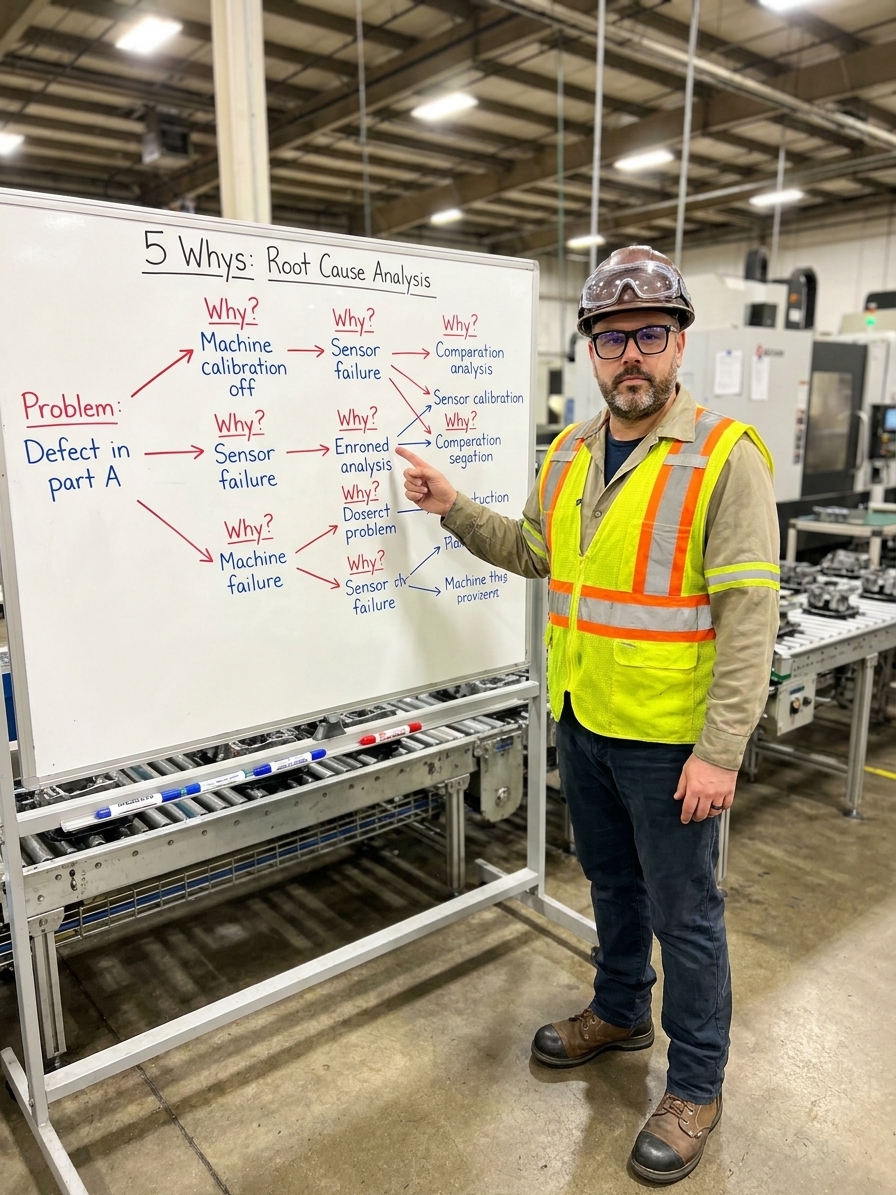
Every manufacturing professional knows the 5 Whys. It is perhaps the
most universally taught problem-solving tool in quality management —
simple enough to fit on a sticky note, powerful enough (in theory) to
unravel even the most tangled defect chain. Taiichi Ohno, the father of
the Toyota Production System, famously said that by asking “why” five
times, the nature of the problem and its solution become clear.
Your organization has posters about it. Your corrective action forms
have a neat little table with five rows. Your auditors ask whether you
performed root cause analysis, and you can point to a completed 5 Whys
worksheet and say yes.
But here is what actually happens on your production floor: a defect
occurs, a team gathers in a conference room, someone facilitates a 5
Whys session, the team fills in five rows, everyone nods, and the form
gets filed. Three months later, the same defect comes back. Not a
similar defect — the exact same one. The same machine, the same failure
mode, the same scramble.
This is not a failure of the 5 Whys technique. This is a failure of
how your organization practices it. And that failure is far more common
than anyone wants to admit.
The Anatomy of a Fake Root
Cause
Let us walk through a real-world example — one that plays out in
manufacturing plants every single day.
The problem: A critical dimension on a machined
bracket is out of tolerance. Customer rejects the lot.
Why 1: Why was the dimension out of tolerance?
Answer: The cutting tool was worn beyond its usable life.
Why 2: Why was the cutting tool worn?
Answer: The operator did not replace it at the scheduled
interval.
Why 3: Why didn’t the operator replace it?
Answer: The replacement tools were not available at the
workstation.
Why 4: Why weren’t replacement tools available?
Answer: The tool crib was not restocked according to the kanban
system.
Why 5: Why wasn’t the kanban system followed?
Answer: The purchasing department delayed the order because the
supplier invoice from the previous month had a discrepancy.
Root cause: Supplier invoice discrepancy caused a
purchasing delay, which caused a tool shortage, which caused an operator
to use a worn tool, which caused out-of-tolerance parts.
Corrective action: Implement a secondary tool
supplier and establish a buffer stock of critical cutting tools.
Sound reasonable? It does. And that is exactly the problem. The team
feels satisfied. The form is complete. The auditor is happy. But this
analysis is almost certainly wrong — or at least woefully
incomplete.
Where the 5 Whys Goes
Wrong in Practice
1. The Single-Path Illusion
The biggest mistake your organization makes with the 5 Whys is
treating every problem as if it has a single causal chain. Real
manufacturing failures are almost always the result of multiple
contributing factors that converge simultaneously. The out-of-tolerance
bracket was not caused only by a worn cutting tool. It was caused by the
combination of a worn tool, inadequate in-process inspection, a machine
that was overdue for calibration, and a setup sheet that had not been
updated after the last engineering change.
When you force your team down a single path of five questions, you
are not finding the root cause — you are finding one root cause among
many. And the ones you ignore are often the ones that matter most.
2. Stopping at the Comfort
Zone
Human beings have a strong tendency to stop the 5 Whys at a cause
that feels actionable and comfortable. In the example above, the team
stopped at “purchasing delayed the order.” That is an organizational
cause — it points to a process gap that can be fixed with a procedure
update and a secondary supplier. It feels productive.
But what if the team had gone further?
Why 6: Why did a single invoice discrepancy stop the
entire procurement process? Why 7: Why is there no
escalation procedure for blocked purchase orders? Why
8: Why does a low-value consumable like cutting tools go
through the same approval workflow as capital equipment?
Suddenly the conversation gets uncomfortable. Now you are questioning
procurement policies, approval hierarchies, and organizational
structures. Most teams never get here — not because the questions are
hard, but because the answers require changes that someone with
authority does not want to make.
The 5 Whys is supposed to be a tool for reaching uncomfortable
truths. In practice, it is used to reach comfortable conclusions.
3. The Blame Magnet
Watch what happens in a 5 Whys session. The causal chain has a
gravitational pull toward human error. It is almost inevitable: if you
ask “why” enough times in a manufacturing context, you will eventually
arrive at “the operator made a mistake” or “the supervisor didn’t follow
procedure.” And once you land there, the investigation stops. The
corrective action becomes “retrain the operator” or “reinforce the
procedure.” Problem solved. Case closed.
Except the operator made the mistake because the fixture was designed
incorrectly, the work instructions were ambiguous, the lighting in the
cell was inadequate, and production targets created pressure to skip
verification steps. The operator was the last link in a chain of
systemic failures — but the 5 Whys, as practiced in most organizations,
identifies the operator as the root cause because the operator is the
easiest target.
4. The Drive-Through Analysis
In many organizations, the 5 Whys is not a methodical investigation —
it is a box-checking exercise performed under time pressure. The
corrective action is due in 48 hours. The customer is waiting. The
production manager needs the line running. So the quality engineer sits
down, fills out the 5 Whys form in fifteen minutes, and submits it.
A proper root cause analysis for a significant manufacturing failure
should take days or even weeks. It should involve going to the gemba,
examining the failed parts, reviewing process data, interviewing
operators, checking machine logs, and testing hypotheses. The 5 Whys is
meant to be the starting point of that investigation, not the entirety
of it.
But in your organization, the 5 Whys form is the investigation. Once
it is filled out, the thinking stops.
5. The Confirmation Bias Trap
The person facilitating the 5 Whys session almost always has a
hypothesis before the first question is asked. They have seen this type
of failure before. They know what “usually” causes it. And the 5 Whys,
because it is an unstructured analytical tool with no built-in
safeguards against bias, will happily lead the team to whichever
conclusion the facilitator expected.
If the quality engineer thinks the problem is tooling, the questions
will naturally gravitate toward tooling. If the engineer thinks it is
operator error, the chain will find its way to the operator. The 5 Whys
does not test hypotheses — it constructs narratives. And narratives are
seductive.
What a Proper
Root Cause Investigation Looks Like
The organizations that get genuine value from root cause analysis do
not rely on the 5 Whys alone. They use it as one tool within a
structured investigation framework:
Is/Is Not Analysis — Before asking why, define what
the problem is and what it is not. Which machines are affected? Which
are not? Which shifts? Which products? This narrows the field before the
causal analysis begins and prevents the team from chasing
irrelevancies.
Multiple Causal Chains — Instead of a single chain
of five whys, map out all plausible causal paths simultaneously. Use a
fishbone diagram, a fault tree, or a cause map to capture the full
complexity of the failure. The out-of-tolerance bracket probably has at
least three independent contributing causes, each with its own
chain.
Data Before Opinions — “Why did the tool wear
prematurely?” should not be answered by the operator’s best guess. It
should be answered by tool life data, spindle load logs, material
certificates, and cutting parameter records. The 5 Whys is only as good
as the evidence that supports each answer.
Go to the Gemba — The 5 Whys session should not
happen in a conference room. It should happen at the machine, with the
failed part in hand, with the operator who was running it, with the
process data on a screen. Context is everything, and you cannot get
context from a conference room chair.
Test the Root Cause — Before implementing a
corrective action, test whether your identified root cause actually
reproduces the failure. If you believe the worn tool caused the defect,
intentionally run a tool to the same wear condition and measure the
result. If the defect does not reproduce, your root cause is wrong.
The Deeper Organizational
Problem
The failure of the 5 Whys in most organizations is not a failure of
the tool — it is a failure of culture. The 5 Whys works at Toyota
because Toyota has a culture where:
- Stopping production to investigate a problem is expected, not
punished - The investigation can go as deep as it needs to, even if it points
to executive decisions - Operators are trusted as experts in their processes
- Root causes that implicate management systems are acted on, not
buried - The goal is learning, not closure
Most organizations do not have this culture. They have a culture of
compliance — a culture where the 5 Whys form exists to satisfy the
auditor, not to solve the problem. And in that culture, the 5 Whys
becomes what it was designed to prevent: a superficial exercise that
treats symptoms as causes and allows the real problems to fester.
Ask yourself honestly: when was the last time a 5 Whys investigation
in your organization led to a systemic change that actually prevented a
recurrence of the defect? Not a band-aid, not a retraining session, not
a procedure update that nobody reads — a real, structural change to how
work is done?
If you are struggling to think of an example, the problem is not the
technique. The problem is the environment in which you are using it.
What to Do Differently
If your organization is going to use the 5 Whys — and you should,
because it remains a powerful tool when used correctly — then commit to
using it properly:
-
Never use it as a standalone method. Pair it
with is/is not analysis, data gathering, and on-site investigation. The
5 Whys is the framework for asking questions, not a substitute for
answering them with evidence. -
Map multiple causal paths. Stop pretending that
complex failures have a single root cause. They do not. Use the 5 Whys
to explore each contributing factor independently. -
Do not stop at five. The number five is a
guideline, not a rule. Some root causes are three questions deep. Some
require eight. Stop when you have reached a cause that is actionable and
verifiable, not when you have filled in five rows on a form. -
Protect the process from blame. If your 5 Whys
consistently end at “operator error,” your analysis is broken. Every
operator error is a system that allowed — or encouraged — that error.
Keep digging. -
Verify before acting. Test your root cause.
Confirm that the corrective action addresses the actual cause, not the
symptom. Measure the result over time, not just in the week after
implementation. -
Give it time. A meaningful root cause
investigation for a significant failure cannot be completed in an
afternoon. Allocate the time and resources the investigation deserves,
or accept that you will be investigating the same failure again next
quarter.
The Bottom Line
The 5 Whys is not too simple for your complex manufacturing problems.
It is exactly the right tool — if you have the discipline to use it
honestly, the courage to follow it wherever it leads, and the integrity
to act on what you find.
Most organizations do not. They use the 5 Whys to close corrective
actions, not to solve problems. They use it to assign blame, not to
understand systems. They use it to satisfy auditors, not to satisfy
customers.
Taiichi Ohno did not intend for his technique to become a form with
five boxes. He intended it to become a way of thinking — a relentless,
uncomfortable, honest pursuit of the truth behind every failure.
Your organization has the form. The question is whether it has the
thinking.
Peter Stasko is a Quality Architect with over 25
years of experience in manufacturing quality management. He has
implemented and audited quality systems across automotive, aerospace,
and industrial manufacturing sectors, and has seen more 5 Whys forms
filled with plausible nonsense than he cares to remember.