The
Art of Jewelry Making: A Collaborative Journey in Craftsmanship
How
Peter Stasko and Prerna Are Redefining Handmade Jewelry — One Ring,
Watch, Bracelet, and Chain at a Time
There is something deeply human about making jewelry. Long before
machines and mass production, people shaped metal and stone into objects
of beauty — rings that symbolized commitment, bracelets that told
stories, chains that carried meaning across generations. Today, in a
world of fast fashion and disposable accessories, the art of crafting
jewelry by hand still holds a quiet, enduring power.
In our workshop, two worlds meet. Peter Stasko — with his roots in
Central Europe and decades of experience in precision engineering and
quality management — and Prerna, a jewelry artisan from India whose
family has been working with gold, silver, and precious stones for
generations. Together, we are building something that bridges our
traditions, our skills, and our shared belief that every piece of
jewelry should be made with intention.
This is the story of how we work — how we design, shape, refine, and
finish each piece that leaves our bench.
The Philosophy: Quality
First, Always
Before we touch a single tool, we talk. Every piece of jewelry begins
as a conversation. What is the purpose of this ring? Who will wear this
bracelet? What story should this watch tell?
Peter brings a quality-first mindset shaped by years in automotive
and aerospace manufacturing. To him, a ring is not so different from a
precision component — it has tolerances, material specifications,
inspection points, and a finish that must meet exact standards. A poorly
made prong means a lost stone. A weak clasp means a lost bracelet. There
is no room for “good enough” when someone will wear this every day.
Prerna brings the soul. Growing up in Jaipur, India — a city
synonymous with jewelry and gemstones — she learned techniques passed
down through her family. She knows how gold behaves differently
depending on its purity. She can read a gemstone the way a musician
reads sheet music. Where Peter sees specifications, Prerna sees
possibility.
Together, we balance precision with artistry. Every piece must be
both technically flawless and emotionally resonant.
How We Make Rings:
From Concept to Closure
Rings are the heart of our workshop. They are also the most
technically demanding pieces we create.
Step 1: Design and Sizing
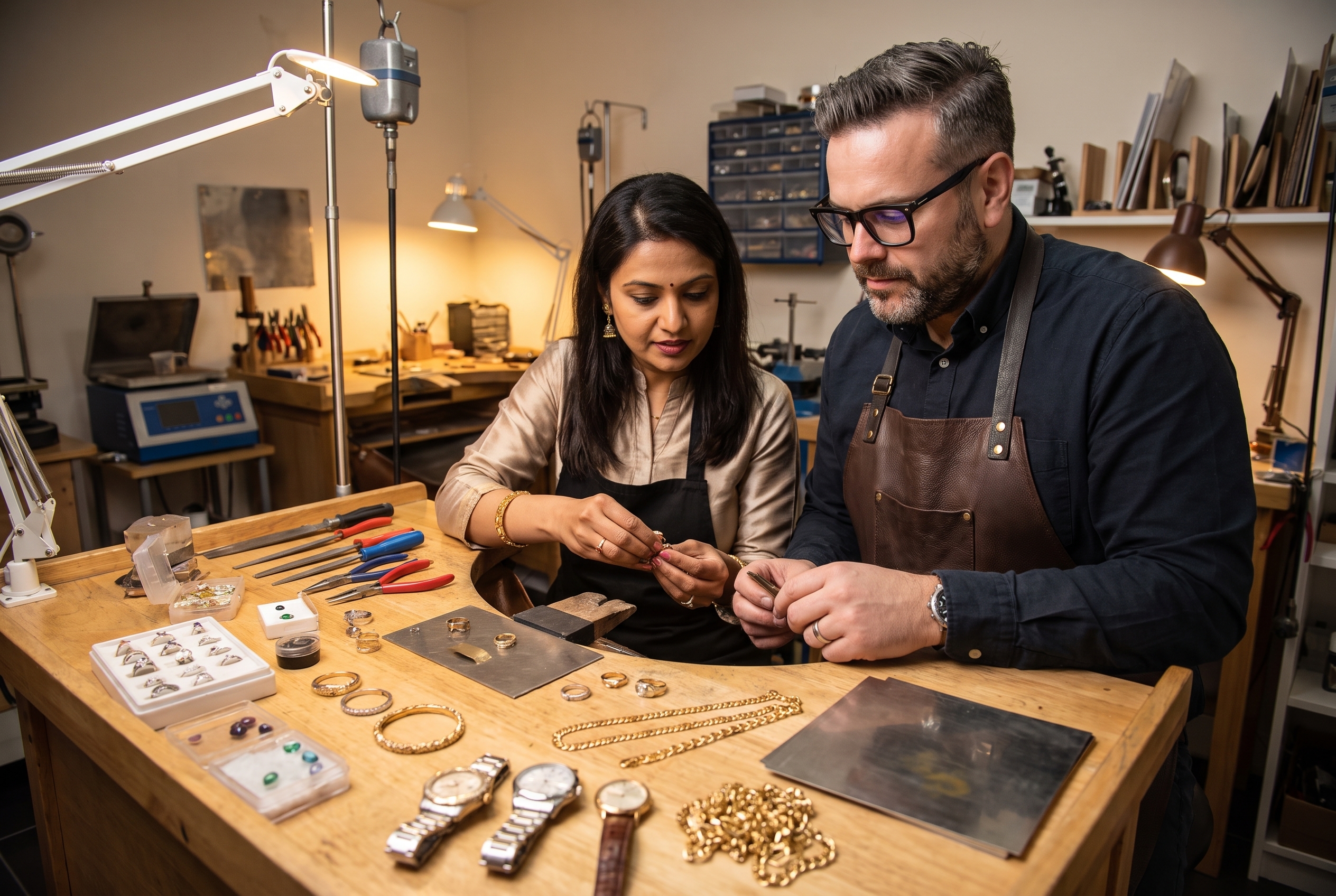
Every ring starts with a sketch. We sit together at the bench — Peter
with calipers and a sizing gauge, Prerna with a pencil and a sheet of
tracing paper. We discuss the design, the stone (if any), the metal, and
the wearer’s finger size.
Peter approaches this like an engineer. He calculates the ring’s
inner diameter, wall thickness, and the stress points where a stone
setting will sit. He thinks about durability — will this ring survive
daily wear, hand-washing, gym sessions, years of use?
Prerna thinks about flow and proportion. A ring should look balanced
from every angle. The band should taper gracefully. The setting should
complement the stone, not compete with it.
Step 2: Selecting and
Preparing the Metal
We work primarily with gold (in various purities), sterling silver,
and platinum. Each metal has its own personality:
- Gold (18K and 14K): Warm, malleable, timeless. Our
most-requested material for engagement and wedding rings. - Sterling Silver (925): Cool, bright, affordable.
Perfect for fashion rings and everyday pieces. - Platinum: Dense, durable, hypoallergenic. The
premium choice for pieces meant to last a lifetime.
Prerna cuts the raw metal to size, filing the edges smooth. She
checks the purity — a habit from her family’s workshop in Jaipur, where
every batch of gold was tested before it touched the bench.
Step 3: Forming the Band
This is where the ring takes shape. Using a mandrel and a rawhide
mallet, Prerna carefully bends the metal into a circle. The process
requires patience — too much force and the metal warps or work-hardens;
too little and the shape won’t hold.
Peter monitors the roundness with a ring gauge. A ring that is even
0.2mm out of round is noticeable on the finger. He checks the wall
thickness at multiple points, ensuring consistency all the way
around.
Step 4: Stone Setting
If the ring includes a gemstone — and many do — this is the most
critical step. Prerna’s specialty.
She begins by creating the setting: a bezel, prong, or flush setting,
depending on the design and the stone. Each type of setting has its own
technique:
- Prong setting: The most common for engagement
rings. Tiny metal claws hold the stone in place. Each prong must be
perfectly positioned and tensioned — too tight and the stone can crack,
too loose and it can fall out. - Bezel setting: A rim of metal wraps around the
stone. More secure than prongs, with a sleek, modern look. - Flush setting: The stone is set directly into the
band, level with the surface. Subtle and contemporary.
Prerna sets the stone under magnification, checking the alignment
from every angle. Peter then performs a “shake test” — holding the ring
near his ear and tapping it gently. A properly set stone makes no sound.
If there is even a faint rattle, the setting needs adjustment.
Step 5: Finishing and
Polishing
The final step transforms a rough piece of metal into a jewel. We use
a progression of abrasives — from coarse to ultra-fine — to bring the
surface to a mirror finish or a soft satin texture, depending on the
design.
Peter inspects every finished ring under a loupe (10x magnification).
He checks for scratches, file marks, uneven polish, and any tool marks
that shouldn’t be there. If he finds a flaw, the ring goes back to the
bench.
Only when it passes inspection does it go into a box.
Watches: Engineering on Your
Wrist
A watch is the most complex piece of jewelry we make. It combines
metallurgy, mechanics, and micro-engineering — which is exactly why
Peter loves it.
We don’t build movements from scratch (that requires specialized
equipment and years of horological training). What we do is create
custom watch cases, dials, and straps — and we modify and assemble
mechanical movements into cases we have designed ourselves.
The Case
The watch case is the frame that holds everything together. We
machine it from a solid block of metal — usually stainless steel,
titanium, or gold — using a combination of CNC milling and hand-filing.
The case must be precise to within hundredths of a millimeter. If the
case is too loose, the movement shifts and the watch loses accuracy. If
it’s too tight, the movement binds.
Peter handles the case machining, drawing on his experience with
precision components. Every dimension is measured with digital calipers
and micrometers. Every edge is deburred and finished by hand.
The Dial
Prerna designs and finishes the dials. This is where artistry takes
over. She has created dials using techniques like guilloché
(engine-turned patterns), hand-applied lacquer, and even stone dials —
thin slices of lapis lazuli, mother-of-pearl, or onyx, cut and polished
to fit perfectly inside the case.
A stone dial is a particular challenge. The material is fragile and
unpredictable. A batch of ten slices might yield only two that are
usable. But the result — a watch face that is literally unique, with
natural patterns that no machine could replicate — is worth the
effort.
Assembly and Testing
Once the case, dial, hands, and movement are ready, we assemble the
watch in a clean environment. Peter places the movement, attaches the
dial and hands, and seals the case. Prerna adds the strap — which she
often makes herself, from leather, metal links, or woven fabric.
Every finished watch is tested for 72 hours. We check timekeeping
accuracy, water resistance (for dive watches), and the smooth operation
of the crown and any complications (date windows, etc.).
Bracelets: Wearable
Architecture
Bracelets are where structure meets style. We make several types:
Bangle Bracelets
Rigid, circular, and elegant. Bangles are formed from a single piece
of metal, shaped on a mandrel, and finished to a high polish. Prerna
often adds engraved or embossed patterns — floral motifs inspired by
Indian design traditions, or geometric patterns with a more contemporary
feel.
Chain Bracelets
Flexible and flowing, made from interconnected links. Each link is
individually formed, soldered, and polished. The links must move freely
but not loosely — a well-made chain bracelet drapes like fabric on the
wrist.
Cuff Bracelets
Open-ended and adjustable, cuffs make a bold statement. We shape them
from thicker metal stock, often combining materials — a silver cuff with
gold inlay, for example, or a copper cuff with a patinated finish.
Peter checks every bracelet for comfort. A bracelet that pinches,
pulls, or catches on clothing has failed its purpose, no matter how
beautiful it looks.
Chains: The Art of the Link
Chains are the most labor-intensive pieces we make. A single chain
can contain hundreds of links, each one formed, cut, and soldered by
hand.
We make several chain styles:
- Cable chain: The classic, with uniform oval links.
Simple, strong, and versatile. - Figaro chain: Alternating long and short links.
Popular for men’s jewelry. - Rope chain: Twisted links that create a spiral
pattern. Catches light beautifully. - Box chain: Square links that create a smooth,
continuous surface.
Prerna is the chain specialist. She can work for hours at the bench,
forming link after link with a rhythm that seems almost meditative. The
key, she says, is consistency — every link must be identical, or the
chain looks uneven.
Peter solders each link closed. An open link is a weak link, and a
weak link means a broken chain. He uses a micro-torch with a flame
smaller than a candle, applying just enough heat to flow the solder
without melting the surrounding metal.
After assembly, the chain is polished in a tumbling machine with
steel shot and polishing compound — a process that takes several hours
but produces a finish that hand-polishing alone cannot achieve.
Quality Control: The Final
Word
Every piece — ring, watch, bracelet, or chain — goes through the same
quality control process before it leaves our workshop.
Peter has adapted the inspection protocols from his quality
management background. Each piece is checked against a checklist:
- Dimensions: Does it match the specified size?
- Finish: Is the polish uniform? Are there scratches,
tool marks, or defects? - Stones: Are all stones secure? Are there chips or
cracks? - Clasps and closures: Do they open and close
smoothly? Do they hold securely? - Comfort: Does it feel right when worn?
- Overall appearance: Does it look like a piece we
are proud to put our name on?
If any item fails, it goes back to the bench. We don’t ship seconds.
We don’t make excuses. A piece is finished when it is right — not a
moment before.
Two Cultures, One Craft
What makes our workshop different is not just the quality of our work
— it is the meeting of two traditions.
Peter’s background in European engineering brings discipline,
precision, and a systematic approach to quality. Every measurement
matters. Every tolerance is documented. Every process has a
standard.
Prerna’s heritage in Indian jewelry-making brings artistry,
intuition, and a deep connection to the materials. She learned at her
grandmother’s bench in Jaipur, watching hands that had shaped gold for
decades move with a confidence that no manual can teach. She brings
techniques that are rarely written down — passed from one generation to
the next through demonstration and practice.
We don’t always agree. Peter might want to add an inspection step
that Prerna finds unnecessary. Prerna might want to try a technique that
Peter worries won’t meet durability standards. But this tension is
productive. It pushes both of us to be better. The result is jewelry
that is neither purely European nor purely Indian, but something new — a
synthesis of two approaches that makes each piece stronger, more
beautiful, and more meaningful.
Why Handmade Still Matters
In an age of 3D printers and automated factories, why bother making
jewelry by hand?
Because a handmade ring carries the mark of its maker. Every hammer
strike, every file stroke, every polished surface tells a story of human
effort and care. No two handmade pieces are exactly alike — and that is
not a flaw, it is the whole point.
When you wear a piece of jewelry that someone made by hand, you are
wearing hours of focused, skilled work. You are wearing decisions — how
thick to make the band, where to place the prongs, how to finish the
edge. You are wearing the combined knowledge of artisans who spent
years, sometimes lifetimes, learning their craft.
That is what we offer. Not just jewelry, but jewelry with intention.
Jewelry made by people who care — about the material, the process, and
the person who will wear it.

Peter Stasko and Prerna are jewelry artisans based in the United
States. Peter brings over 20 years of experience in quality management
and precision engineering to the craft, applying ISO 9001 principles to
the art of jewelry making. Prerna, originally from Jaipur, India,
continues a family tradition of jewelry craftsmanship that spans
multiple generations. Together, they create handmade rings, watches,
bracelets, and chains that combine European precision with Indian
artistry.