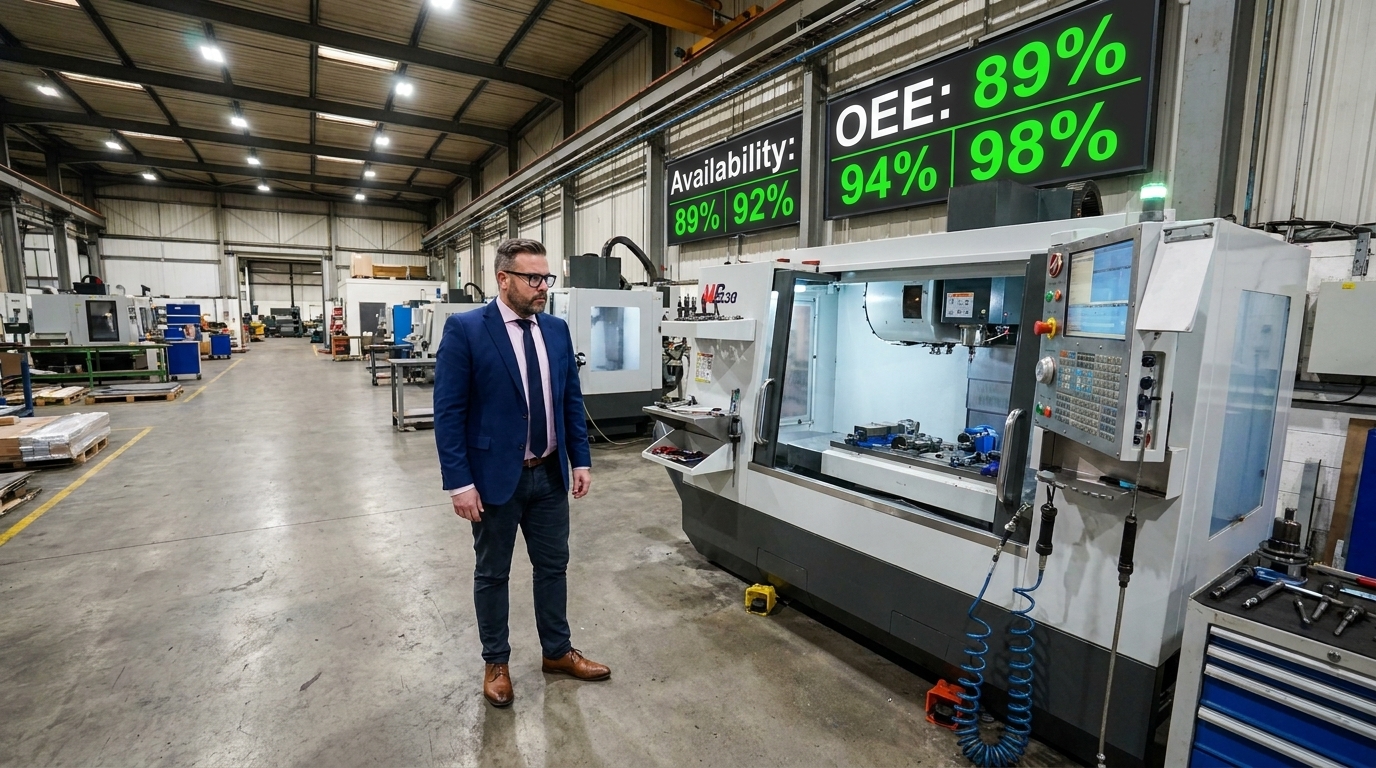
You bought the software. You installed the sensors. You hired the OEE
champion. You put a giant digital dashboard on the shop floor showing a
rolling OEE percentage in colors so bright they could be seen from the
parking lot. Green meant good. Red meant someone was about to have an
uncomfortable conversation. And for the first few months, the number
climbed. Sixty-two percent. Seventy-one percent. Eighty-three percent.
Your COO sent an all-company email congratulating the team. Investors
were shown the dashboard during facility tours. A consulting firm used
your plant as a case study.
And the actual equipment effectiveness? The real, honest,
on-the-ground question of whether your machines were producing good
parts at their theoretical maximum rate? That number was almost
certainly flat. Or declining. You just couldn’t tell anymore, because
the metric you built to measure it had become something else entirely: a
story your organization told itself about how well it was doing,
carefully constructed from components that had each been individually
optimized to produce a number that looked like improvement without
actually being improvement.
Overall Equipment Effectiveness is one of the most powerful
diagnostic tools in modern manufacturing. It is also one of the most
systematically corrupted metrics in the history of industrial
measurement. And the story of how that corruption happens — how a
concept designed to reveal the truth about your equipment becomes the
machinery for hiding it — is a story every manufacturing leader needs to
understand before their own OEE dashboard becomes the most expensive lie
in the building.
What OEE Actually Is —
and Why It Worked
OEE was developed by Seiichi Nakajima in the 1960s as part of the
Total Productive Maintenance framework. The concept is elegant in its
simplicity. It breaks equipment effectiveness into three multiplicative
components:
Availability — the percentage of scheduled time your
equipment is actually running. Downtime for changeovers, breakdowns,
missing materials, and planned maintenance all eat into this number.
Performance — the speed at which your equipment
operates compared to its theoretical maximum. Small slowdowns,
micro-stops, and running below nameplate speed all eat into this
number.
Quality — the percentage of parts produced that meet
specification. Scrap and rework eat into this number.
Multiply them together and you get OEE — a single number that, when
calculated honestly, tells you exactly how much of your equipment’s
potential you are actually realizing. A world-class OEE is generally
considered to be around 85%. Most manufacturers operate somewhere
between 40% and 60%. The gap between those numbers represents billions
of dollars in untapped capacity, unnecessary capital expenditure, and
competitive disadvantage.
The power of OEE is that it forces honesty. You cannot hide behind a
high availability number if your performance rate is terrible. You
cannot celebrate a high quality rate if your machines are down half the
shift. The multiplication is unforgiving: a 90% availability times a 90%
performance times a 90% quality gives you 72.9% OEE — which immediately
tells you that “pretty good” in three categories is “not great”
overall.
For the first decade or so after an organization adopts OEE, this
honesty is transformative. People see the real numbers for the first
time. The gap between what they thought was happening and what is
actually happening creates urgency. Improvement projects get launched.
Breakdowns get investigated. Changeover times get attacked. And the
number goes up because real things are getting better.
Then the number becomes important. And that is when everything starts
to go wrong.
Phase One: The Availability
Game
Availability is the easiest component to game because it is the
easiest to redefine. The formula is simple: run time divided by planned
production time. But what counts as planned production time? That is
where the creativity begins.
The first move is usually reclassifying downtime. A machine goes down
for forty minutes because of a material shortage. The operator logs it
as “external cause — logistics” rather than “equipment downtime.” The
shift supervisor approves the reclassification because, technically, the
machine didn’t break — it just wasn’t being fed. The OEE calculation
excludes the event from availability because it wasn’t an equipment
failure. The availability number stays high. The actual lost production
is identical, but it has been moved off the books.
Then come the planned downtime reclassifications. Changeovers that
used to take ninety minutes are reclassified as “planned maintenance
windows” and removed from the denominator entirely. A 45-minute shift
handover that used to count against availability is reclassified as
“non-production time.” The scheduled production window shrinks from 410
minutes to 360 minutes per shift, and suddenly availability jumps from
78% to 89% — without a single minute of actual improvement.
The most sophisticated version of this game involves simply not
counting certain stops. The OEE software has a threshold — events
shorter than five minutes, or two minutes, or one minute, are classified
as “minor stops” and rolled into the performance calculation rather than
availability. So operators learn to restart machines within the
threshold window. The machine stops. The operator hits reset. The
machine starts again. The stop is too short to register in availability.
The performance rate takes a small hit, but performance has more
headroom anyway. Net effect: availability looks better, OEE looks
better, and the underlying instability that caused the stops in the
first place continues to degrade the equipment.
None of this is fraud. It is all defensible. It is all done by smart,
well-meaning people who have been told that OEE is the metric that
matters, and who are responding rationally to that incentive. They are
not lying about the numbers. They are simply choosing, from among the
many legitimate ways to calculate availability, the one that makes the
number look best. And then doing it again next month. And again the
month after that. Each individual reclassification is reasonable. The
cumulative effect is a complete disconnect between the OEE number and
actual equipment effectiveness.
Phase Two: The Performance
Illusion
Performance is where the most insidious gaming happens because it
involves the most technical-sounding justification. Performance is
actual cycle time divided by ideal cycle time. The ideal cycle time —
the theoretical maximum speed at which the equipment can run — is the
number that determines everything.
And it is a number that someone, at some point, set based on limited
information.
The game begins when someone realizes that lowering the ideal cycle
time makes the performance number go up. Not the actual speed of the
machine — just the number on the dashboard. If your machine was rated to
produce 100 parts per minute but you typically run it at 85 parts per
minute, your performance is 85%. But if you redefine the ideal cycle
time as 90 parts per minute — citing wear, age, tooling considerations,
or “process realities” — your performance at the same actual speed jumps
to 94%.
The justifications are always reasonable. “The nameplate speed was
theoretical.” “The equipment is fifteen years old.” “We’ve never
actually run at that speed.” “The vendor rating was optimistic.” Each of
these statements may be true. But the effect of acting on all of them
simultaneously is that the performance number inflates without any
change in actual output.
The deeper problem is that ideal cycle time is supposed to be
aspirational — it is the speed at which the equipment should run under
optimal conditions. It is the reference point that tells you how much
room there is for improvement. When you lower it to make today’s
performance look better, you are not just inflating the number. You are
destroying the diagnostic power of the metric. You can no longer see the
gap because you have moved the target to where the arrow already
landed.
Then there is the micro-stop problem. Performance is often calculated
from total parts produced divided by run time at ideal cycle rate. But
micro-stops — those brief interruptions where the machine pauses for ten
seconds to clear a sensor, or an operator clears a jam without logging
it — reduce actual output without showing up as downtime. The
performance number absorbs them silently. A machine that runs at ideal
speed 90% of the time and micro-stops for the other 10% shows a
performance rate of 90%, which sounds decent. But that 10% of
micro-stops often represents the most addressable waste in the entire
process — the small, recurring instability that, if fixed, would unlock
real capacity. Because the performance number absorbs them without
distinguishing them, they become invisible.
Phase Three: The Quality
Loophole
Quality is the most straightforward component — good parts divided by
total parts — and it is also the one where the gaming is most structural
and least visible.
The most common move is reclassification of borderline parts. A part
that is slightly out of tolerance on one dimension gets sent to rework
rather than scrap. Reworked parts that pass subsequent inspection are
counted as good parts. The quality rate stays high. But the rework cost
— the labor, the machine time, the material waste — is real, and it is
hidden inside the quality number.
A more aggressive version is “deviation approval.” A part that
doesn’t meet specification gets a deviation signed by engineering
allowing it to be used as-is. It is now, by definition, a good part. The
quality rate is unaffected. The customer who receives the part has no
idea that it was produced out of specification. And the underlying
process issue that caused the deviation is never fixed because it never
shows up as a quality problem.
The most systemic version is the “inspection escape.” Quality is
often measured at the point of production — the in-process check that
determines whether the part is counted as good or bad. But defects that
are caught later — at final inspection, at the customer, in the field —
are often tracked in a separate system that does not feed back into OEE.
The production quality rate looks excellent. The overall cost of poor
quality, spread across warranty claims, customer returns, and brand
damage, tells a very different story. But that story lives in a
different department’s spreadsheet, so the OEE dashboard never sees
it.
The Multiplier
Effect of Collective Gaming
Here is where the tragedy reaches its full dimension. Each component
of OEE — availability, performance, quality — can be individually
inflated by 5-8% through reasonable, defensible adjustments. That does
not sound catastrophic. But OEE is multiplicative. A 5% inflation in
each component compounds:
Real OEE: 0.75 × 0.80 × 0.92 = 0.552 (55.2%) Reported OEE: 0.80 ×
0.85 × 0.97 = 0.660 (66.0%)
That is an 11-point gap — a 20% overstatement of actual equipment
effectiveness. And because each individual adjustment was reasonable,
nobody feels responsible for the gap. The availability manager points
out that the downtime reclassifications are standard practice. The
performance engineer notes that the ideal cycle time adjustment is
documented and approved. The quality director explains that rework
classification follows industry norms. Each person is correct. Together,
they have built a number that bears no relationship to reality.
This is the point at which the dashboard becomes actively dangerous.
Leadership looks at the OEE trend — climbing steadily, now approaching
world-class — and makes decisions based on it. Capital expenditure
requests are denied because the equipment is “running at 82% OEE —
there’s headroom.” Improvement projects are deprioritized because the
numbers say things are getting better. The gap between the reported
number and the real number grows wider every month, and the
organization’s ability to see its own problems shrinks in direct
proportion.
The Irony of OEE Software
The great irony of the OEE software revolution is that automation has
made the gaming worse, not better. When OEE was calculated manually by
engineers who understood the process, the calculations were transparent.
You could see the assumptions. You could challenge the ideal cycle time.
You could trace a downtime event from the machine to the
spreadsheet.
Modern OEE software automates the calculation, which means it
automates the assumptions. The ideal cycle time is a field in a
configuration screen, set once and forgotten. The downtime categories
are predefined, and the rules for what goes where are baked into the
system. The thresholds for micro-stops are set in a parameter that most
users have never looked at. The software does not make these choices
visible — it makes them invisible. The number on the dashboard looks
objective, data-driven, and authoritative. But it is the product of
dozens of hidden assumptions, each of which was set by someone who had
an incentive to make the number look good.
The result is OEE theater — a performance so convincing that even the
actors believe it. The dashboard says 84%. The actual equipment
effectiveness is 58%. And the sixteen people in the organization who
know the truth — the operators who see the micro-stops, the engineers
who know the ideal cycle time is wrong, the quality techs who see the
rework piling up — have learned that raising these issues is a
career-limiting move. The number is going up. Leadership is happy. Why
would anyone point out that it is a lie?
How to Fix It
The fix is not to abandon OEE. It remains one of the best diagnostic
frameworks in manufacturing. The fix is to restore its honesty through
structural changes that make the gaming visible and unrewarding.
Audit the three inputs annually. Bring in someone
who was not involved in setting the parameters and have them validate
the ideal cycle time against actual machine capability data. Review
every downtime category reclassification from the past year. Trace a
sample of parts through the entire quality process — production, rework,
final inspection, customer return — to see where the numbers
diverge.
Track the components, not just the product. An OEE
number without its three components is meaningless. If availability is
95% and performance is 65%, the OEE of 57% tells you something very
specific: your problem is speed, not downtime. But if the components
have been inflated, the diagnosis is wrong. Publish the components
openly. Let people see which one is moving and ask why.
Separate the diagnostic from the target. This is the
hardest change and the most important. OEE was designed as a diagnostic
tool — a way to see where you were losing effectiveness so you could fix
it. When it becomes a target — when it appears on scorecards, when it
drives bonuses, when it is shown to investors — it ceases to be a
diagnostic and becomes a story. Goodhart’s Law applies in full force.
The moment OEE becomes a target, it stops being a measure. Keep it as a
diagnostic. Measure improvements in specific losses — changeover time
reduction, micro-stop elimination, scrap reduction — rather than in the
aggregate number.
Resist the denominator shrink. Every reduction in
planned production time — every reclassification of shift time, every
expansion of planned maintenance windows — inflates OEE without
improving effectiveness. Track planned production time as a metric in
its own right. If it is shrinking while OEE is climbing, you are not
improving. You are reclassifying.
Listen to the operators. The sixteen people who know
the truth are always on the shop floor. They see the micro-stops that do
not register. They know the machine cannot actually run at the ideal
cycle time without jamming. They see the rework piling up. Create a
channel for their observations that does not threaten the OEE number — a
parallel reporting system focused on losses, not percentages. The
operators will tell you exactly where the number diverges from reality.
They always know.
The Deeper Lesson
OEE is not unique. The pattern — a powerful diagnostic metric that
becomes corrupted when it becomes important — repeats across every
quality tool and manufacturing system. SPC charts become wallpaper.
Control plans become paperwork. FMEAs become spreadsheets. And OEE
becomes a dashboard that everyone admires and nobody believes.
The lesson is not that these tools are broken. It is that measurement
systems have a natural lifecycle. They are born honest, they become
useful, they become important, and then they become corrupted. The job
of leadership is not to prevent this cycle — it cannot be prevented —
but to recognize when it is happening and reset the system before the
gap between the number and reality becomes catastrophic.
Your OEE dashboard is probably lying to you. Not because anyone
intended to deceive, but because the metric has been through enough
hands, enough reclassifications, enough reasonable adjustments, that it
no longer reflects the truth it was designed to reveal. The fix starts
with a simple question: when was the last time you checked not the
number, but the assumptions behind it?
If you cannot answer that question, the dashboard has already won.
And the equipment it claims to represent is quietly declining while the
green numbers glow.
Peter Stasko is a Quality Architect with over 25
years of experience in manufacturing quality management, process
improvement, and production systems across automotive, electronics, and
industrial manufacturing sectors. He has implemented and audited OEE
systems in plants across three continents and has seen the same pattern
of metric corruption in every one of them.