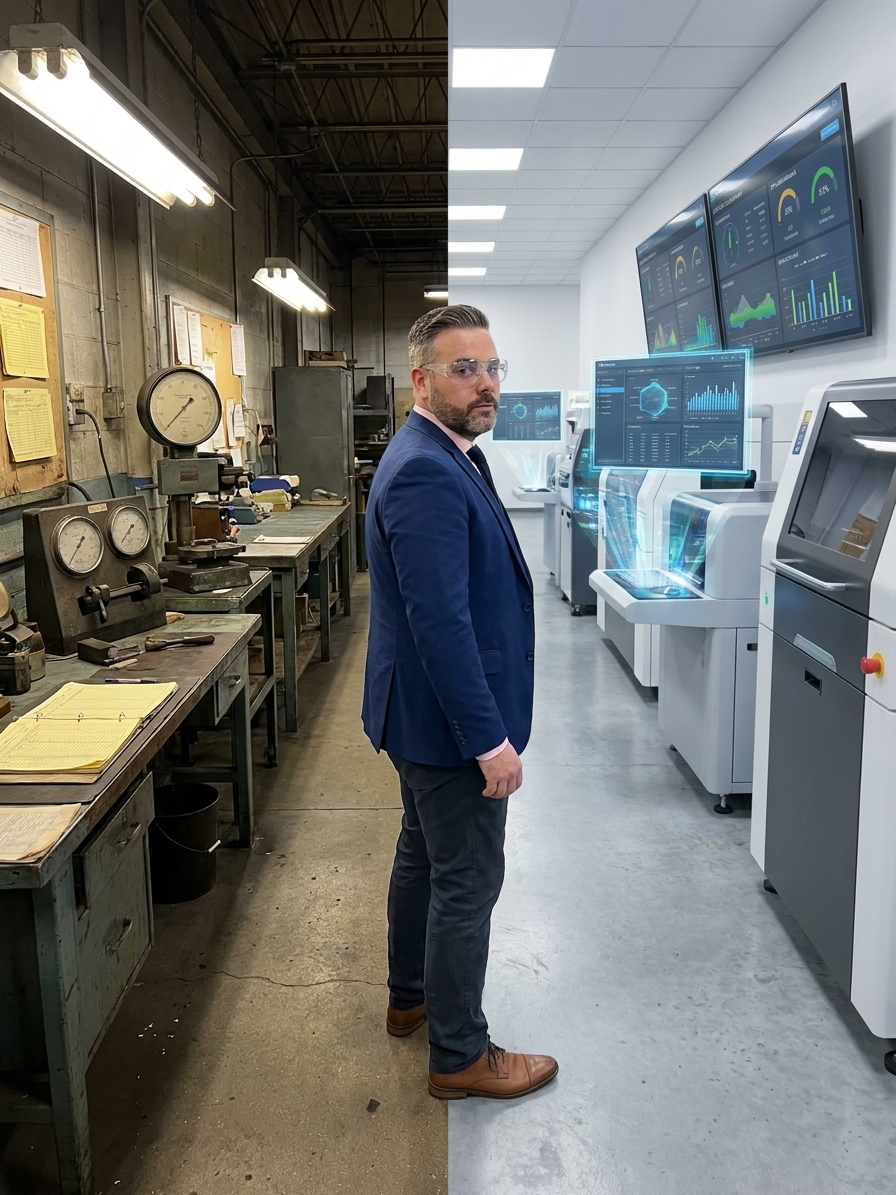
Walk into any plant that has been running for more than ten years and you will find processes nobody can fully explain, nobody wants to change, and nobody dares to question. Not because these processes are good. Not because they produce excellent results. But because they are familiar. This is the status quo bias — the deep, irrational preference for the current state of affairs over any alternative, even when the alternative is demonstrably better.
In manufacturing quality, this bias is not a psychological curiosity. It is one of the most powerful forces preventing organizations from improving, adapting, and surviving. It does not announce itself in management meetings as someone declaring a preference for mediocrity. It shows up as skepticism toward new methods, as defence of existing inspection steps that have never caught a defect, and as the quiet, persistent resistance to anything that threatens predictability.
I have audited plants where the status quo bias was the single largest source of quality cost — larger than scrap, larger than warranty, larger than supplier defects. The organization was not failing because it lacked tools or talent. It was failing because it had learned to defend its current state as stability, while that state quietly produced the defects it could no longer hide.
The Cognitive Mechanisms Behind the Bias
The status quo bias was first documented by Samuelson and Zeckhauser in 1988. It describes the tendency to prefer the current state of affairs even when better alternatives exist and the cost of switching is low. Four mechanisms drive it, and each one maps directly onto patterns I see in quality systems across automotive and aerospace plants.
Loss aversion is the first. People weigh potential losses from change more heavily than potential gains. A new inspection method might catch thirty percent more defects, but the five percent risk of disruption feels more significant than the improvement. The math is irrational, but the emotion is real — and in quality, emotion often overrides data.
The mere exposure effect reinforces this. People prefer things simply because they are familiar. The existing PFMEA feels safer, more tested, more reliable — not because it actually is, but because it is known. Anticipated regret completes the trap: people overestimate how much they will regret a change that goes wrong compared to how much they regret maintaining a failing process. A new SPC system that causes one false alarm feels worse than the old system that missed ten real shifts.
Where the Bias Lives in Your Quality System
The most visible symptom is the legacy process that nobody can justify. Every factory has them — processes running for years that everyone follows but nobody can explain. When someone asks why final inspection checks twelve dimensions when only four are critical, the answer is always the same: the procedure says so. The procedure was written in 2003. The product design has changed six times since then. The inspection criteria have not.

The status quo bias keeps these legacy processes alive not because they add value but because removing them feels like a risk. The burden of proof is always on the change, never on the status quo. The existing process gets a free pass simply because it exists. I have seen plants running inspection steps that have not caught a single defect in five years, yet the reaction to removing them is panic.
The same pattern infects measurement systems. Your CMM has been reporting measurements with a known bias of plus 0.02 mm for three years. The quality team knows about it. Engineering knows about it. Production compensates informally by adjusting process targets. Everyone has adapted to the inaccuracy rather than fixing it, because fixing it means recalibrating, retraining, updating procedures, and potentially re-inspecting recent production.
Symptoms of Status Quo Bias in Quality Systems
What teams do
- Defend inspection steps that have not caught a defect in years
- Work around a known CMM bias rather than recalibrate
- Keep deteriorating suppliers because qualification feels risky
- Shelve improvement proposals for further study that never happens
What works
- Calculate the annual cost of each legacy step and force the decision
- Run old and new systems in parallel and compare results directly
- Set mandatory review cycles so change becomes scheduled, not exceptional
- Shift the default: the improvement happens unless there is a documented reason to stop
The Cost Structure of Standing Still
Unlike one-time failures that produce dramatic events and immediate responses, the cost of the status quo bias is continuous, cumulative, and invisible. Every outdated procedure, every legacy inspection step, every known-but-uncorrected measurement bias adds to the organization's quality technical debt. Like financial debt, it compounds. The longer you maintain the status quo, the more expensive the eventual correction becomes.
Competitive erosion runs parallel. While your organization defends its existing quality system, competitors are improving theirs. The gap does not appear overnight. It appears gradually, as your defect rates stay flat while theirs decline, your customer returns hold steady while theirs drop, your cost of quality remains unchanged while theirs shrinks. You will not notice the year it happened. You will notice the year you lost the contract.
Talent loss accelerates the decline. The best quality engineers and managers want to improve things. When they encounter an organization where every improvement suggestion is met with resistance, they leave. The people who stay are the ones comfortable with the status quo, which reinforces the bias in a self-perpetuating cycle. The organization becomes progressively less capable of the change it desperately needs.
Why Quality Departments Are Especially Vulnerable
Several factors make the status quo bias particularly difficult to combat inside quality functions. Quality professionals are trained to manage risk, and this training — while essential — can reinforce the bias by framing any change as a risk to be mitigated rather than an opportunity to be seized. The risk assessment process meant to protect the organization becomes the process that prevents it from improving.
Certification pressures compound this. ISO 9001, IATF 16949, and AS9100 create a framework that organizations invest heavily in maintaining. Changing that framework feels like threatening the certification itself, even though every one of these standards explicitly requires continual improvement. The certification becomes a reason not to change rather than a framework for changing intelligently.
The measurement problem seals it. It is easy to measure the cost of a change. It is difficult to measure the cost of not changing. New SPC software has a clear price tag. The cost of continuing to miss process shifts with the old system is buried in scrap, rework, warranty claims, and customer dissatisfaction across dozens of product lines over months and years. The bias exploits this asymmetry by making the cost of change visible and the cost of standing still invisible.
The certification becomes a reason not to change rather than a framework for changing intelligently.
Structured Methods to Break the Pattern
Overcoming the status quo bias requires deliberate, structured approaches — not appeals to motivation or culture. The most effective antidote is data that reveals the true cost of not changing. Calculate the annual cost of maintaining legacy inspection steps that add no value. Quantify the warranty cost of known measurement biases that go uncorrected. Estimate the revenue at risk from declining supplier quality. When the cost of the status quo is expressed in the same concrete terms as the cost of change, the bias loses much of its power.
The reversal test, proposed by Bostrom and Ord, is another practical tool. If your organization is considering a change from state A to state B, ask whether you would also resist changing from state B to state A. If the existing inspection process produced a forty percent escape rate and someone proposed a new process that would produce the current fifteen percent rate, would you resist it? If the answer is no, your resistance to the reverse change is driven by bias, not by genuine evaluation.
Parallel systems address the fear of disruption directly. When resistance is driven by uncertainty, run the old and new methods side by side for a defined period. Compare results. It is hard to argue for the old method when you can see the new one catching defects the old one missed. Shifting the default option works the same way: instead of asking whether to switch, announce the transition date and require a documented reason to stop it.
Breaking the Bias: A Decision Sequence
- 01Quantify the status quoCalculate annual cost of legacy steps, known measurement bias, and supplier decline in hard currency.
- 02Apply the reversal testAsk whether you would resist changing from the proposed new state back to the current one.
- 03Run parallel systemsOperate old and new methods simultaneously for a fixed period and compare defect data side by side.
- 04Shift the defaultSet the improvement as the planned transition; require documented evidence to override it.
- 05Schedule mandatory reviewEvery quality process faces a fixed-cycle review that explicitly asks whether better alternatives now exist.
The Realisation That Drives Improvement
The fundamental irony of the status quo bias in manufacturing quality is that quality management is, at its core, the discipline of change. Continual improvement is change. Corrective action is change. Preventive action is change. Every quality tool — from Pareto analysis to Six Sigma to lean manufacturing — exists to identify what should change and how to change it.
An organization that has succumbed to the status quo bias has not merely fallen behind. It has fundamentally misunderstood what quality management is. Quality is not a state to be preserved. It is a capability to be developed, a standard to be raised, a process to be evolved. The moment an organization decides its current quality system is good enough to leave alone, decline has already begun.
Look at your quality system — your procedures, your inspection methods, your measurement systems, your supplier arrangements, your corrective action process. For each element, ask one question: if we were designing this from scratch today, knowing what we know now, would we design it exactly this way? If the answer is no and you are not changing it, the status quo bias is making your decisions for you.
The status quo is not safety. It is stagnation dressed in the language of stability. In manufacturing, stagnation is not a stable state. It is the beginning of decline — slow enough to ignore, steady enough to be fatal. The processes you are protecting are not protecting your quality. They are protecting your comfort while your quality quietly deteriorates.