Quality
Andon: When Your Organization Stops Hiding Problems and Starts Making
Them Visible in Real Time — and the Problems You Exposed Became the
Trust You Built
There is a moment in every manufacturing plant where a decision is
made that defines everything that follows. It happens in a fraction of a
second, and most organizations never even realize they made it.
An operator notices something wrong. The part doesn’t feel right. The
surface finish is off. The dimension is drifting. In that instant, a
question flashes through their mind — should I stop the
line?
In most organizations, the answer is obvious. Don’t stop. Keep going.
Fix it later. The schedule matters more. The target matters more.
Someone will catch it downstream. And so the defect flows on, the
operator buries the doubt, and the system teaches its most powerful
lesson: problems are not welcome here.
The organizations that master quality have made a different choice.
They have built a system — a philosophy, a culture, a signal — that
answers that question before the operator even has to ask it. It is
called Andon. And it changes everything.
What Is Andon?
The word comes from Japanese manufacturing. Literally, it means
“lantern” or “lamp.” In the Toyota Production System, an Andon is a
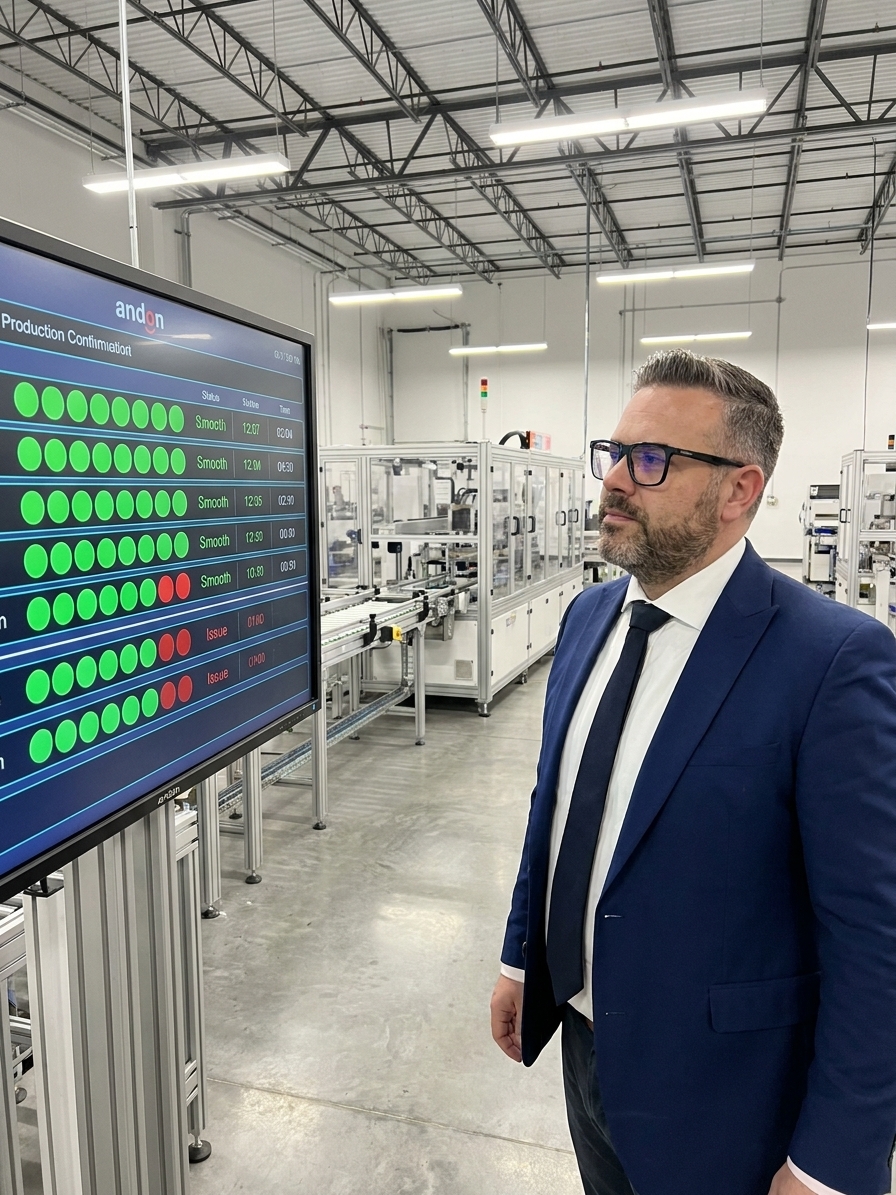
visual signal — a light, a board, an alarm — that tells everyone in the
area that something has gone wrong and needs attention. Not later. Not
after the shift. Not when someone has time. Now.
But Andon is not really about the light. The light is just the
mechanism. Andon is about permission. It is the
organization saying, explicitly and unmistakably, that stopping
production to fix a problem is not a failure — it is the highest form of
professional discipline.
In a factory without Andon, problems are buried. Operators learn to
work around issues. Supervisors learn to manage through crises. Quality
becomes a function of heroism — individual people catching individual
defects through individual effort. It is exhausting, unsustainable, and
ultimately doomed.
In a factory with Andon, problems are exposed. The moment something
goes wrong, it is visible to everyone. The operator pulls the cord. The
light flashes. The team leader arrives. The problem is diagnosed. The
fix is applied. Production resumes. The entire cycle might take three
minutes. And in those three minutes, the organization just prevented a
defect that would have cost thirty hours to track down and correct
downstream.
The Mathematics of Stopping
Let me show you the arithmetic, because the arithmetic is what
convinces the skeptics.
A production line runs at 60 parts per hour. A defect appears at
Station 4. The operator doesn’t pull the Andon. The defect flows through
Stations 5, 6, 7, and 8 before it is caught at final inspection. By that
time, 27 minutes have passed. In those 27 minutes, the line produced 27
additional parts — and because the root cause was never addressed, every
single one of them carries the same defect. You now have 28 defective
parts. Each one needs to be dispositioned: scrap, rework, or sort. The
quality engineers spend two hours tracing the problem back to Station 4.
The corrective action takes another day.
Total cost: 28 defective parts, 2 hours of engineering investigation,
1 day of corrective action, and one customer who received a shipment
late.
Now the same scenario with Andon. The defect appears at Station 4.
The operator pulls the cord immediately. The line stops. The team leader
arrives in 30 seconds. They diagnose the issue — a worn tool insert — in
90 seconds. The insert is replaced. The line restarts. Total downtime: 3
minutes. Defective parts produced: 1.
The math is not complicated. The line stopped for 3 minutes to
prevent 27 minutes of defective production. The organization traded a
small, visible cost for a large, hidden one. And it did so with the full
knowledge and participation of everyone involved.
This is the Andon bargain, and it is the best deal in
manufacturing.
The Three Levels of Andon
Maturity
Organizations don’t implement Andon overnight. They evolve through
it. After 25 years of watching this evolution across automotive,
aerospace, and pharmaceutical plants on three continents, I have seen a
clear pattern — three distinct stages that separate the organizations
that merely install lights from the ones that truly transform.
Level 1: The Light Nobody
Pulls
The organization has installed Andon cords. It has trained people on
the procedure. It has even written it into the standard work. But nobody
pulls the cord.
Why? Because the culture hasn’t changed. Operators know — through
experience, through observation, through the subtle signals that
organizations send — that stopping the line is punished, not rewarded.
Maybe not formally. Maybe nobody gets written up for pulling the cord.
But the operator who stops production gets the stare from the supervisor
who is behind on the schedule. They get the sarcastic comment in the
break room. They get the reputation for being “difficult.”
The light is there. The cord is there. The system is there. But the
culture kills it before it breathes.
I once visited a plant that had spent $200,000 installing an Andon
system — lights, buzzers, digital displays, the works. In the previous
month, the system had been activated exactly zero times. Zero. The plant
was producing 15,000 parts a day with a defect rate of 2.3%. That’s 345
defective parts a day that nobody stopped to fix because the $200,000
system was nothing more than expensive theater.
Level 2: The Light People
Pull
This is where real change begins. Operators pull the cord. The line
stops. Supervisors respond. Problems get fixed. The defect rate drops.
Productivity, counter-intuitively, goes up.
Getting to Level 2 requires three things. First,
psychological safety — the absolute, unwavering
conviction that pulling the Andon will never result in punishment,
criticism, or social penalty. This has to come from the top. The plant
manager has to celebrate the pull, not tolerate it. I have seen plant
managers who, when an Andon was activated, walked to the station, shook
the operator’s hand, and said, “Thank you for catching that.” That
single gesture did more for quality than any training program ever
could.
Second, response discipline. When the cord is
pulled, someone has to show up. Immediately. Not in ten minutes. Not
after they finish what they’re doing. Now. If the operator pulls the
cord and nobody comes, the system teaches a lesson: your signal
doesn’t matter. And the cord stays silent after that.
Third, closure. Every Andon activation must end with
a documented root cause and corrective action. Not a band-aid. Not a
workaround. A real fix. The operator needs to see that their signal led
to a permanent improvement. This is what turns a one-time act of courage
into a sustainable habit.
Level 3: The Light That
Pulls Itself
This is the pinnacle. This is where technology meets culture in a way
that makes Andon automatic, continuous, and invisible.
At Level 3, the system itself detects the anomaly. Sensors monitor
process parameters in real time. Machine learning algorithms identify
patterns that precede defects. Statistical process control limits
trigger automatic alerts. The Andon activates before the defect is even
produced.
But here is the critical insight: Level 3 only works if Level 2 is
already solid. Technology does not create Andon culture. It amplifies
it. If you automate Andon without first building the human discipline of
stopping and fixing, you end up with a system that generates alerts that
nobody responds to. And you are back at Level 1, but with more expensive
technology.
The plants that achieve Level 3 are the ones that spent years at
Level 2 first. They built the muscle memory of responding to problems.
They built the trust between operators and management. They built the
discipline of root cause analysis. And then, when the technology
arrived, it was like giving a calculator to someone who already
understood mathematics — it made them faster, not different.
The Hidden
Benefit: Trust as a Quality System
Here is something most people miss about Andon. The defect prevention
is important, but it is not the most important thing. The most important
thing is trust.
When an organization implements Andon — real Andon, not just the
lights — it is making a declaration. It is saying to every operator,
every technician, every team leader: We trust your judgment. We
believe that you know when something is wrong. And we are willing to
stop the entire operation to listen to what you have to say.
This is radical. Most manufacturing organizations operate on the
opposite assumption — that operators need to be monitored, controlled,
and managed. Andon inverts the power dynamic. It says that the person
closest to the work has the best information, and the organization’s job
is to create a channel for that information to flow.
The trust that Andon builds does not stay on the production floor. It
spreads. Operators who feel trusted become operators who take ownership.
They start suggesting improvements. They start coaching new hires. They
start caring about the quality of the work in a way that no inspection
system, no audit protocol, and no management directive could ever
compel.
I have seen this transformation happen. A pharmaceutical plant in
Central Europe implemented Andon as part of a larger quality improvement
initiative. In the first month, Andon activations averaged 3 per day.
The operators were testing the system — will they really come? Will they
really fix it? Will I really be safe? When the answer was yes,
consistently and without exception, the activations increased. By month
three, the average was 12 per day. By month six, it was 8 per day —
because the permanent fixes from the earlier activations had eliminated
the root causes.
Defect rate dropped by 62% in six months. But more remarkably,
employee engagement scores increased by 34%. Absenteeism decreased by
18%. The plant went from being one of the worst performers in the
company’s global network to one of the best. And it started with a
simple signal: we want to see your problems.
Digital Andon: The Next
Frontier
The Andon concept is evolving beyond the factory floor. With Industry
4.0 technologies, Andon is becoming:
- Predictive: Machine learning models detect
anomalies before they become defects, triggering preventive Andon
signals - Mobile: Real-time alerts pushed to smartphones and
tablets, so the right expert responds regardless of their location - Data-rich: Every Andon activation generates a data
point that feeds into trend analysis, enabling systemic improvements
rather than just point fixes - Cross-functional: Supply chain Andon systems that
alert teams to incoming material quality issues before they reach the
production floor
But the principle remains the same. Technology without culture is
just expensive hardware. The most sophisticated digital Andon system in
the world is worthless if the organization’s culture still punishes
people for exposing problems.
The Andon Litmus Test
If you want to know whether your organization has real Andon or
theater, ask yourself one question: What happened the last time
someone stopped the line?
Did the supervisor rush over with support or with frustration? Did
the plant manager acknowledge it in the morning meeting or conveniently
ignore it? Did the operator who pulled the cord feel proud or
anxious?
The answer to that single question will tell you more about your
quality culture than any audit report ever could.
Andon is not a tool. It is not a system. It is not a piece of
equipment. It is a promise that the organization makes to its people:
We would rather stop and fix than run and hide. And the
organizations that keep that promise — consistently, relentlessly,
without exception — are the ones that achieve quality levels that their
competitors cannot understand, let alone match.
The light is easy to install. The culture is the real work. But if
you do the work, the results will speak for themselves — in defect
rates, in employee engagement, in customer satisfaction, and in the
quiet confidence of an operator who knows that when they see something
wrong, their organization is ready to hear it.
Peter Stasko is a Quality Architect with 25+ years
of experience transforming organizations across automotive, aerospace,
and pharmaceutical industries. He specializes in building quality
systems that work in the real world — not just on paper — with a focus
on culture, process discipline, and the practical application of lean
and statistical methods.