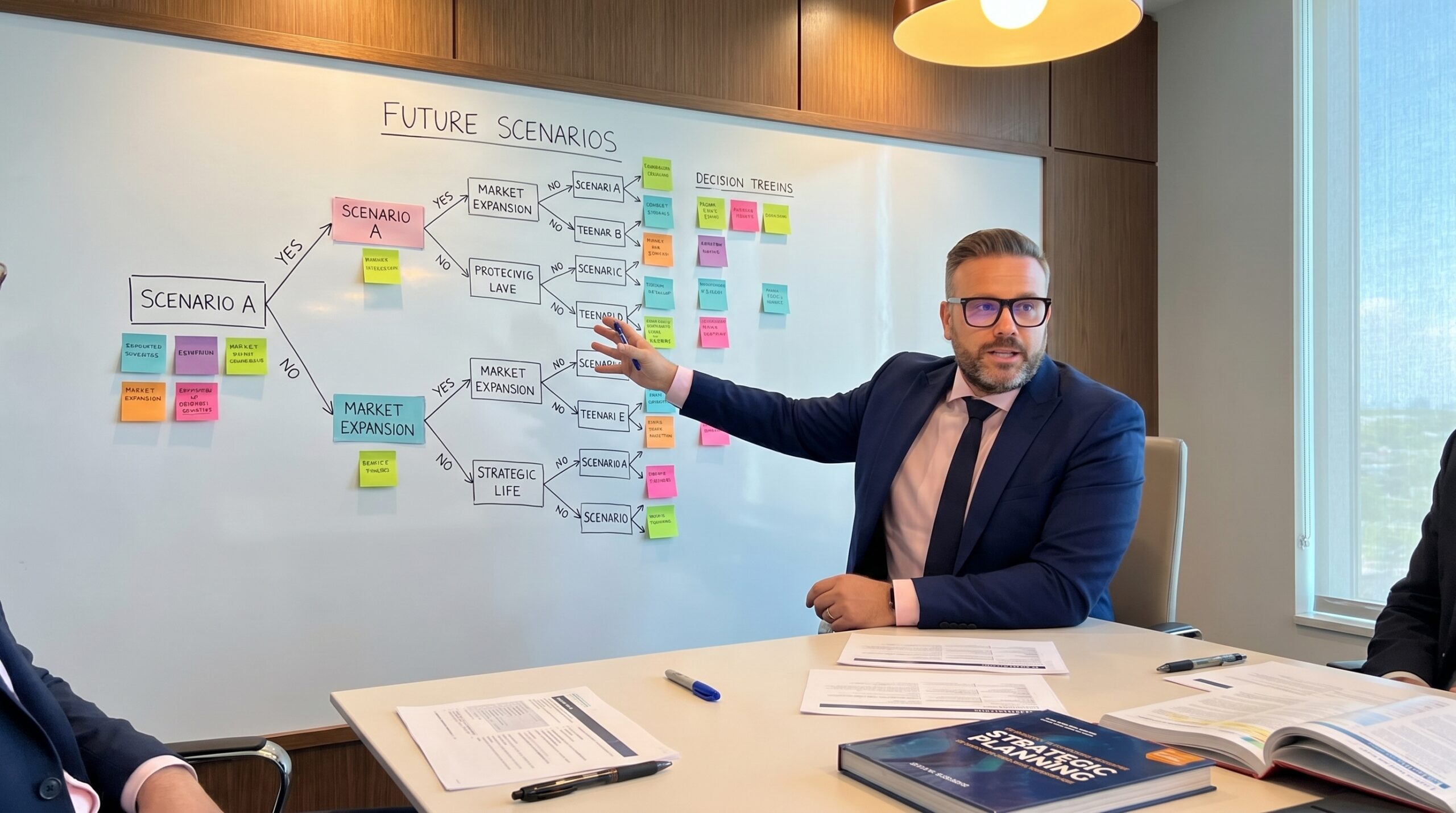
Quality Scenario Planning: When Your Quality System Stops Preparing for One Future — and Starts Surviving All of Them
The Danger of the Single Story
Every quality manager has a plan. It sits in a binder, or a SharePoint folder, or — if you’re lucky — in a living document that someone actually updates. It describes how your quality system will respond when things go wrong. There’s a corrective action procedure. There’s a risk assessment. There’s a contingency for supplier failure and a backup for equipment breakdown.
But here’s the uncomfortable truth that most organizations discover only after disaster strikes: that plan was written for one future. One reality. One set of assumptions about what “going wrong” actually looks like.
And reality? Reality doesn’t read your procedures.
In 2024, a mid-sized automotive supplier in Central Europe had a beautifully documented quality management system. ISO 9001 certified. IATF 16949 compliant. Risk registers maintained quarterly. FMEAs updated for every new product launch. Their quality team was competent, their processes were capable, and their customers were satisfied.
Then three things happened simultaneously: a key raw material supplier in Asia shut down without warning due to a geopolitical event, a new regulatory requirement dropped with a six-month compliance deadline, and their most experienced quality engineer — the one who held twenty years of process knowledge in her head — resigned.
Their quality system, built for a world where problems arrive one at a time and announce themselves politely, collapsed under the weight of three converging disruptions.
This is the scenario that most quality systems are not built to handle. Not the single failure, but the convergence. Not the known risk, but the unfamiliar combination. Not the problem you planned for, but the future you never imagined.
This is where Quality Scenario Planning becomes not just useful, but essential.
What Is Quality Scenario Planning?
Scenario planning is not new. The military has used it for centuries. Royal Dutch Shell famously used it to navigate the 1973 oil crisis, emerging stronger while competitors scrambled. Strategic planners use it to test business models against multiple possible futures.
But in quality management? It remains remarkably rare.
Quality Scenario Planning is the disciplined practice of constructing multiple, plausible future states for your quality environment — and then testing your quality system against each one to identify vulnerabilities before they become crises.
It is not prediction. It is not forecasting. It is not about guessing which future will arrive. It is about building a quality system robust enough to handle several of them.
Think of it as stress-testing your quality system the way banks stress-test their portfolios. Not because you expect a financial crisis, but because you want to know exactly where you’ll break if one comes.
The Five Futures Every Quality System Should Rehearse
Through years of working with manufacturing organizations across automotive, electronics, and medical devices, I’ve identified five scenario archetypes that every quality system should be tested against. Not because these are the only futures possible, but because they represent the categories of disruption that expose the deepest vulnerabilities.
Scenario 1: The Talent Cliff
The premise: Your three most critical quality professionals leave within 90 days. Not because of one event — coincidence, retirement, and a competitor’s offer.
What it exposes: Your knowledge management, succession planning, documentation quality, and onboarding effectiveness. If your FMEA ratings depend on one person’s judgment, if your calibration system runs on one person’s memory, if your customer-specific requirements live in one person’s inbox — this scenario will find the gap.
The question: Can your quality system maintain capability and compliance with three key people gone?
Scenario 2: The Supply Chain Earthquake
The premise: Your top two suppliers for a critical component simultaneously fail — one loses certification, the other has a force majeure event. You have 30 days of inventory and no qualified alternative.
What it exposes: Your supplier qualification depth, your supply chain risk assessment maturity, your incoming inspection flexibility, and your customer communication protocols. Most organizations have backup suppliers listed in their APQP documentation. Few have actually qualified them. Fewer still have tested whether those backups can deliver at volume under time pressure.
The question: How fast can you qualify, validate, and integrate a new supplier without compromising your quality requirements?
Scenario 3: The Regulatory Shock
The premise: A new regulation or customer-specific requirement arrives with a compliance deadline that’s shorter than your typical change management cycle. Non-compliance means losing your largest customer.
What it exposes: Your management of change process, your document control agility, your training deployment speed, and your ability to demonstrate compliance under audit pressure. Organizations with rigid change management processes — the kind that take 90 days to update a control plan — will find themselves choosing between compliance and customer loss.
The question: Can your quality system adapt to a major requirement change in 30 days?
Scenario 4: The Silent Drift
The premise: Over 18 months, your process capability gradually degrades from Cpk 1.67 to Cpk 1.10. No single point failure. No dramatic event. Just slow, invisible erosion — until a customer audit catches it.
What it exposes: Your SPC effectiveness, your reaction protocols for gradual shifts, your management review depth, and your internal audit ability to detect systemic degradation. This is the most dangerous scenario because nothing triggers an alarm. Your control charts might show trends, but if no one’s reacting to them, the drift continues silently.
The question: Does your quality system have the sensitivity to detect slow degradation before an external party does?
Scenario 5: The Technology Disruption
The premise: A competitor introduces a product with fundamentally different technology that makes your current quality approach partially obsolete. Your customers start asking for capabilities your inspection methods can’t provide.
What it exposes: Your innovation readiness, your measurement system flexibility, your quality team’s technical adaptability, and your ability to validate new methods quickly. Quality systems built around legacy measurement and inspection approaches often struggle when technology shifts.
The question: Can your quality system evolve its methods and tools fast enough to remain relevant?
How to Run a Quality Scenario Planning Workshop
The power of scenario planning isn’t in the documents it produces — it’s in the conversations it forces. Here’s a practical framework for running your first Quality Scenario Planning workshop.
Step 1: Assemble the Right Team
Don’t do this with quality people alone. You need supply chain, engineering, production, HR, and commercial perspectives in the room. Quality scenarios are systemic — they don’t respect departmental boundaries.
Aim for 6-10 participants. More than that and the conversation fragments. Fewer and you lack perspective diversity.
Step 2: Pick Two Scenarios
Don’t try to tackle all five at once. Pick the two that feel most relevant to your current situation. If you’ve recently lost key people, start with the Talent Cliff. If your supply chain is concentrated, start with the Supply Chain Earthquake.
Step 3: Build the Narrative
For each scenario, spend 30 minutes building a detailed narrative. Not bullet points — a story. “On Monday morning, the quality manager receives a call from the supplier’s quality director. The supplier’s IATF certification has been suspended effective immediately due to a systemic nonconformity found during a surveillance audit…”
The narrative matters because it forces participants to imagine themselves in the situation. Bullet points are abstract. Stories are visceral.
Step 4: Stress-Test Your System
Now walk through your quality system step by step. What happens first? Who gets notified? What documentation is triggered? What decisions need to be made, and by whom? Where does the process break down?
Be brutally honest. If a step depends on a person who might not be available, flag it. If a document exists but hasn’t been updated in two years, flag it. If a procedure says “management shall review” but doesn’t specify who or when, flag it.
Step 5: Document the Vulnerabilities
Every gap you find is a gift. Document it with the same rigor you’d apply to an audit finding:
- Vulnerability: What specifically is at risk?
- Trigger: Under what scenario does this vulnerability become a failure?
- Impact: What happens if it fails — to product quality, customer satisfaction, compliance, cost?
- Current mitigation: What exists today that partially addresses this?
- Required action: What needs to change?
Step 6: Build Response Playbooks
For the highest-impact vulnerabilities, don’t just list them — write response playbooks. These are not standard operating procedures. They are scenario-specific action plans that can be activated when a situation begins to unfold.
A good response playbook includes: – Trigger criteria (what tells you this scenario is beginning) – Immediate actions (first 24-48 hours) – Communication protocol (who needs to know what, when) – Decision authority (who has the power to make which decisions) – Resource requirements (what you’ll need and where to get it) – Escalation criteria (when this becomes a crisis-level event)
The Scenario Planning Maturity Model
Organizations don’t jump from “never thought about it” to “fully prepared” overnight. Here’s a maturity progression I’ve observed:
Level 0 — Reactive: Quality system responds to events after they happen. No scenario thinking. Each crisis is a surprise.
Level 1 — Risk-Aware: Risk assessments exist (often for ISO compliance). Some risks have mitigation plans. But risks are treated independently, and the plans are rarely tested.
Level 2 — Scenario-Aware: The organization has conducted at least one scenario planning exercise. Key vulnerabilities are documented. Some response playbooks exist.
Level 3 — Scenario-Ready: Scenario planning is a regular practice (quarterly or semi-annually). Response playbooks are maintained and tested through tabletop exercises. The quality team can articulate its top vulnerabilities without looking at a document.
Level 4 — Scenario-Embedded: Scenario thinking is embedded in daily quality decisions. New processes are evaluated against multiple futures. The organization doesn’t just respond to scenarios — it anticipates them. Quality strategy is explicitly designed to be robust across multiple possible futures.
Most organizations I work with are at Level 1. A few have reached Level 2. I’ve seen Level 3 perhaps a dozen times. Level 4 is rare — but achievable.
The Connection to Existing Quality Tools
Scenario planning doesn’t replace your existing quality tools. It amplifies them.
FMEA becomes more powerful when you’ve thought through scenarios. Your failure mode analysis gains depth because you’ve imagined failure combinations, not just individual failure modes.
Risk assessments gain dimension when you test them against scenarios. A risk rated “medium” in isolation might become “critical” in combination with another concurrent event.
Management reviews become more strategic when they include scenario insights. Instead of reviewing what happened last quarter, you’re discussing what could happen next quarter — and whether you’re ready.
Training becomes more relevant when it’s built around scenarios. “Here’s how to fill out this form” is compliance training. “Here’s what to do when two suppliers fail in the same month” is capability training.
Contingency plans become testable when they’re scenario-based. You can run tabletop exercises. You can simulate disruptions. You can find out if your backup plan actually works before you need it.
The Human Element: Why This Work Matters Beyond Compliance
There’s a deeper reason to practice scenario planning that goes beyond risk management and system robustness.
It builds confidence.
Quality professionals who have walked through scenarios — who have imagined the worst and found a path through it — carry themselves differently. They’re less reactive in crises because the crisis feels less alien. They’ve been there before, in their minds. They know the terrain.
It builds collaboration. When engineering, quality, supply chain, and production sit in a room and work through a scenario together, they build relationships that activate instantly when the real crisis hits. They’ve already practiced working together under pressure.
It builds humility. Scenario planning has a way of revealing assumptions that everyone knew were fragile but nobody wanted to question. “We’ve always done it this way” dies quickly in a well-facilitated scenario workshop.
And perhaps most importantly, it builds organizational resilience that no certificate can provide. ISO 9001 tells you that you have a quality management system. Scenario planning tells you whether that system actually works when the world doesn’t cooperate.
Getting Started: This Week’s Homework
You don’t need a three-day offsite to start. Here’s what you can do this week:
-
Pick one scenario from the five above. The one that makes you most uncomfortable is probably the right choice.
-
Spend one hour walking through it with two or three colleagues. Don’t overthink the format. Just tell the story and see where your system breaks.
-
Write down three vulnerabilities you discovered. Not ten. Not a comprehensive report. Three. The three that scare you most.
-
Pick one and do something about it this month. Update a procedure. Qualify a backup supplier. Document a critical process that lives in one person’s head.
That’s it. One scenario. One hour. Three vulnerabilities. One action.
Because the future is coming whether your quality system is ready or not. And the organizations that survive aren’t the ones that predicted the right future. They’re the ones that prepared for several.
The Paradox of Preparation
Here’s the beautiful paradox of scenario planning: the scenarios you prepare for rarely arrive exactly as you imagined them. But the capabilities you build while preparing — the cross-functional relationships, the response playbooks, the documented knowledge, the practiced decision-making — those capabilities transfer to whatever future actually shows up.
You don’t prepare for a specific crisis. You prepare for crisis itself.
And that preparation — that organizational muscle memory for dealing with uncertainty — is the most underrated quality capability there is.
Your FMEA scores your failure modes. Your control plan manages your process. Your audit program verifies your compliance.
Your scenario planning builds your resilience.
And in a world where the only certainty is that something unexpected will happen, resilience isn’t a nice-to-have.
It’s the whole game.
Peter Stasko is a Quality Architect with 25+ years of experience in automotive and manufacturing quality management. He specializes in building quality systems that don’t just comply — they perform under pressure.