The Promise That Sold Itself
When Noriaki Kano published his model of customer satisfaction in
1984, he gave the quality world something it had desperately needed: a
vocabulary for the non-linear relationship between what you deliver and
how customers feel about it. The insight was elegant. Not all features
are equal. Some things customers explicitly demand — get them wrong and
you lose the customer. Some things customers don’t even know they want
until they experience them — get them right and you create delight. And
some things, no matter how much you improve them, will only ever prevent
dissatisfaction without ever generating satisfaction.
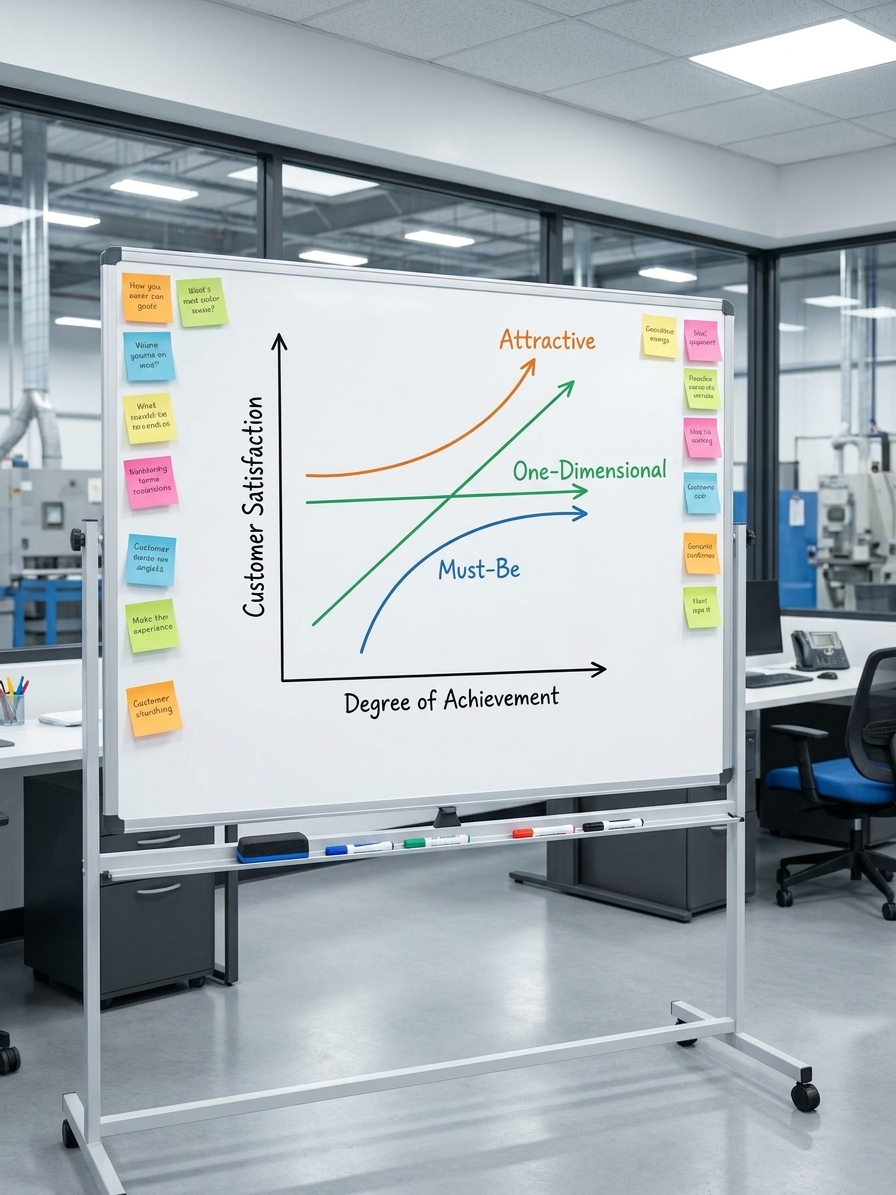
The Kano Model categorized these into five types: Must-Be
(threshold), One-Dimensional (performance), Attractive (excitement),
Indifferent, and Reverse. The framework spread through product
development, manufacturing quality, and service design like wildfire. It
was adopted by Six Sigma programs, embedded in QFD matrices, taught in
MBA courses, and plastered across strategy decks in every industry from
automotive to software.
And then, almost universally, it was misunderstood, misapplied,
reduced to a checkbox, and stripped of every insight that made it worth
using in the first place.
This is the story of how that happens — not because the Kano Model is
flawed, but because organizations are flawlessly consistent in their
ability to take a powerful analytical tool and transform it into
administrative theater.
The Five Categories
(Before We Distort Them)
Let’s briefly establish what the Kano Model actually says, because
the version most organizations practice bears little resemblance to the
original.
Must-Be (Threshold) Requirements: These are the
basics. The features or attributes that customers assume will be
present. A car must start. A phone must make calls. A surgical
instrument must be sterile. Their absence causes extreme
dissatisfaction, but their presence creates zero satisfaction. Meeting
them doesn’t win customers — failing them loses customers
permanently.
One-Dimensional (Performance) Requirements: These
exist on a linear spectrum. More is better. Faster delivery, longer
battery life, higher fuel efficiency. Customers explicitly request
these, and their satisfaction scales proportionally with performance.
This is where most competitive differentiation historically happens.
Attractive (Excitement) Requirements: These are the
unexpected delights. Features customers didn’t ask for, didn’t imagine,
and didn’t know they wanted — but once experienced, they become the
reason they choose you over everyone else. The first time a car
parallel-parked itself, that was an Attractive feature. The first time a
phone unlocked with your face, that was an Attractive feature.
Indifferent: Attributes the customer genuinely
doesn’t care about either way. Spending resources here is pure
waste.
Reverse: Attributes where more actually creates less
satisfaction. A complicated interface, an overwhelming number of
options, a feature that adds confusion rather than value.
The model also includes a critical dynamic insight:
attributes decay over time. What is Attractive today
becomes One-Dimensional tomorrow and Must-Be the day after. Face unlock
on phones was a delight in 2017. By 2020, it was expected. By 2023, its
absence was a dealbreaker. This lifecycle — this migration from
excitement to baseline — is the most practically important aspect of the
entire model, and it is almost never the part organizations focus
on.
Now let’s examine what actually happens when companies try to use
it.
How the Kano
Model Becomes a Survey Nobody Acts On
The typical Kano implementation follows a depressingly predictable
path.
Phase 1: The Discovery Session. A product manager or
quality director reads about the Kano Model in a book, attends a
conference presentation, or inherits it from a consultant’s deliverable.
They organize a workshop. Cross-functional stakeholders gather in a room
with sticky notes and brainstorm features. The energy is high. People
are genuinely engaged. The model’s categories make intuitive sense, and
for the first time, the team has a shared language for discussing why
some features matter more than others.
Phase 2: The Survey Construction. The team builds a
Kano questionnaire. For each feature, they ask two questions — a
functional form (“If the product has this feature, how do you feel?”)
and a dysfunctional form (“If the product does NOT have this feature,
how do you feel?”). Each question has five response options: I like it,
I expect it, I’m neutral, I can tolerate it, I dislike it. The responses
are cross-referenced in a standard Kano evaluation table to classify
each feature.
This is methodologically correct. It’s also where most organizations’
competence ends.
Phase 3: The Survey Deployment. The questionnaire is
sent to customers — or, more commonly, to a sample of customers selected
for convenience rather than representativeness. Response rates are low.
The survey is long. The dual-question format (functional + dysfunctional
for every feature) doubles the cognitive load. Customers rush through
it. The data quality degrades. But the survey was sent, so the box is
checked.
Phase 4: The Analysis That Wasn’t. The results come
back. Someone on the team — usually the newest hire or an intern — is
tasked with classifying each feature using the Kano evaluation matrix.
They produce a spreadsheet. The spreadsheet has columns for each feature
and its Kano category. The spreadsheet is shared in a meeting. People
nod. Someone notes that Feature X is “Attractive” and Feature Y is
“Must-Be.” The meeting ends.
And then nothing happens.
The spreadsheet is filed. It may be referenced in a future deck as
evidence that “we use the Kano Model.” But the actual product decisions
— what to prioritize, what to cut, what to invest in — are made through
the same gut-feel, HIPPO (Highest Paid Person’s Opinion), and
political-capital processes that were used before the survey. The Kano
classification, if it influences anything at all, influences the
language used to justify decisions that were already made.
This is the first failure mode: the model becomes an artifact
rather than an input. The organization goes through the motions
of Kano analysis but never integrates the findings into its
decision-making processes. The survey exists to prove the model was
used, not to change what the organization does.
How “Delight” Becomes
“Baseline”
The second — and arguably more damaging — failure mode relates to the
dynamic aspect of the Kano Model: the migration of attributes over
time.
Here’s what typically happens. A company identifies an Attractive
feature through genuine customer insight. They invest in developing it.
They launch it. Customers are delighted. Competitors notice and copy it.
Within eighteen months, the feature has migrated from Attractive to
One-Dimensional, and within three years, it has become Must-Be.
This is the natural lifecycle. It’s not a failure — it’s the model
predicting exactly what will happen. But here’s where the organizational
failure occurs: the company treats the feature as permanently
Attractive long after it has become Must-Be.
They built their competitive strategy around a feature that delighted
customers in 2021, and they’re still investing in it in 2026 as if it’s
a differentiator, when in reality, every competitor has it, customers
expect it, and its absence would be a dealbreaker. The company’s
internal Kano classification — frozen at the moment of the original
survey — still lists it as “Attractive.” No one has re-evaluated it. No
one has acknowledged that what was once their edge is now their table
stakes.
This is how the delight you were supposed to deliver becomes the
baseline expectation you can never exceed. You stopped running the model
dynamically and started treating a snapshot as if it were eternal truth.
Your competitors, who understood that Attractive features decay, have
already moved on to the next delight. You’re still polishing a feature
that customers now categorize as “the bare minimum.”
The re-survey that never happens: The Kano Model
requires periodic re-administration — typically every twelve to eighteen
months — to track how attribute classifications shift. Almost no
organization does this. The original survey was expensive,
time-consuming, and produced a deliverable that satisfied the immediate
need to “use the Kano Model.” Re-running it has no champion, no budget,
and no urgency — until a competitor launches a feature that makes the
company realize, painfully, that the landscape has shifted beneath
them.
Must-Be Neglect: The Silent
Killer
There’s a third failure mode that is perhaps the most dangerous of
all. In many organizations that attempt Kano analysis, the excitement
around Attractive features leads to a systematic neglect of Must-Be
requirements.
The logic, never spoken aloud but clearly visible in budget
allocations, goes like this: “Must-Be features are just table stakes. We
already meet them. Our growth comes from Attractive features. Let’s
invest our resources where the upside is.”
This is a catastrophic misreading of the model.
Must-Be features are the foundation. Their defining characteristic is
that their failure is catastrophic — not gradual, not marginal, but
catastrophic. A Must-Be failure doesn’t reduce satisfaction. It destroys
the relationship. When a bank’s app won’t process transactions, it
doesn’t matter how beautiful the UI is. When a medical device fails
sterilization, it doesn’t matter how innovative the ergonomics are. When
a restaurant’s kitchen has a health code violation, it doesn’t matter
how creative the menu is.
Organizations that over-invest in Attractive features while
under-investing in Must-Be reliability are building castles on sand. The
Attractive features generate buzz. The Must-Be failures generate churn —
and lawsuits, and regulatory action, and brand destruction.
The Kano Model’s insight is not “focus on Attractive features.” The
insight is understand which category each feature occupies, and
resource them accordingly. Must-Be features need relentless
attention to reliability and consistency. One-Dimensional features need
continuous improvement. Attractive features need innovation and
surprise. Indifferent features need to be cut.
But the organization that treats Kano as a prioritization hierarchy —
Attractive at the top, Must-Be at the bottom — is doing the opposite of
what the model prescribes. They are investing where the competition will
eventually neutralize their advantage, while neglecting the fundamentals
that, if failed, will eliminate their ability to compete at all.
The One-Dimensional Trap
One-Dimensional features — the “more is better” category — deserve
their own cautionary note.
Many organizations, especially in manufacturing and technology,
default to treating all quality attributes as One-Dimensional. More
resolution, more features, more power, more options, more everything.
The linear logic is seductive: if customers are happier with 10
megapixels, they’ll be happier with 12. If they’re happier with 2-day
shipping, they’ll be happier with 1-day shipping.
Sometimes this is true. But sometimes the attribute has a Reverse
component — past a certain threshold, more becomes worse. More options
create decision paralysis. More features create complexity. More power
creates safety concerns. More customization creates configuration
nightmares.
The Kano Model explicitly accounts for this with the Reverse
category, but organizations that flatten everything into One-Dimensional
thinking never look for it. They keep pushing the dial further, adding
more of what customers are starting to find excessive, and then they’re
confused when satisfaction scores plateau or decline.
This is how the precision you engineered became the confusion you
could never resolve. You optimized a dimension that had already passed
its peak of marginal satisfaction, and the resources you spent pushing
past the tipping point would have been better spent identifying the next
Attractive feature or shoring up a Must-Be requirement.
What Real Kano Practice
Looks Like
Organizations that use the Kano Model effectively share several
characteristics:
They re-survey regularly. They understand that
attribute classifications are dynamic. They track the migration of
features from Attractive to One-Dimensional to Must-Be, and they adjust
their investment strategies accordingly. They have a roadmap not just
for features, but for the lifecycle stages of features.
They segment their analysis. They recognize that
different customer segments may classify the same feature differently.
What is Must-Be for enterprise customers may be Attractive for small
business customers. They run Kano analysis per segment, not across their
entire customer base as an undifferentiated mass.
They integrate Kano with other tools. They use Kano
classifications as inputs to QFD matrices, to prioritize features in
their product roadmap, to guide their reliability engineering
investments, and to inform their competitive analysis. The Kano Model is
one lens, not the entire strategy.
They act on the findings. This sounds obvious, but
it is the single point of failure for most implementations. A Kano
analysis that doesn’t change what the organization does was a waste of
everyone’s time. The output of a Kano study should be a set of specific,
actionable decisions: what to invest in, what to maintain, what to
innovate, what to cut.
They respect Must-Be. They understand that Must-Be
reliability is not a lower priority than Attractive innovation — it is
the precondition for everything else. They resource their Must-Be
requirements with the same rigor and intensity as their Attractive
opportunities, because they know that a single Must-Be failure can erase
years of Attractive investment in a single news cycle.
The Model Isn’t
Broken. The Implementation Is.
Noriaki Kano gave the quality world a framework of remarkable clarity
and power. It describes something真实 about how customers experience
quality — non-linear, dynamic, and deeply contextual. It explains why
some investments in quality generate disproportionate returns while
others generate nothing. It explains why competitive advantages erode
and why basics matter more than innovations.
The model isn’t wrong. The model is almost never wrong.
What’s wrong is what we do to it.
We turn it into a one-time survey instead of an ongoing discipline.
We treat its classifications as permanent instead of transitional. We
prioritize the exciting category over the foundational one. We flatten
its nuance into a linear ranking. We produce the spreadsheet, file the
spreadsheet, and then make decisions the same way we always made them —
with gut feel, internal politics, and a vague memory that someone once
said something about Kano.
The result is always the same. The delight you were supposed to
deliver became the baseline expectation you could never exceed — because
you stopped looking for the next delight. The basics you were supposed
to guarantee became the failures you could never explain — because you
stopped investing in them. And the framework that was supposed to
illuminate your strategy became another document in the binder that
collects dust on every manager’s shelf.
The Kano Model is not a deliverable. It is a practice. The
organizations that understand this difference are the ones that
consistently — and almost invisibly — stay ahead of their customers’
expectations rather than perpetually, expensively, and confusedly
chasing behind them.
About the Author: Peter Stasko is a Quality
Architect with over 25 years of experience in manufacturing excellence,
quality systems design, and continuous improvement. He has implemented
quality frameworks across automotive, electronics, and precision
manufacturing environments throughout Europe and North America. He
writes about the gap between what quality tools promise and what
organizations actually deliver — because closing that gap is where real
competitive advantage lives.