The Promise That Sells the
Program
Every manufacturing leader has heard the pitch: reduce your
changeover time from four hours to under ten minutes, unlock small-batch
flexibility, slash inventory, and respond to customer demand in real
time. Single-Minute Exchange of Die — SMED — is one of the most
universally recognized Lean tools, and for good reason. Developed by
Shigeo Shingo at Toyota in the 1950s and 1960s, it fundamentally changed
how manufacturers think about setup operations.
The concept is elegant. Separate your setup activities into two
categories: internal operations that require the machine to be stopped,
and external operations that can be performed while the machine is still
running. Then systematically convert as many internal operations as
possible into external ones, and streamline what remains. The
mathematics is compelling — if you run fifteen changeovers a week and
each one takes three hours, cutting that to thirty minutes gives you
back over five hundred hours of capacity per week without buying a
single new machine.
So why does it so rarely work?
What Actually
Happens on the Factory Floor
Here is the typical trajectory. A consultant or internal Lean
champion runs a SMED kaizen event. The team video-records a changeover,
analyzes every step, creates a detailed spaghettic diagram of operator
movement, and identifies dozens of improvement opportunities. Quick
clamps are ordered. Standard work is rewritten. External setup tables
are staged. The changeover time drops from four hours to ninety minutes
during the event week. Everyone celebrates.
Six months later, the changeover time has crept back to three hours
and forty-five minutes.
What went wrong? The answer is not that SMED doesn’t work — it
demonstrably does, in organizations that commit to the discipline. The
problem is that most companies treat SMED as a one-time engineering
project rather than an ongoing operational capability. They invest in
the mechanical improvements but neglect the systemic conditions that
make those improvements stick.
The Seven Failure
Modes I See Repeatedly
1. The Video Was the
Deliverable
Recording a changeover is a diagnostic tool, not an outcome. Yet in
many organizations, the video itself becomes the proof that “we did
SMED.” The team watches it together during the event, marks up a
timeline, and then the recording goes into a shared drive where it is
never accessed again. The analysis is never updated when processes
change. New operators never see it. Six months in, nobody can find the
file.
What to do instead: Treat the video as living
documentation. Re-record changeovers quarterly. Compare them. Use them
in onboarding. Make the before-and-after visible on the shop floor, not
buried in a SharePoint folder.
2. Internal
Was Never Truly Converted to External
The heart of SMED is the internal-to-external conversion. But this
requires something most plants resist: staging materials and tools
before the machine stops. That means operators need to prepare dies,
fixtures, bolts, and measuring instruments in advance — often twenty or
thirty minutes before the actual changeover begins.
In practice, what happens is that the previous job runs until the
last possible second (because every minute of production counts against
the schedule), and then operators scramble to find tools and materials
during the changeover. The external preparation that should have
happened during the previous run gets absorbed into the internal time,
defeating the entire purpose.
What to do instead: Build external setup into the
production schedule. The last fifteen minutes of a run are not
“production time” — they are “next-job preparation time.” This requires
leadership conviction, because it looks like you are giving up capacity.
You are not. You are investing it in flexibility.
3.
Quick Clamps Without Standard Work Are Just Expensive Hardware
I have visited plants where tens of thousands of dollars were spent
on hydraulic clamping systems, quick-change die plates, and pre-set
tooling — only to find operators still bolting things down manually
because “the new system doesn’t hold tolerance” or “maintenance never
calibrated the hydraulic unit.” Mechanical improvements are necessary
but insufficient. Without updated standard work, training, and periodic
verification, the hardware degrades into unused capital equipment.
What to do instead: Every mechanical improvement
must be paired with a revised standard work document, a training session
for all affected operators across all shifts, and a thirty-day audit
cycle to verify adoption.
4. The Changeover Team
Was Never Defined
In high-performing plants, changeovers are choreographed. Each
operator knows their role, their sequence, their tools, and their
position. It looks like a pit stop in Formula 1 — and that is exactly
the right analogy.
In most plants, changeovers are improvisational. Whoever is available
pitches in. The die is staged differently depending on which shift is
running. One operator sets the first piece; another checks it twenty
minutes later. The setup standard exists on paper but nobody has been
trained to it, and the concept of a “changeover team” with assigned
roles has never been formalized.
What to do instead: Assign specific changeover
roles. Define them visually — who retrieves the die, who prepares tools,
who cleans the machine bed, who performs the first-article check. Rotate
roles during practice sessions so every operator can fill every
position.
5. Nobody Measured the
Baseline Honestly
“We need to reduce our changeover time” is a statement that assumes
you know your current changeover time. Most plants do not — not
honestly. They know the scheduled time (what the ERP system says the
changeover should take). They may know the last recorded time from a
SMED event eighteen months ago. But they do not measure changeover time
routinely, with consistent definitions of “start” and “finish.”
Does the clock start when the last good part of the previous job
comes off the machine, or when the operator begins preparing for the
changeover? Does it end when the first good part of the new job is
produced, or when the machine is running at full cycle time? These
definitions matter enormously, and inconsistent measurement makes it
impossible to track whether you are improving or regressing.
What to do instead: Define changeover time with a
precise, unambiguous start and end point. Measure it every time. Track
it on a run chart visible to the production team. Trend it weekly, not
annually.
6. Engineering
Changes Were Never Sustained
SMED improvements often involve mechanical modifications: adding
locating pins, machining pre-set marks, installing intermediate plates,
modifying bolt hole patterns. These changes need to be captured in
engineering documentation, maintenance procedures, and spare parts
inventories.
What commonly happens is that a modification is made during a kaizen
event, works well for a few weeks, and then gradually fails. A locating
pin shears off and is not replaced because it is not in the spare parts
list. A pre-set mark wears away and is not re-machined. An intermediate
plate is removed during a maintenance overhaul and never reinstalled
because the procedure does not mention it.
What to do instead: Every mechanical modification
from a SMED event must be entered into the engineering change order
system, added to preventive maintenance schedules, and included in spare
parts kits. If your CMMS does not know about it, it does not exist.
7. The Culture Eats the Tool
This is the deepest failure mode. SMED requires a culture of
preparation, precision, and pride in execution. It asks operators to
treat changeovers as a critical skill, not a necessary evil. It asks
supervisors to protect preparation time rather than squeezing every last
second of production. It asks engineers to stay engaged after the event,
not move on to the next fire.
Most organizations do not have this culture, and a one-week kaizen
event will not create it. The result is that SMED becomes another entry
in the long list of “flavor of the month” programs that the shop floor
has learned to wait out.
A Framework That Actually
Works
After twenty-five years of implementing and observing SMED across
automotive, electronics, consumer goods, and heavy machinery sectors, I
have developed a simple framework for sustaining results. I call it the
Four Pillars.
Pillar 1: Measurement. You cannot improve what you
do not measure consistently. Install a simple changeover log at each
machine — paper, whiteboard, or digital. Record the start time, end
time, operator names, issues encountered. Review the log daily during
the first ninety days, then weekly.
Pillar 2: Standardization. Every changeover has a
documented standard work sheet with photographs, not just text
descriptions. Each step is assigned to a named role. Tools are
shadow-boarded and positioned at point of use. The standard is
version-controlled and updated whenever a process change is made.
Pillar 3: Practice. Treat changeovers as a skill
that requires deliberate practice. Run monthly changeover drills where
the team performs the setup while being timed and observed. Review the
results together. Celebrate improvements. Identify gaps. This is how
Formula 1 pit crews achieve two-second tire changes — not through
hardware alone, but through relentless, deliberate practice.
Pillar 4: Ownership. Assign a changeover owner for
each critical machine — typically a senior operator or team leader. This
person is responsible for maintaining the standard work, updating the
changeover log, ordering spare parts for modified components, and
training new operators. Without clear ownership, the system drifts.
The Financial Case for
Doing It Right
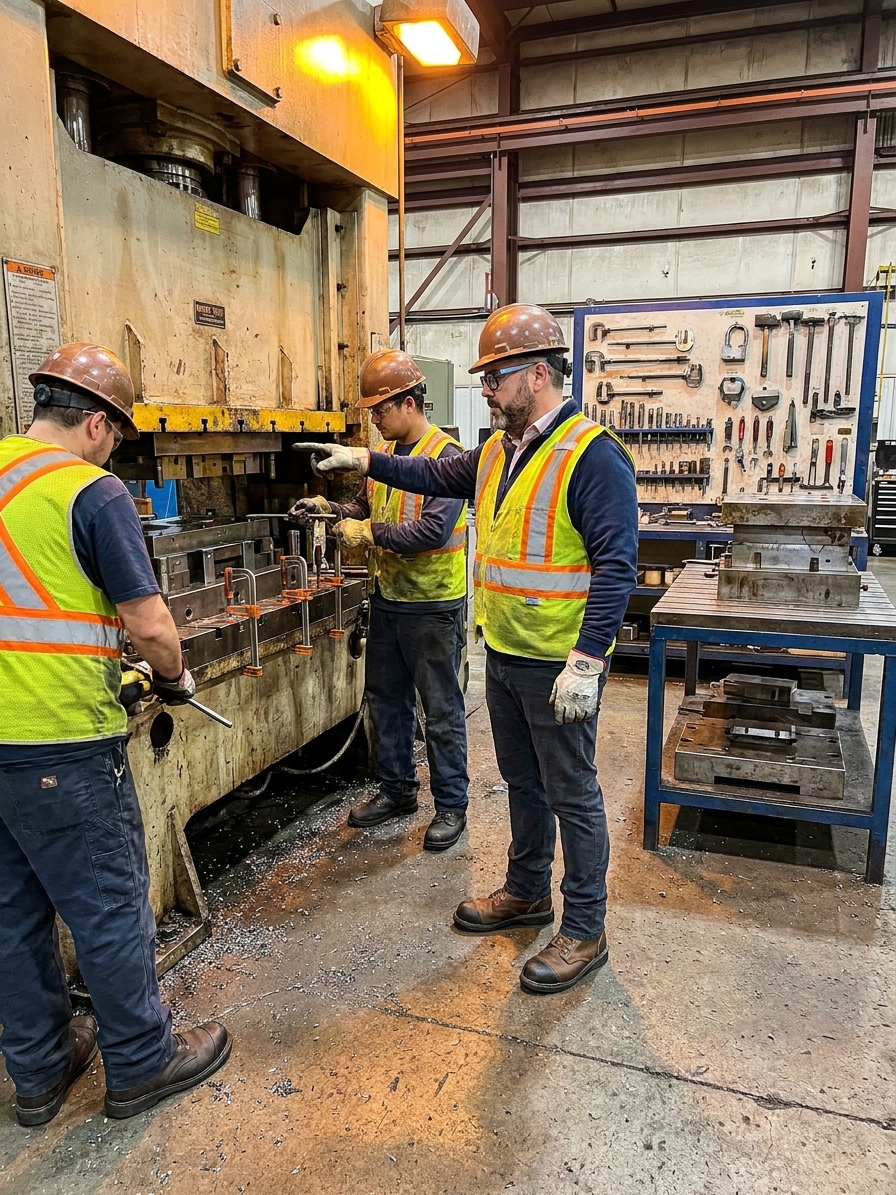
Let me make this concrete with numbers from a real engagement. A
tier-1 automotive supplier was running sixteen changeovers per week on a
stamping press, averaging two hours and forty minutes per changeover.
Total weekly changeover time: forty-two hours and forty minutes — the
equivalent of more than one full shift of lost capacity.
Through a disciplined SMED implementation using the Four Pillars
framework, they reduced average changeover to fifty-two minutes within
four months and sustained it at forty-eight minutes at the twelve-month
mark. The recovered capacity — roughly thirty hours per week — allowed
them to absorb a 15% volume increase without purchasing additional
equipment or adding a shift.
The total investment? Twelve thousand dollars in mechanical
modifications (quick clamps, locating pins, a pre-set staging table) and
approximately two hundred hours of internal labor across the
implementation period. The payback period was under three weeks.
The difference between this outcome and the typical “six months later
we are back where we started” scenario was not the tools or the
technique. It was the commitment to measurement, standardization,
practice, and ownership.
When SMED Is the Wrong
Answer
I want to be clear about something: SMED is not universally
applicable. There are situations where aggressive changeover reduction
is the wrong priority.
If you are running a single product with infrequent changeovers, the
ROI of SMED improvements will be low. If your bottleneck is not at the
changeover operation but downstream (in inspection, packaging, or
material handling), reducing changeover time will not increase
throughput — it will just move the waiting. If your demand profile is
stable and predictable, large-batch production may be economically
optimal, and the flexibility gains from fast changeovers may not justify
the investment.
SMED delivers the highest value in environments with high product
mix, volatile demand, or where WIP reduction is a strategic priority.
Before launching a SMED program, verify that faster changeovers will
actually address a binding constraint.
The Path Forward
If you are reading this and recognizing your organization in the
failure modes described, you are not alone. The good news is that SMED
recoveries are entirely possible. Unlike some quality system failures
that require deep structural changes, SMED is fundamentally about
operational discipline. The mechanical improvements you have already
made are probably still mostly intact. What is missing is the systemic
scaffolding around them.
Start with measurement. You cannot fix what you cannot see. Then
standardize. Then practice. Then assign ownership. In that order. Skip
none of the steps.
Shigeo Shingo did not invent a technique. He invented a way of
thinking about waste in setup operations. The technique — quick clamps,
external staging, parallel operations — is the visible part. The
thinking is what sustains it.
Your changeover time is not a technical problem. It is a management
problem. Treat it that way, and you will be surprised how fast it comes
down.
About the Author: Peter Stasko is a Quality
Architect with over 25 years of experience in manufacturing quality,
Lean implementation, and operational excellence across automotive,
electronics, and industrial sectors. He has led SMED implementations,
quality system transformations, and continuous improvement programs in
plants across Europe and North America.